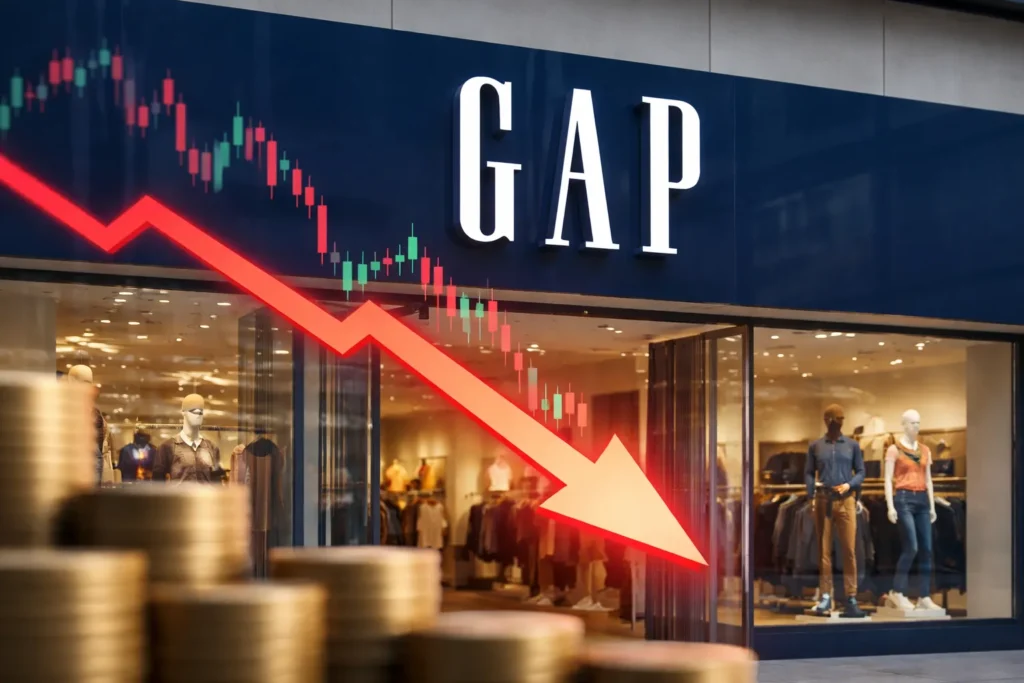

Gap stock came under heavy pressure after the company delivered a quarter that looked solid on the surface but failed to calm investor concerns about the months ahead. Shares closed at $27.20, down 1.95%, while pre-market trading showed the stock near $24.92, a drop of about 8.40%. The move was sharp enough to stand out even in a weaker tape for consumer names, and the reaction made it clear that the market was focused less on the holiday quarter and more on guidance, tariffs, and whether Gap can keep its turnaround story intact into fiscal 2026.
The company’s fourth-quarter numbers were not weak. Gap reported Q4 net sales of $4.2 billion, up 2% year over year, while comparable sales rose 3%. That marked the eighth consecutive quarter of positive comps, showing that the core business still has momentum. Online sales increased 5% and represented 42% of total net sales in the quarter, while store sales were flat. For the full year, net sales reached $15.4 billion, also up 2%, with comparable sales again up 3%. Gap said that result landed at the high end of its prior guidance and represented its second straight year of top-line growth.
Still, the stock fell because investors were not paying for the past quarter. They were reacting to a softer near-term outlook. Management projected 2026 net sales growth of 2% to 3%, but the company’s first-quarter revenue outlook came in below what Wall Street had hoped to see. That was enough to outweigh the better headline sales performance in Q4. Investors also remain cautious about the effect of tariffs, especially after management flagged a meaningful pressure point on margins. Gap’s Q4 gross margin was 38.1%, down 80 basis points year over year, while full-year gross margin came in at 40.8%, down 50 basis points. The company said tariffs created roughly a 200 basis point headwind in the fourth quarter.
Profitability held up better than the stock reaction might suggest, but not enough to erase the concern around forward earnings power. Gap posted fiscal-year operating income of $1.1 billion with an operating margin of 7.3%. Fourth-quarter earnings per share came in at $0.45, down from $0.54 a year earlier, and full-year EPS was $2.13, down 3%. The balance sheet, however, remained one of the brighter parts of the report. Gap ended the year with $3 billion in cash and short-term investments, which management said was its highest year-end cash position in nearly two decades. The company also generated strong cash flow and announced a new $1 billion share repurchase authorization.
The market’s problem was simple: Q4 showed that the turnaround is still alive, but the guidance suggested that 2026 may be harder, slower, and more margin-sensitive than investors wanted.
Looking inside the business, the brand picture was mixed. Old Navy, still the biggest piece of the company, generated $2.3 billion in fourth-quarter sales, up 3%, with comparable sales also up 3%. Management pointed to strength in active, denim, and kids and baby. The Gap brand itself was the standout, with net sales rising 8% to $1.1 billion and comparable sales up 7%, helped by momentum in fleece, denim, and sleepwear and lower discounting. Banana Republic posted $549 million in sales, up 1%, with comparable sales up 4%. The clear weak spot remained Athleta, where sales dropped 11% to $354 million and comparable sales fell 10%. That continues to be a central drag on sentiment around the stock.
Wall Street’s response has not been one-sided. In fact, analyst sentiment remains surprisingly constructive even after the selloff. Recent updates included UBS lifting its price target to $41 from $26 and upgrading the stock to Buy, Barclays raising its target to $33 from $30 while keeping an Overweight rating, and Telsey Advisory increasing its target to $34 from $32 while reiterating Outperform. The broad bullish argument is that Gap still has more room to grow through brand relevance, product expansion, and better execution at Athleta. But the bearish side is easy to understand too: if demand softens or execution slips, those higher targets start looking less comfortable very quickly.
Gap’s strategic story is one reason some analysts are staying upbeat. The company is pushing into new categories such as beauty and accessories, including a beauty pilot in 150 Old Navy stores and a Gap fragrance relaunch planned for summer 2026. Management also continues to build what it calls a Fashiontainment platform, designed to keep its brands closer to pop culture, partnerships, and entertainment-led marketing. That push includes a new Los Angeles office on Sunset Boulevard, campaigns such as Better in Denim with KATSEYE, an Old Navy collaboration with Disney, and brand visibility tied to events like NBA All-Star Weekend. Alongside that, Gap launched its Encore loyalty program, which has nearly 40 million active members, and said it is using AI and technology across the business to improve productivity, decision-making, and customer experience.
There were also shareholder-friendly updates in the release. Gap authorized a first-quarter fiscal 2026 dividend of $0.175 per share, which is 6% higher than its prior quarterly payout. The dividend is payable on or after April 29, 2026, to shareholders of record as of April 8, 2026. The company’s internal model assumptions also moved modestly higher in one fresh valuation update, with fair value estimates ticking up from $30.42 to $30.71, helped by slight improvements in revenue growth, margin, and discount-rate assumptions.
The bottom line for investors is that Gap did not report a collapse. It reported a quarter with genuine strengths, led by Old Navy and the namesake brand, backed by a healthier cash position and continued brand-building efforts. The problem was that the stock had already built in optimism, and the company’s weaker first-quarter revenue guide reopened the debate around tariffs, demand visibility, and Athleta’s turnaround. That combination was enough to send shares sharply lower even with analysts still pointing to upside over time. For now, Gap remains a story of two competing forces: a retailer that has made measurable progress, and a market that wants clearer proof that progress can keep translating into stronger growth through 2026.
For investors tracking the company, the next big focus will be whether the stronger Gap and Old Navy trends can continue to offset Athleta’s weakness, and whether category expansion into beauty and accessories starts adding enough growth to support margin resilience. Until that happens, the stock may continue to swing hard on every update, especially when guidance falls short of a market that had started to believe the turnaround was becoming easier.
Gap’s latest quarterly release is available through the company’s official earnings statement.

Make Swikblog your go-to source on Google for reliable updates, smart insights, and daily trends.