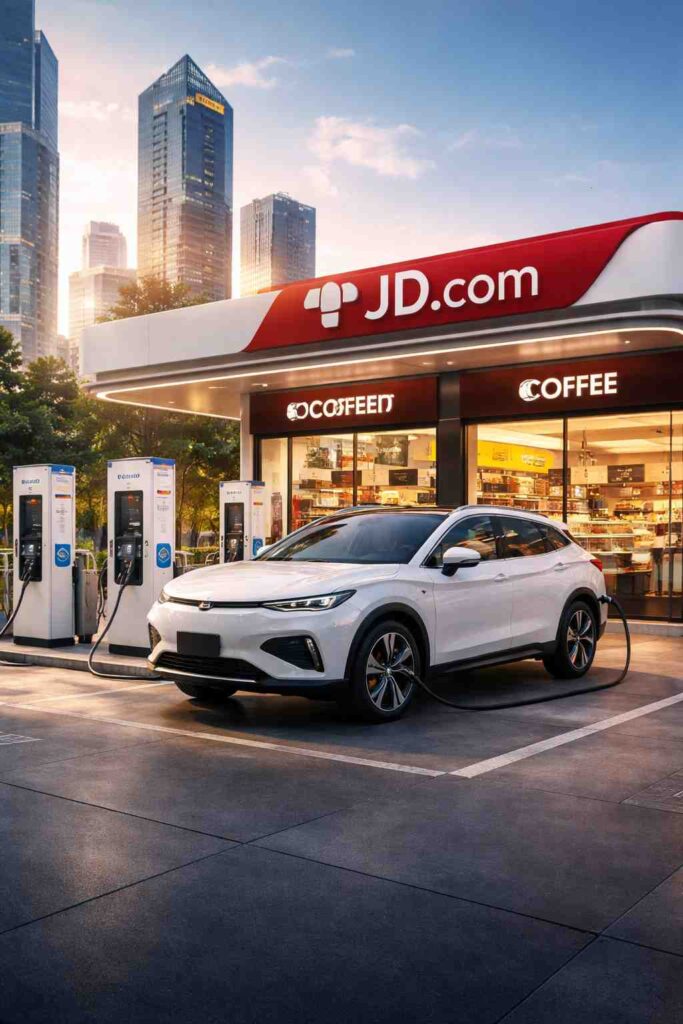

JD.com (NASDAQ: JD) stock climbed to $28.28, up 1.22%, after the Chinese e-commerce giant announced a strategic partnership with electric vehicle leader BYD to develop fast-charging stations across China. The agreement, revealed on Friday, signals JD.com’s deeper push into the EV ecosystem while potentially accelerating China’s charging infrastructure expansion.
The collaboration was confirmed through a statement released on BYD’s Chinese social media platform and later reported by Reuters. The companies also unveiled their first jointly developed EV fast-charging station in Shenzhen, one of China’s most advanced electric vehicle markets.
The news sparked modest but notable investor optimism. JD.com shares edged higher as markets interpreted the deal as more than just a charging infrastructure project. Instead, it appears to be a broader effort to combine EV charging with retail, logistics, and service offerings.
First Charging Station Launches in Shenzhen
The first jointly developed charging station opened in Shenzhen, marking the initial step in what both companies suggest could become a wider rollout across China. Shenzhen is already one of the most EV-friendly cities globally, making it an ideal testing ground for a new charging model that blends infrastructure with retail services.
Unlike traditional charging stations that offer little more than parking spaces and power outlets, the BYD-JD.com station integrates consumer-focused amenities. The site includes a convenience store, coffee shop, and retail space operated by JD.com. This design allows drivers to shop or relax while their vehicles charge, turning waiting time into a retail opportunity.
The concept reflects a broader shift in the EV industry. As charging times remain longer than traditional refueling, operators are increasingly transforming stations into service hubs where drivers can spend time productively.
Partnership Expands Beyond Charging Hardware
The agreement between BYD and JD.com goes beyond simply installing chargers. According to the announcement, the companies plan to collaborate on several additional areas, including site selection for charging stations and broader vehicle ecosystem services.
This wider scope suggests the partnership could extend into operational support, customer services, and potentially integrated digital features linked to JD.com’s retail platform. The companies aim to create charging locations that function as part of a broader mobility ecosystem rather than isolated infrastructure assets.
For BYD, expanding charging access is a critical component of sustaining EV adoption. While the automaker continues to lead global EV sales, widespread charging infrastructure remains a key factor influencing consumer confidence and long-distance usability.
JD.com’s Logistics Network Could Accelerate Expansion
One of the most strategic aspects of the partnership lies in JD.com’s existing infrastructure footprint. The company operates extensive logistics parks, warehouses, and office complexes across China. Under the agreement, many of these sites are expected to support the deployment of new charging stations.
This could dramatically speed up the rollout of EV charging facilities. Instead of searching for new land or building entirely new locations, the partners can integrate chargers into properties already owned or operated by JD.com.
Logistics hubs are particularly attractive locations for charging infrastructure because they sit close to major transportation routes and urban centers. These sites also attract frequent vehicle traffic, which could increase station utilization and make the business model more viable.
In addition, JD.com’s large delivery fleet and third-party logistics partners could potentially benefit from nearby charging access, creating another layer of operational synergy.
Retail and Charging Integration Creates New Revenue Streams
Another major feature of the partnership is the combination of EV charging with JD.com’s retail capabilities. The stations are designed to include commercial services such as coffee shops, convenience stores, and retail outlets managed by JD.com.
This hybrid model may open new revenue streams for the company. Charging locations can attract steady vehicle traffic, and each visit creates opportunities for additional consumer spending. Drivers waiting for their vehicles to charge may browse products, purchase food or drinks, or access other services available on site.
Such integration mirrors similar experiments taking place globally, where charging providers partner with retailers to transform stations into consumer destinations rather than simple utility infrastructure.
Why Investors Are Watching the Deal Closely
Although JD.com’s stock rose only modestly following the announcement, the partnership carries strategic implications that could extend well beyond the initial Shenzhen launch.
China’s EV market is expanding rapidly, and the country is racing to build enough charging capacity to support millions of electric vehicles on its roads. Companies that successfully position themselves within this infrastructure network could gain long-term advantages.
For JD.com, the deal offers a way to diversify beyond e-commerce and logistics while leveraging its existing assets. By integrating EV charging into logistics parks and commercial sites, the company could transform underutilized spaces into energy and retail hubs.
BYD, meanwhile, gains an infrastructure partner with nationwide real estate access and operational scale. That combination could accelerate the development of charging stations in locations that might otherwise take years to secure.
Investors tracking JD.com’s performance can follow the stock’s latest price movements and market data on Yahoo Finance.
A Potential Blueprint for China’s EV Infrastructure
The Shenzhen station may ultimately serve as a blueprint for how EV charging infrastructure evolves in China. Instead of isolated charging points, the model emphasizes integrated mobility hubs combining energy, retail, and services.
If the concept proves successful, the BYD-JD.com partnership could expand across JD’s nationwide network of logistics and commercial sites. That would not only accelerate charger deployment but also reshape how drivers interact with charging stations.
For now, JD.com’s stock reaction — rising to $28.28 with a 1.22% gain — reflects cautious optimism from investors. But the deeper story may lie in how the partnership connects two of China’s most powerful industries: electric vehicles and digital commerce.
You may also like Amazon (AMZN) Stock in Focus as Cerebras AI Chip Partnership Boosts AWS Buzz.

Make Swikblog your go-to source on Google for reliable updates, smart insights, and daily trends.