
By Chetan Sharma
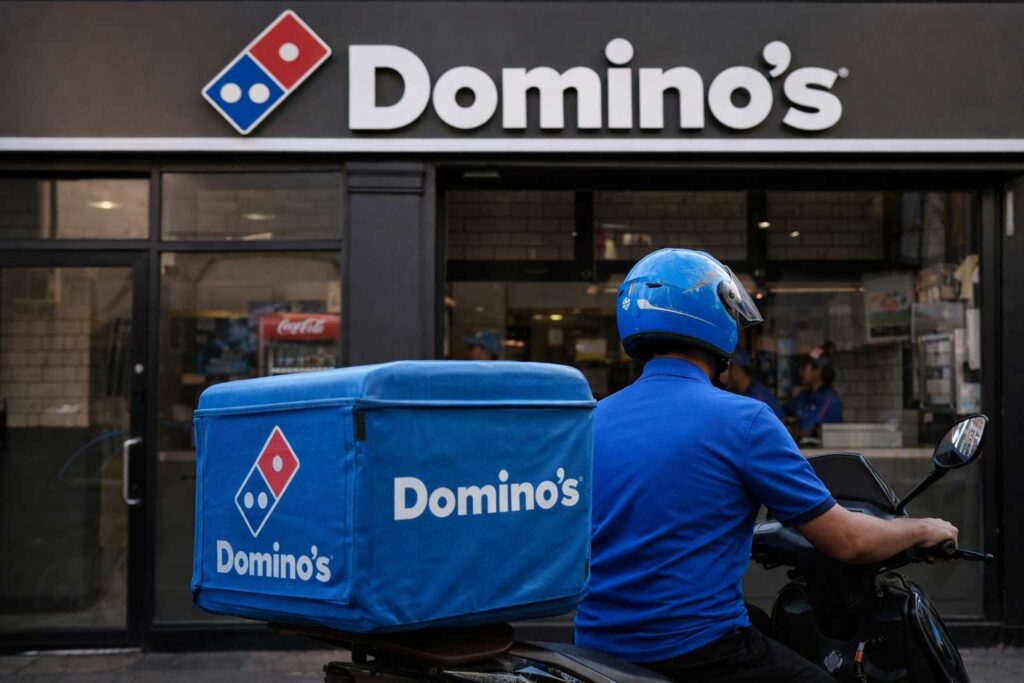
Domino’s shares edged higher to $352.94, up 1.38%, after the company confirmed Nicola Frampton as its permanent chief executive — a move that signals a sharper, more focused strategy at a time when growth in the core pizza market is becoming harder to find.
The leadership decision comes after a turbulent few months for the delivery giant. Frampton had been serving as interim CEO since November, when former boss Andrew Rennie stepped down abruptly after roughly two years in charge. His exit followed candid remarks about the state of the UK pizza market, where he warned there was no “massive growth” left — a statement that raised eyebrows among investors and underlined a deeper challenge facing the company.
By making Frampton’s role permanent, Domino’s appears to be drawing a line under that uncertainty and shifting the narrative toward execution rather than speculation. The company is no longer talking about what it might do next — it is now committing to a more disciplined path focused on strengthening its core pizza business while selectively expanding into adjacent categories.
One of those categories is chicken, an area where Domino’s is now placing a meaningful bet. Over the past year, the company quietly built and then rolled out its Chick ‘N’ Dip sub-brand nationwide, tapping into one of the fastest-growing segments in the UK’s fast-food market. Demand for chicken products has been rising steadily, and Domino’s wants to capture that momentum without straying too far from its delivery-first model.
That strategy also explains why the company has stepped back from earlier acquisition plans. Rennie had previously floated the idea of buying a second food brand to accelerate growth, but Frampton has made it clear that such a move is no longer necessary. Trialling Chick ‘N’ Dip internally showed the company it could access the chicken market without committing to a costly, potentially risky takeover — a decision that likely reassured investors looking for more capital discipline.
Still, Domino’s is not operating in an easy environment. The company itself described 2025 as a “difficult year,” with weaker consumer spending weighing on order volumes. At the same time, many franchisees raised prices, putting additional pressure on demand as customers became more selective about discretionary purchases. In a delivery-driven business, even small shifts in pricing or consumer confidence can have an outsized impact on order frequency.
That backdrop makes Frampton’s appointment more than just a routine leadership change. Having served as chief operating officer for around four years before stepping into the interim CEO role, she brings deep operational experience at a time when consistency matters more than bold experimentation. Domino’s is not trying to reinvent itself overnight — it is trying to stabilize performance and rebuild momentum in a more mature market.
Chairman Ian Bull reinforced that message, noting that Frampton had already created stronger alignment across the business during her interim tenure. For investors, that kind of internal stability is often just as important as external growth opportunities, especially after a period marked by leadership turnover and strategic uncertainty.
Balancing a mature pizza market with new growth bets
The bigger question now is whether Domino’s can successfully balance its established pizza business with newer growth drivers like chicken. The UK pizza market may be approaching saturation, as Rennie suggested, but Domino’s still has scale, brand recognition and a large delivery network working in its favour. The challenge is finding incremental growth without diluting the core offering.
Early signs from 2026 are encouraging. The company said the year has started well, with expectations that Chick ‘N’ Dip could provide a meaningful boost to sales. Domino’s is also planning to open a wave of new stores, signalling that it still sees room for expansion — even if that growth is likely to be more measured than in previous years.
At the same time, the company must navigate broader consumer trends. Households remain cautious with spending, competition across the quick-service restaurant sector is intense, and delivery platforms continue to reshape how customers choose where to order from. Domino’s advantage lies in its established infrastructure, but maintaining that edge will require careful execution and consistent value for customers.
For now, the market reaction suggests investors are willing to give the new leadership team time to deliver. The share price move may not have been dramatic, but it reflects growing confidence that Domino’s has a clearer direction — one that avoids large, risky acquisitions and instead builds on what the company already does well.
The coming months will be crucial. Investors will be watching closely for signs that order volumes are stabilizing, that franchise relationships remain healthy, and that Chick ‘N’ Dip can evolve from a promising concept into a meaningful revenue driver. Domino’s does not need a dramatic turnaround — it needs steady, consistent progress.
Frampton now sits at the center of that effort. Her task is not just to manage the business, but to prove that Domino’s can still grow in a market where easy wins are disappearing. With a clearer strategy, a renewed focus on its core and a calculated push into chicken, the company is positioning itself for a more disciplined phase of growth.
For more details on Domino’s strategy and financial updates, visit the official investor page. Broader insights into UK consumer and food delivery trends can be followed via Financial Times coverage.
You may like: Unilever’s $11.9 billion deal with McCormick signals a major shift in the global food industry.

Make Swikblog your go-to source on Google for reliable updates, smart insights, and daily trends.