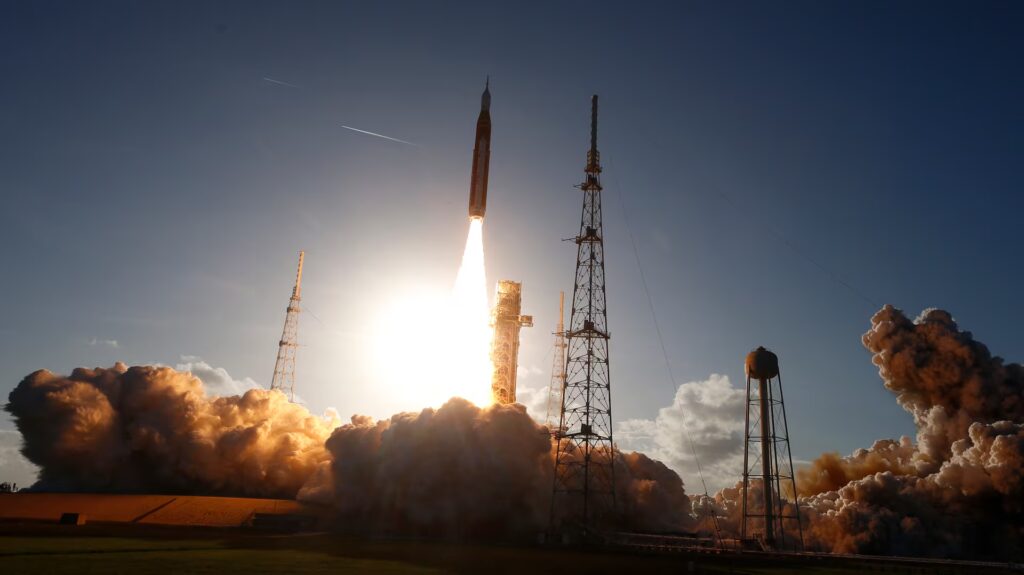

NASA’s Artemis II mission has delivered the kind of liftoff that instantly grabs global attention. As the giant Space Launch System thundered away from Kennedy Space Center, the launch lit the sky and signaled something larger than a routine mission: this is the first crewed Artemis flight and one of NASA’s clearest steps yet toward returning humans to the Moon. For many viewers, it felt like the old wonder of space exploration had suddenly become present tense again.
What makes Artemis II so compelling is not just the scale of the rocket or the spectacle of launch day. It is the fact that four astronauts are flying around the Moon on a mission lasting about 10 days, testing the deep-space systems NASA will rely on for later lunar landings. The mission is using the Orion spacecraft and marks the first time astronauts have flown aboard NASA’s SLS rocket, turning years of preparation into a highly visible moment of proof.
The crew itself adds to the historic weight of the mission. Reid Wiseman is serving as commander, Victor Glover as pilot, while Christina Koch and Jeremy Hansen are mission specialists. Hansen’s seat is especially notable because he is the first Canadian assigned to a lunar mission under Artemis, giving the launch an international dimension that stretches beyond the United States.
Sydney Royal Easter Show 2026 Opens With Fireworks and Night Parade
Why this mission matters far beyond launch day
Artemis II is not designed as a Moon landing. Its purpose is more demanding in a different way. NASA is putting people inside the hardware, sending them into deep space, and using the flight to verify that the spacecraft systems, communications, navigation, life support, and mission operations all perform as expected with humans on board. In simple terms, this is the mission that has to work if the broader Moon-return strategy is going to keep moving.
That is why the public reaction has been so intense. The mission combines visual drama with a genuine sense of consequence. Crowds gathered to watch in person, millions followed from home, and the launch quickly became one of those rare science stories that cuts through the usual news cycle. The appeal is easy to understand: the images are huge, the mission is ambitious, and the destination still carries an emotional pull that few places in space can match.
There is also a deeper narrative behind the excitement. NASA’s Artemis program is not only about revisiting the Moon for nostalgia. It is part of a wider effort to build the skills, systems, and endurance needed for longer exploration campaigns in the years ahead. Artemis II follows the success of Artemis I in 2022, when Orion completed an uncrewed lunar test flight. Now, with astronauts aboard, the stakes feel much more immediate.
According to NASA’s Artemis II mission overview, the flight is intended to prove the hardware and operations needed for future missions, including later attempts to put astronauts back on the lunar surface. That broader context helps explain why this launch has been watched so closely. It is not just about a single journey around the Moon. It is about whether a new era of crewed lunar exploration is finally taking shape in full public view.
A launch that feels bigger than one mission
For now, Artemis II has already achieved something powerful: it has made spaceflight feel urgent, human, and widely shared again. The roar of launch, the scale of the vehicle, and the presence of a live crew have given the mission a level of emotional force that numbers alone cannot capture. NASA still has more milestones ahead before a return to the lunar surface becomes reality, but Artemis II has made that goal feel far less distant. After years of buildup, the Moon no longer looks like a remote ambition. It looks closer than it has in decades.

Make Swikblog your go-to source on Google for reliable updates, smart insights, and daily trends.