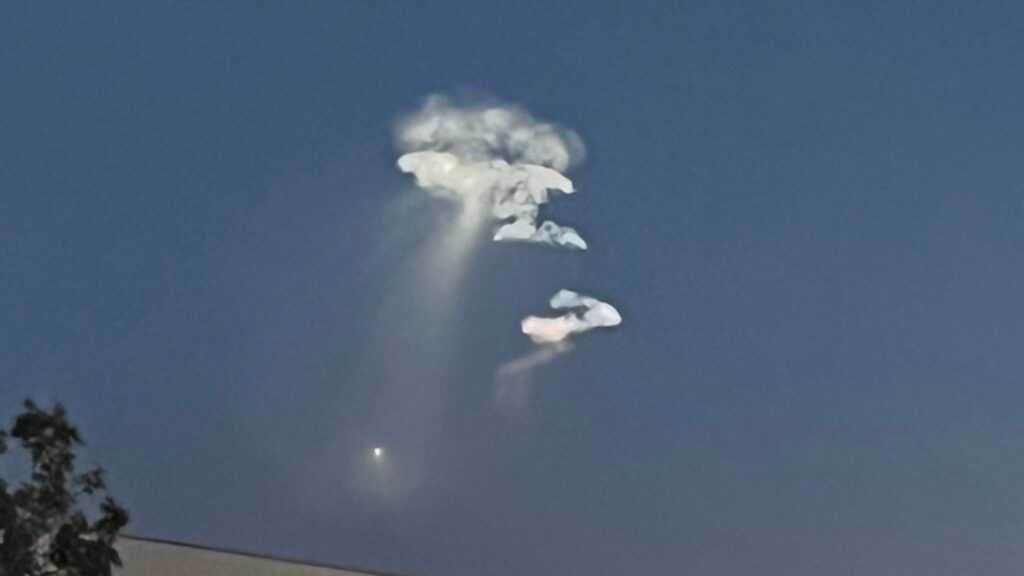

A SpaceX Falcon 9 rocket launch lit up the evening sky across Central and Northern California on Monday, prompting widespread confusion and online speculation as residents questioned the unusual glowing formation overhead. The rocket lifted off from Vandenberg Space Force Base around 7:49 p.m., carrying 25 Starlink satellites into low Earth orbit.
From Fresno to Sacramento and beyond, people reported seeing a towering plume of white smoke streaking across the twilight sky, often dotted with bright, glowing spots. For many, the sight was unfamiliar enough to spark immediate questions — and in some cases, fears — about a possible unidentified flying object.
The explanation, however, lay in the timing and physics of the launch. Occurring just after sunset, the Falcon 9 rocket was still illuminated by sunlight at higher altitudes, even as the ground below had grown dark. This created a striking visual effect, making the expanding exhaust plume appear bright and otherworldly across a wide region.
The mission itself was part of SpaceX’s ongoing effort to expand its Starlink satellite internet network. Roughly two and a half minutes after liftoff, the rocket’s first and second stages separated as planned. The second stage continued toward orbit with the 25 satellites, while the first stage reversed course and successfully landed on a drone ship positioned off the coast of Baja California, Mexico.
Why this launch stood out
While SpaceX launches from Vandenberg have become increasingly frequent — often occurring about once a week — this particular mission drew unusual attention due to exceptionally clear skies and its twilight timing. Those conditions allowed the rocket’s trajectory to remain visible across much of California’s Central Valley and parts of Northern California, far beyond the immediate launch site.
Viewers captured images and videos of the rocket’s arc as it stretched across the sky, with the plume expanding dramatically as it reached higher altitudes. Unlike aircraft or meteors, which follow more familiar visual patterns, the Falcon 9’s exhaust appeared to bloom and shift shape, adding to the sense of mystery for those seeing it for the first time.
Such reactions are not uncommon. Twilight launches have repeatedly produced similar scenes in recent years, often mistaken for unexplained aerial phenomena before being identified. The combination of altitude, sunlight reflection and atmospheric conditions can transform a routine launch into a spectacle visible hundreds of miles away.
Beyond the visual impact, the event highlights the growing regularity of commercial space activity. SpaceX’s reusable rocket system has enabled a steady cadence of launches, particularly for Starlink, which aims to provide global internet coverage through a rapidly expanding constellation of satellites. More details about Falcon 9 missions and capabilities are available on SpaceX’s official Falcon 9 page.
For many Californians, Monday’s launch was both a moment of confusion and a reminder of how spaceflight is becoming an increasingly visible part of daily life. What once might have been a rare sight is now a recurring phenomenon — though, under the right conditions, it still has the power to surprise.
You may also like: Amaltal Mariner Crew Missing Overboard in New Zealand: What Happened and Latest Updates
Author Bio
Chetan is a Swikblog writer with 5 years of experience covering global news, stock market developments, and trending topics, focusing on clear reporting and real-world context for fast-moving stories.