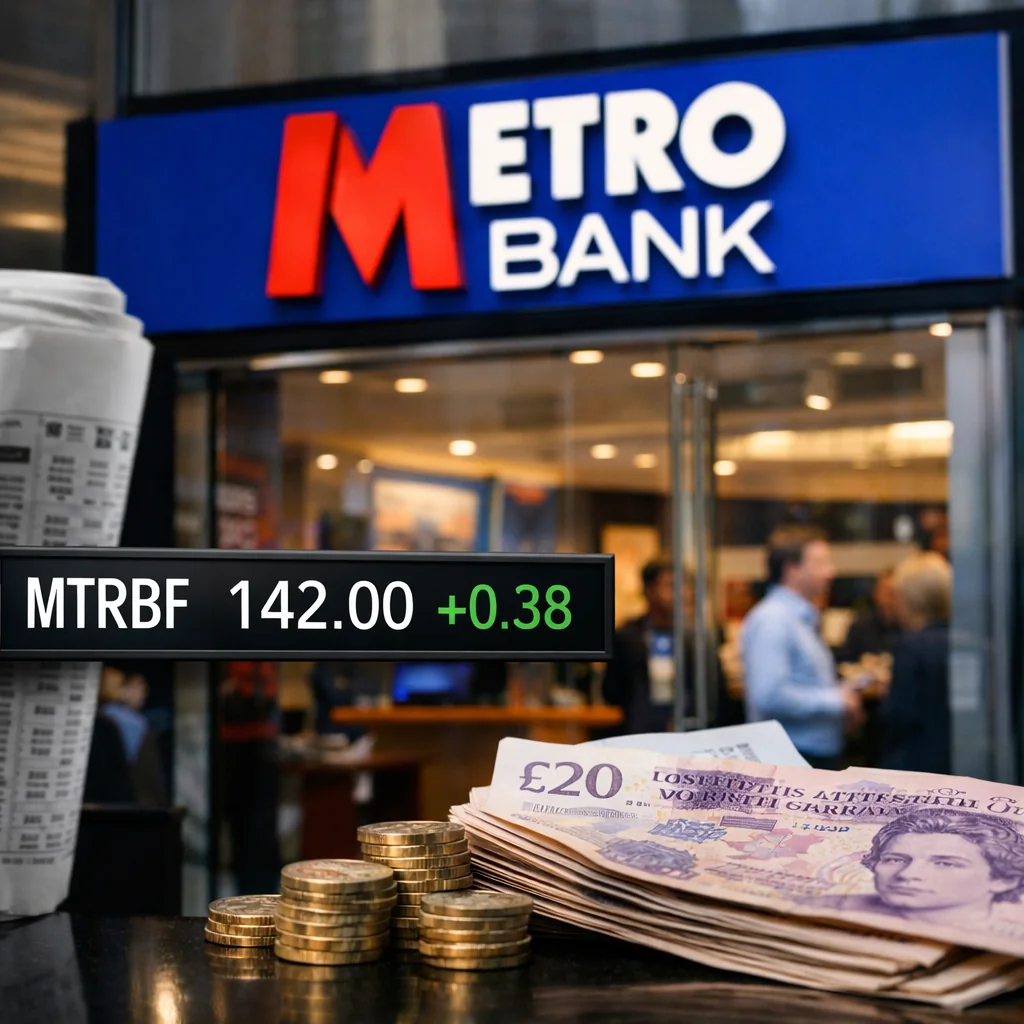

Metro Bank (MTRBF) shares rose to 142p, holding firm as investors reacted to a sharp improvement in profitability, with the lender reporting a record £87 million in pre-tax profit for 2025. The stock’s steady movement reflects growing confidence in the bank’s turnaround strategy, even as controversy around executive pay and past restructuring decisions continues to draw attention.
The latest performance marks a significant shift for Metro Bank, which just a few years ago was grappling with regulatory concerns, investor skepticism and a near-collapse that forced a major rescue deal. Now, the lender is beginning to rebuild credibility, driven by stronger earnings, a refined lending strategy and tighter cost controls.
Profit growth lifts shares as turnaround gains traction
The move to 142p signals a stabilizing trend in Metro Bank’s stock, supported by its strongest financial showing since its founding in 2010. The reported £87 million pre-tax profit represents a key milestone in the bank’s recovery, indicating that its shift toward corporate lending and disciplined operations is starting to deliver consistent results.
Metro Bank’s turnaround has been shaped by difficult decisions. In 2024, the bank cut more than 1,000 jobs and scaled back operations, including closing branches on Sundays, in an effort to reduce costs and preserve capital. While these measures drew criticism, they played a central role in improving efficiency and restoring profitability.
At the same time, the bank has pivoted away from its earlier growth-heavy retail model toward corporate lending, a segment that has provided more stable and higher-margin returns. This strategic shift has been a major driver behind the improved earnings profile and has helped reposition Metro Bank in a more competitive segment of the UK banking sector.
CEO pay surge and bonus structure spark debate
Despite the positive financial momentum, Metro Bank remains under scrutiny over executive compensation. Chief executive Dan Frumkin received a total pay package of £2.6 million for 2025, more than double the £1.2 million he earned in 2024. The package included a salary of £938,875, a £1.2 million annual bonus and a £470,000 deferred bonus from 2023, along with pension and other benefits.
The timing of the pay increase has raised questions, as it follows the bank’s decision to cut over 1,000 jobs during its restructuring phase. Critics argue that such a sharp rise in executive pay after significant workforce reductions creates governance concerns, even as the company’s financial performance improves.
Adding to the debate is a long-term incentive plan that could potentially award Frumkin up to £60 million over five years, depending on Metro Bank’s share price performance. Under the scheme, the stock must remain above 120p in 2028 for the bonus to begin vesting, while a surge to 437p could unlock the maximum payout.
While the scale of the incentive has drawn criticism from proxy advisory firms, shareholders largely backed the plan, with 88.6% voting in favor. The support suggests that investors are willing to accept aggressive compensation structures if they are tied to long-term value creation and share price growth.
More details about the bank’s structure and services can be found on its official platform at Metro Bank.
Rescue deal and ownership play key role in recovery
Metro Bank’s current position cannot be understood without looking at its recent history. In 2023, the lender faced a critical moment after struggling to convince regulators of its risk management capabilities. A significant accounting error in earlier years had already led to the departure of senior leadership, including its founder.
The situation culminated in a £925 million rescue deal led by Colombian billionaire Jaime Gilinski Bacal, who now holds a 53% stake in the bank. The investment provided much-needed capital and stability, allowing Metro Bank to implement its turnaround strategy under new leadership.
Frumkin, who took over as chief executive in 2020 and is best known for his role in restructuring Northern Rock after the global financial crisis, has been central to executing this recovery plan. His experience in crisis management has helped guide Metro Bank through one of the most challenging periods in its history.
Investor sentiment improves, but risks remain
The market’s response to Metro Bank’s latest results suggests improving investor sentiment. The stock holding at 142p reflects confidence that the bank’s turnaround is gaining credibility, particularly as profitability improves and the business model becomes more focused.
However, sentiment is not without caution. Governance concerns around executive pay and the bank’s past missteps continue to linger. Investors are also aware that the recovery is still in its early stages, and sustained performance will be critical to maintaining confidence.
The broader macroeconomic environment could also play a role. Interest rate trends, credit demand and economic stability in the UK will influence Metro Bank’s ability to expand its corporate lending operations and maintain profit growth.
Outlook: momentum building, but execution remains key
Looking ahead, Metro Bank’s outlook will depend on its ability to sustain the momentum generated by its recent results. The £87 million pre-tax profit provides a strong foundation, but investors will be watching closely to see if the bank can deliver consistent earnings growth in the coming years.
The share-price-linked bonus structure adds another layer of pressure, effectively tying management’s rewards to the bank’s long-term market performance. While this alignment can be seen as positive, it also raises expectations for continued execution and growth.
For now, Metro Bank appears to be transitioning from a recovery story to a growth narrative. The stock’s position at 142p, combined with improving profitability and a clearer strategic direction, suggests that the bank is on a more stable footing than it has been in years.
Still, the journey is far from complete. Metro Bank must continue to rebuild trust, deliver consistent results and navigate the balance between growth and governance. If it succeeds, the turnaround story could evolve into a longer-term value opportunity. If not, the challenges that once threatened its survival could quickly resurface.

Make Swikblog your go-to source on Google for reliable updates, smart insights, and daily trends.