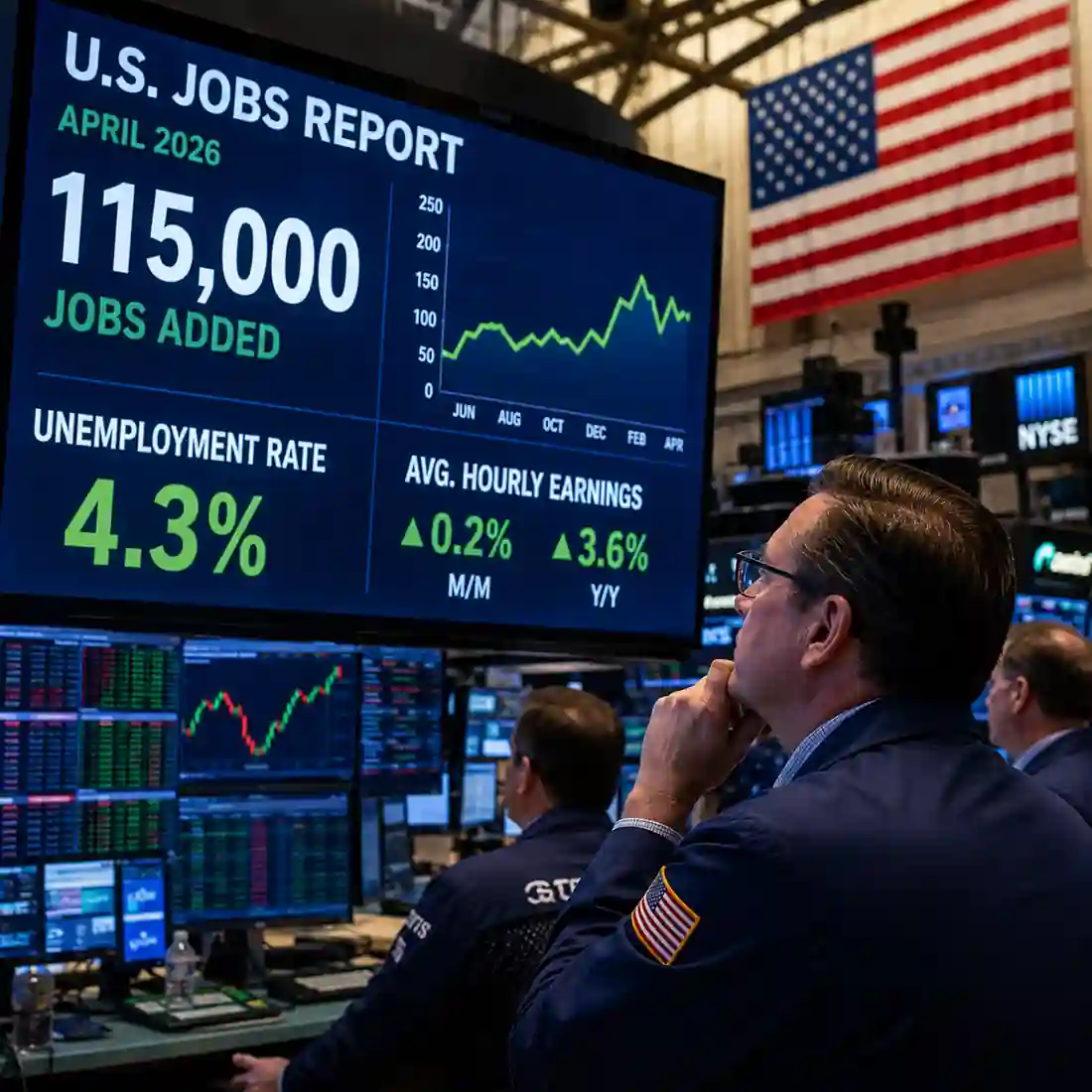

US stock market today moved higher on May 8 as the Dow Jones Industrial Average (^DJI), S&P 500 (^GSPC) and Nasdaq Composite (^IXIC) rose after a stronger-than-expected April jobs report lifted Wall Street sentiment. The US economy added 115,000 jobs, beating forecasts for 65,000, while the unemployment rate held steady at 4.3%.
The Nasdaq Composite (^IXIC) led the early advance with a gain of about 0.6%, helped by renewed appetite for growth and technology shares. The S&P 500 (^GSPC) rose about 0.4% at the open and later traded near 7,394.87, up 57.76 points, or roughly 0.79%. The Dow Jones Industrial Average (^DJI) also gained around 0.4%, giving all three major indexes a positive start after the previous session’s weakness.
The main catalyst was the April employment report. The US economy added 115,000 jobs in April, comfortably above the 65,000 gain economists had expected. The unemployment rate held steady at 4.3%, reinforcing the view that the labor market remains firm enough to support consumer spending, but not so hot that it immediately changes the market’s broader expectations for the Federal Reserve.
For investors, the jobs report carried two messages at once. On one side, the numbers reduced near-term recession fears and helped lift equities. On the other, a stable labor market can also make it harder for the Fed to justify rapid rate cuts, especially if energy prices stay elevated. The official Employment Situation release from the Bureau of Labor Statistics remains the key reference point for traders watching payrolls, unemployment and wage growth.
Technology stocks split as AI optimism meets earnings pressure
The Nasdaq’s early lead showed that investors were still willing to buy large-cap and growth-oriented names, but individual stock reactions were far from uniform. Cloudflare (NET) was one of the sharpest decliners, falling to about $200.44 after dropping more than 20%. The company’s update included sweeping layoffs, with artificial intelligence cited as one factor, making NET one of the clearest examples of how AI is now influencing both corporate cost structures and investor sentiment.
CoreWeave (CRWV), another closely watched AI infrastructure name, traded near $117.10, down about 9.1%, after its revenue forecast disappointed investors. The move showed how high expectations around AI-linked stocks can quickly turn into pressure when guidance falls short. With CoreWeave still seen as a key AI infrastructure story, the stock’s reaction may keep attention on whether demand growth can match the valuation investors have already priced in.
Coinbase (COIN) also weakened, trading near $188.53, down around 2.3%. The crypto exchange reported a quarterly net loss of $394 million, or $1.49 per share, while net revenue fell 31% to $1.4 billion. The result added pressure to crypto-linked equities at a time when Bitcoin (BTC-USD) hovered around the $80,000 level after slipping earlier in the session.
Gold, oil and global tickers stay in focus
Outside the major US indexes, safe-haven and energy markets remained active. Gold futures (GC=F) rose to around $4,741.60 per troy ounce, up about 0.65%, as investors balanced the stronger jobs data against geopolitical risk. Gold’s move suggested that even with equities rising, traders were not fully stepping away from defensive assets.
Oil prices also stayed in focus after reports of military exchanges near the Strait of Hormuz. Brent crude (BZ=F) traded around $101.22, up about 1.16%, while West Texas Intermediate crude (CL=F) was watched closely after earlier gains. Any sustained disruption near the Strait of Hormuz could matter for inflation expectations, transportation costs and the broader earnings outlook for energy-sensitive sectors.
Investors also tracked earnings and updates from global names listed in the US. Toyota Motor (TM) traded near $187.21, down around 0.9%. Sony Group (SONY) moved higher to about $20.83, gaining roughly 4.7%. Brookfield Asset Management (BAM) traded near $48.09, down around 1.4%. These moves added a global earnings layer to a US market session already shaped by jobs data, rates and geopolitical headlines.
Treasury yields added another important signal. The 10-year Treasury yield (^TNX) fell by about 3 basis points to roughly 4.35%, giving equities some relief as borrowing-cost pressure eased. Lower yields can support growth stocks by improving the present value of future earnings, which partly explains why the Nasdaq outperformed the Dow and S&P 500 in early trading.
Still, Friday’s rally was not a simple risk-on move. A stronger labor market helped stocks, but the combination of higher oil, firm gold and falling yields showed investors were still hedging against uncertainty. For now, the US stock market today is being shaped by a three-way tug of war: solid jobs data, geopolitical risk and earnings reactions from high-profile companies.
That mix may keep Wall Street volatile into the next session. If labor data continues to beat expectations while inflation-sensitive commodities rise, investors may have to reassess the timing of any Fed policy shift. But for May 8, the message from the market was clear: the Dow, S&P 500 and Nasdaq all moved higher as the April jobs report gave investors enough confidence to buy, even with oil tensions and stock-specific sell-offs still hanging over the day.

Make Swikblog your go-to source on Google for reliable updates, smart insights, and daily trends.