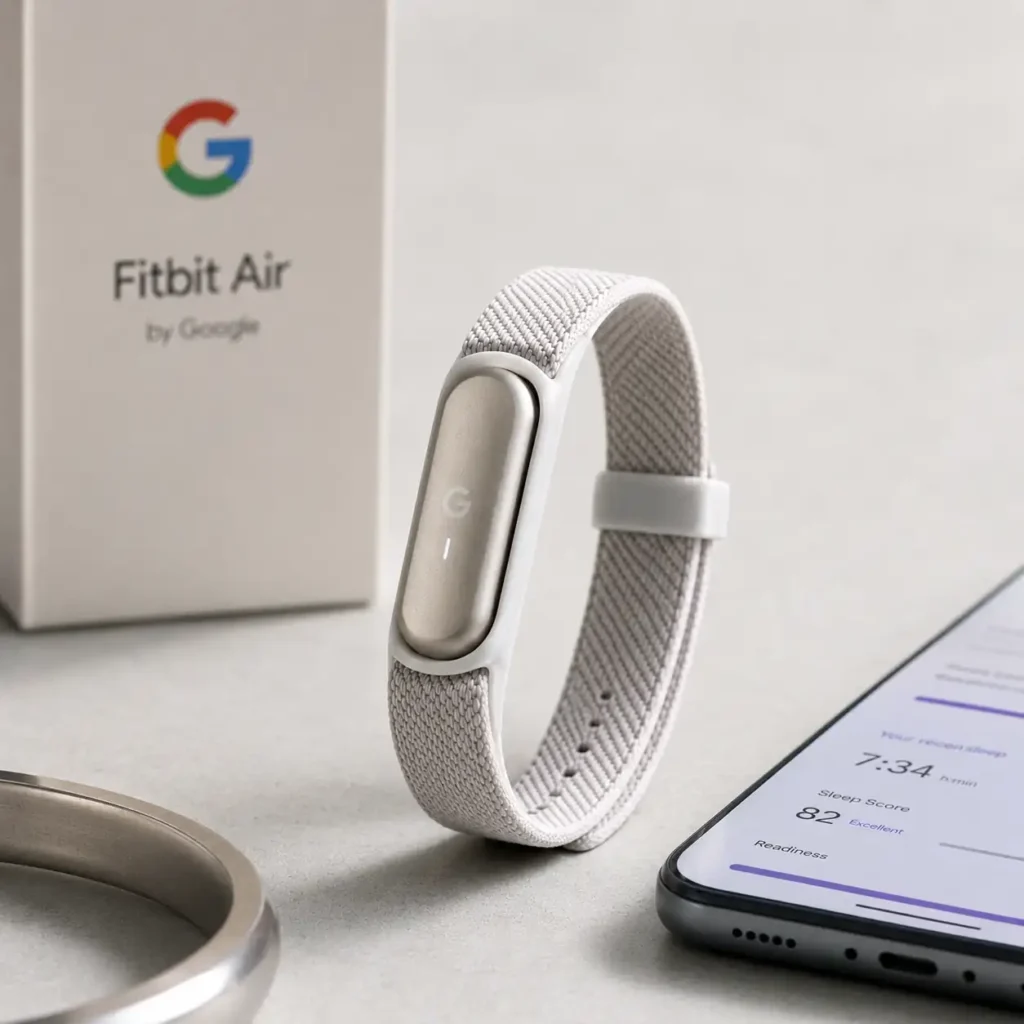

Google’s new Fitbit Air is not just another fitness band. It is a clear sign of where the company wants wearable health technology to go next: smaller hardware, fewer distractions, longer battery life, and more personalized guidance powered by artificial intelligence.
The newly launched Fitbit Air is a screenless fitness tracker priced at $99, with a special Stephen Curry edition available for $129. The device is built for people who want continuous health tracking without wearing a full smartwatch, and it puts Google’s Gemini-powered Health Coach at the center of the experience.
Instead of adding more apps, alerts, and watch faces, Google has removed the screen completely. The Fitbit Air quietly collects health and workout data in the background, then sends those insights to the Google Health app, where users can review sleep, recovery, activity, readiness, and AI-generated coaching suggestions.
Fitbit Air Shows Google’s New Health Strategy
The Fitbit Air looks simple, but its launch carries a bigger message. Google is moving Fitbit away from basic step counting and traditional fitness tracking toward a more advanced health ecosystem built around AI, subscriptions, and long-term biometric data.
The tracker uses a small removable sensor that fits inside interchangeable wristbands. Google says the device is significantly smaller than earlier Fitbit models, making it easier to wear throughout the day, during workouts, and overnight while sleeping.
That matters because recovery-focused wearables depend on consistency. A device can only provide useful sleep and readiness insights if users are comfortable wearing it nearly all the time. This is where Fitbit Air appears to be targeting users who may find smartwatches too bulky or distracting.
The Fitbit Air tracks core health signals including 24/7 heart rate, heart rate variability, blood oxygen levels, skin temperature changes, sleep stages, cardio load, training readiness, steps, distance, and irregular heart rhythm notifications for signs of atrial fibrillation.
It can also automatically detect common workouts such as walking, running, cycling, rowing, elliptical training, and high-heart-rate activity. For users who prefer manual tracking, the Google Health app supports dozens of workout types and allows additional activities to be added later.
Google says the Fitbit Air is powered by newer machine learning models that improve accuracy compared with previous Fitbit algorithms. That is important because the device is not trying to impress users with a display. Its value depends on whether the data and coaching feel useful over time.
Battery life is another major selling point. The Fitbit Air is rated for up to seven days on a single charge. It can also gain a full day of use from about five minutes of charging, while a full charge takes around 90 minutes.
For many users, that could be a major advantage over smartwatches that need charging every day or every other day. A fitness tracker designed for sleep and recovery becomes far less useful if it spends too much time on a charger.
Google’s wearable push comes as the company expands its broader health ecosystem. Recent updates around Google Health replacing the Fitbit app show how aggressively the company is consolidating its fitness and AI services into one unified platform.
Gemini AI Coach Is the Real Product
The most important part of Fitbit Air may not be the band itself. The real product is Google Health Coach, an AI-powered assistant built with Gemini technology.
The coach is designed to turn health data into practical suggestions. Instead of only showing charts, it can help users understand whether they should train harder, take a lighter day, improve sleep habits, or adjust their weekly fitness plan.
Google Health Coach can create personalized workout plans, adapt recommendations based on recent performance, respond to recovery signals, and provide guidance through a conversational interface. The goal is to make health data easier to act on, not just easier to collect.
Read More
This is also where Google’s business strategy becomes clearer. Every Fitbit Air purchase includes three months of Google Health Premium. After that, the subscription costs $10 per month or $100 per year.
That means Fitbit Air is not only a hardware launch. It is a doorway into Google’s paid health platform. As more consumers become comfortable with AI assistants, Google is betting that personalized fitness and recovery coaching could become a recurring subscription service.
The move also comes as Google continues shifting the Fitbit app experience toward Google Health. Fitbit branding remains on the hardware, but the software experience is increasingly becoming part of Google’s wider health ecosystem.
According to The Verge, the launch reflects Google’s broader push to combine Fitbit hardware with AI-powered coaching and a redesigned health platform.
Cross-platform support could also help Google reach more users. Unlike the Pixel Watch, Fitbit Air works with both Android and iPhone. That gives Google a way to bring its AI health tools to Apple users without requiring them to switch phones or buy an Android-only smartwatch.
The Stephen Curry Special Edition adds another layer to the product story. Designed with the NBA star and Fitbit Performance Advisor, the special model features an orange and gray colorway, Curry branding, a raised interior liner for better airflow, additional water resistance, and a workout-focused fabric band.
The Curry edition is likely to appeal to users who want a more athletic version of the Fitbit Air rather than a basic everyday tracker. Its higher $129 price also gives Google a premium option without changing the core sensor hardware.
Fitbit Air arrives at a time when screenless health wearables are gaining attention. Devices like Whoop and Oura have shown that many users do not necessarily want another screen on their body. They want better sleep tracking, recovery scores, training advice, and a clearer picture of their health trends.
Google is now entering that race with a lower entry price, a familiar Fitbit name, and AI software that could become more powerful over time.
There are still questions. Real-world accuracy, comfort, battery life, and the usefulness of Google’s AI coaching will matter more than launch claims. Privacy will also remain an important issue because Fitbit Air collects sensitive health data continuously. Google says Fitbit and health data are not used for advertising, but users should still review privacy settings carefully before connecting deeper health information to any platform.
For now, Fitbit Air looks like Google’s most direct attempt yet to challenge recovery-first wearables while reshaping Fitbit for the AI era. It is smaller than a smartwatch, more focused than a traditional fitness band, and built around the idea that the future of wearables may be less about screens and more about intelligent health guidance running quietly in the background.

Make Swikblog your go-to source on Google for reliable updates, smart insights, and daily trends.