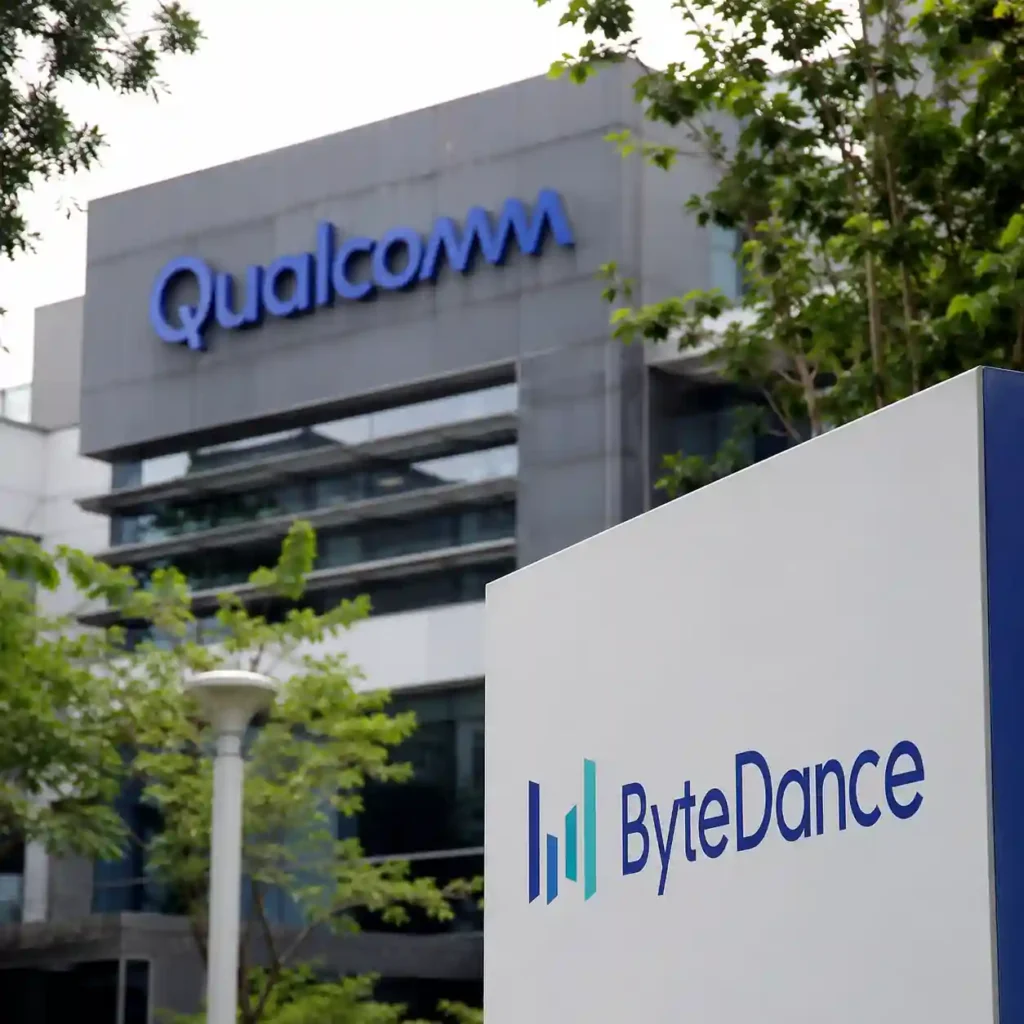

Qualcomm’s reported AI chip agreement with ByteDance is more than another semiconductor supply deal. It shows how quickly the artificial intelligence hardware market is moving beyond one-company dominance, as large technology groups search for custom chips, wider supply options and lower-cost computing for data centers.
According to a Bloomberg report carried by The Economic Times, ByteDance is set to buy millions of Qualcomm chips for artificial intelligence data centers. The chips are described as application-specific integrated circuits, or ASICs, which are designed for targeted workloads rather than broad general-purpose computing.
That detail is important. AI companies are no longer only chasing the fastest graphics processors. They are also looking for chips that can handle repeated inference tasks efficiently, reduce energy use and bring down the long-term cost of running AI products at scale. For ByteDance, which operates TikTok globally and Doubao in China, the need for reliable computing power is becoming central to its next phase of growth.
ByteDance is building for an AI-heavy future
ByteDance has been increasing its focus on AI agents, chatbots and model-driven services. Doubao has become one of China’s most widely used AI chatbot products, putting the company in competition with platforms such as ChatGPT, Gemini and Claude. That kind of growth requires vast data center capacity, especially when AI tools move from simple chat features to more advanced agent-style software.
The company’s spending plans underline that shift. ByteDance has reportedly lifted its AI infrastructure budget by 25% to about 200 billion yuan, or roughly $29.4 billion. A chip order of this scale would give the company more control over its AI roadmap at a time when access to advanced processors remains one of the biggest bottlenecks in the industry.
The Qualcomm partnership could also help ByteDance move closer to production with an already completed in-house chip design. That makes the deal different from a standard supplier relationship. It suggests ByteDance wants hardware tailored more closely to its own AI workloads, while Qualcomm gets a major customer that can test its data center ambitions at real scale.
Qualcomm gets a stronger opening in AI data centers
Qualcomm has long been associated with mobile processors, but the company has been trying to expand into higher-growth areas as smartphone markets mature. AI infrastructure is one of the most attractive opportunities, although it is also one of the hardest markets to enter because Nvidia has built a powerful lead in both hardware and software.
Read More
Flight operations restart in Adelaide following the deadly Parafield airport incident as authorities continue investigations.
Ferrari prepares for the EV era with its upcoming Luce project, blending luxury performance with Apple-inspired design influence.
The ByteDance deal gives Qualcomm something it badly needs in AI infrastructure: volume. Millions of chips going into data centers would offer a stronger commercial proof point than product announcements alone. Qualcomm CEO Cristiano Amon had recently said the company was engaging with potential customers for its AI-focused chips, and this reported agreement gives those comments more weight.
Qualcomm’s broader AI data center roadmap also supports this push. The company has introduced platforms such as AI200 and AI250 for rack-scale AI inference, with a focus on memory capacity, efficiency and total cost of ownership. That strategy fits a market where customers are looking for alternatives to expensive, power-hungry GPU clusters.
The competitive backdrop is still tough. Nvidia remains the clear leader in AI accelerators, while AMD, Broadcom, Google and other chip developers are also trying to win more data center business. Swikblog recently covered how strong AI chip demand continues to shape Nvidia’s market story in this report on Nvidia’s AI chip demand and earnings pressure.
There is also a geopolitical layer. U.S. export controls have limited Chinese access to some of the most advanced AI chips. Qualcomm’s chips may still be produced through partners such as Taiwan Semiconductor Manufacturing Co. if they remain within legally allowed performance thresholds. That gives ByteDance a possible route to expand AI computing without directly relying on restricted high-end processors.
For Qualcomm, the opportunity is clear but not guaranteed. Winning ByteDance would not make it an Nvidia replacement overnight. But it would show that the AI chip market is broadening, especially for custom silicon built around specific workloads. For ByteDance, the deal strengthens its ability to keep scaling AI services. For Qualcomm, it could be the most important sign yet that its data center ambitions are becoming commercially serious.

Make Swikblog your go-to source on Google for reliable updates, smart insights, and daily trends.