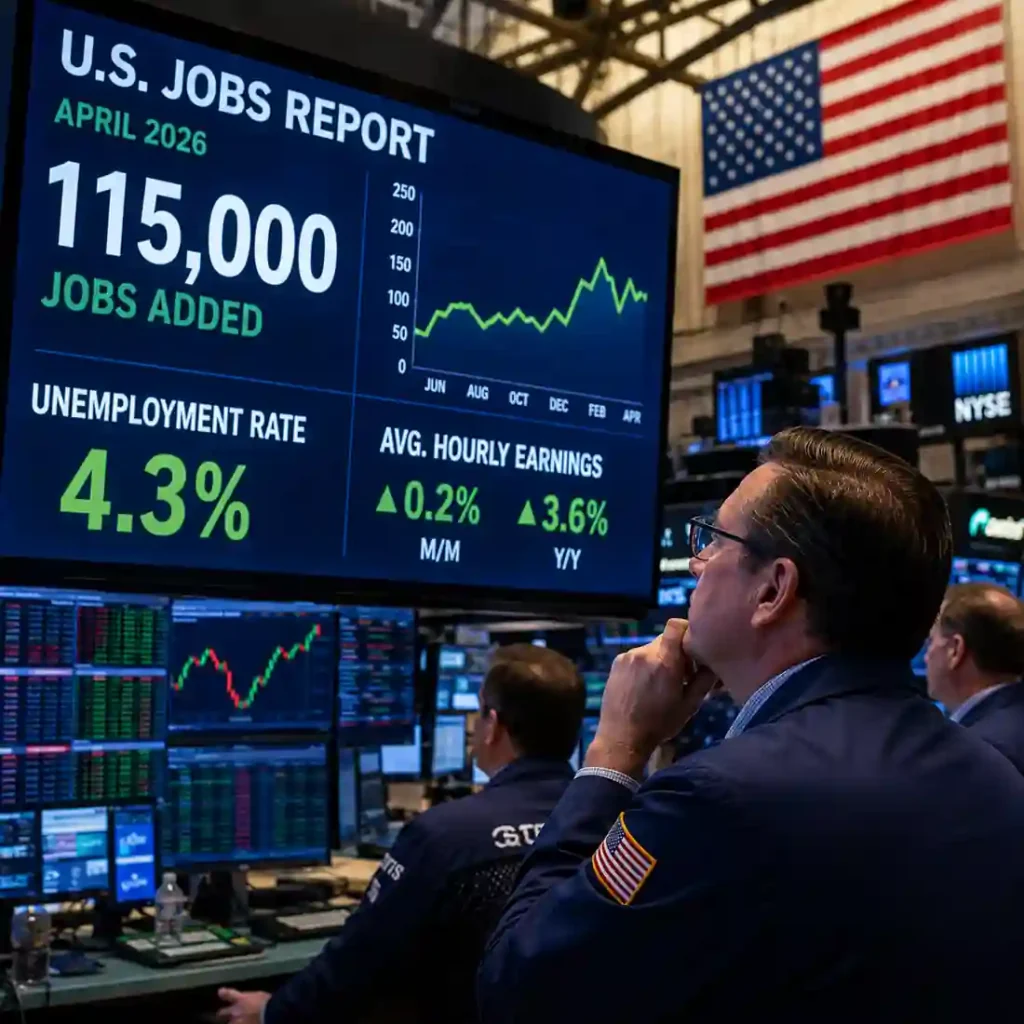

WASHINGTON — The April 2026 US jobs report gave Wall Street a stronger signal than expected: the economy is still creating jobs, unemployment is not moving higher, and the labor market has not cracked under the weight of high interest rates, policy uncertainty, and slower business investment.
Nonfarm payrolls increased by 115,000 in April, beating economist expectations that had mostly centered near 55,000 to 65,000. The unemployment rate stayed unchanged at 4.3%, a level that suggests the jobs market remains stable even though hiring is no longer running at the rapid pace seen in earlier post-pandemic years.
The report matters because investors, businesses, and Federal Reserve officials have been watching labor data closely for signs of either a deeper slowdown or renewed inflation pressure. April’s numbers landed somewhere in the middle: hiring was better than expected, wage growth cooled, and job gains were concentrated in a few service-heavy sectors.
March’s payroll gain was revised higher to 185,000 from the earlier estimate of 178,000. February, however, was revised lower to a loss of 156,000 jobs, showing just how uneven monthly labor data has become. That volatility is one reason economists are increasingly focused on three-month averages rather than a single headline number.
For readers tracking the broader market reaction, Swikblog’s latest business and finance coverage follows how labor data, inflation reports, and Federal Reserve policy expectations are shaping investor sentiment in 2026.
Where the April jobs growth came from
Healthcare again played a major role in supporting job creation. The sector added tens of thousands of positions as demand for medical care, hospitals, outpatient services, and elder care continued to expand. Social assistance also remained a steady contributor, reflecting long-term demographic needs across the US economy.
Transportation and warehousing posted one of the strongest gains of the month, adding around 30,000 jobs. Couriers, messengers, and logistics-related employers helped drive that increase, suggesting that delivery demand and supply-chain activity remain firm despite concerns over consumer spending.
Retail employment also improved, with payrolls rising by about 22,000. That gain points to a consumer economy that is slowing but still active, especially in everyday goods and service-related spending.
Not every part of the economy shared in the strength. The information sector lost 13,000 jobs in April and has now shed roughly 342,000 positions since its most recent peak in November 2022. That decline has become one of the clearest weak spots in the labor market, with artificial intelligence adoption, automation, media disruption, and corporate restructuring all weighing on employment.
Financial activities also declined by 11,000 jobs as banks, lenders, insurers, and investment-related firms remained cautious. Higher borrowing costs and uncertainty around future Federal Reserve policy have made some firms slower to expand headcount.
Wage growth also cooled. Average hourly earnings increased 0.2% in April, below expectations for a 0.3% gain. On a yearly basis, wages rose 3.6%, also softer than expected. For the Federal Reserve, slower wage growth may be a welcome sign because strong pay increases can keep inflation pressure elevated.
Read More
Why 115,000 jobs may be stronger than it looks
A few years ago, a 115,000 monthly payroll gain might have looked modest. In 2026, economists are reading the number differently. The US labor force is growing more slowly because of an aging population and lower immigration, which means the economy may need fewer new jobs each month to keep unemployment steady.
Some estimates now place the “break-even” level of monthly job growth between zero and 50,000. If that range is accurate, April’s 115,000 gain is not weak at all. It suggests the economy is still adding jobs at a pace comfortably above what is needed to prevent unemployment from rising sharply.
That explains why economists described the report as a sign of resilience rather than a warning. The labor market appears to be in a “slow hire, slow fire” phase. Companies are not hiring aggressively, but they are also not cutting workers in large numbers. Many businesses remain cautious because of trade policy, immigration changes, tax uncertainty, and geopolitical risks, yet layoffs remain limited in most major industries.
There were still soft spots beneath the headline number. A broader measure of unemployment, which includes discouraged workers and people working part-time for economic reasons, rose to 8.2% from 8.0%. The number of people working part-time because they could not find full-time jobs increased by 445,000 to 4.9 million.
The household survey also showed employment falling by 226,000, while the labor force participation rate slipped to 61.8%, its lowest level since October 2021. Those details suggest that while payroll growth beat forecasts, the labor market is not uniformly strong.
The April report also arrived as economists monitored the impact of higher energy prices and geopolitical tensions linked to the Iran conflict and risks around the Strait of Hormuz. Those pressures have already affected fuel costs, but economists said it may take more time before any effect appears clearly in hiring data.
Markets took the report as another reason to believe the Federal Reserve will stay patient. With unemployment steady and hiring stronger than expected, policymakers may feel less pressure to cut interest rates quickly. At the same time, softer wage growth gives the Fed some room to argue that inflation pressure is not accelerating.
For investors, the report supports a careful but constructive view of the US economy. Growth is slower, hiring is uneven, and some sectors are clearly under pressure. But the April jobs data also shows that the labor market remains durable enough to keep recession fears from dominating the outlook.

Make Swikblog your go-to source on Google for reliable updates, smart insights, and daily trends.