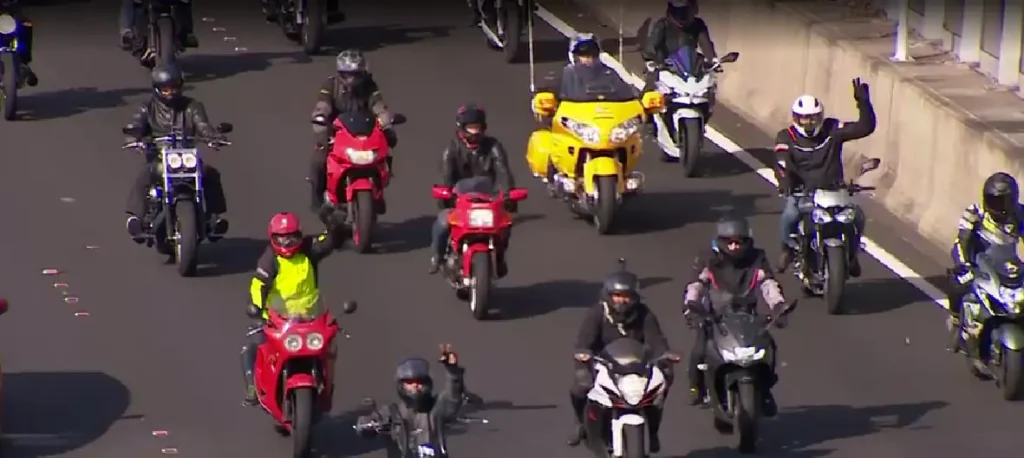

Hundreds of motorcyclists used Auckland Harbour Bridge on Saturday to send a direct message to ACC and the Government: the planned rise in motorcycle levies has become more than a registration issue. For many riders, it is now a question of whether the cost of owning and using a motorcycle in New Zealand is being pushed too far.
Around 400 riders joined the protest, which was organised by Motorcycle Advocacy Group New Zealand (MAGNZ). The group gathered at Onepoto Domain on Auckland’s North Shore from 11am before riding across the Harbour Bridge and looping back through the city centre.
The protest was carefully chosen for visibility. The Harbour Bridge is not just a major Auckland route; it is one of the country’s most recognisable pieces of transport infrastructure. MAGNZ said the issue needed national attention, arguing that riders across New Zealand were frustrated by levy changes that will hit many motorcycle owners from July.
During the demonstration, riders occupied the two 80km/h lanes on the bridge and kept speeds no higher than 40km/h. The slow-moving ride turned the bridge crossing into a public show of opposition without removing the focus from the reason behind the protest: higher ACC costs tied to motorcycle registration.
The sharpest concern is the increase facing larger motorcycles. Registration costs for bigger bikes are set to rise from $540 in 2025 to $816 from July 2026. A second increase is expected next year, lifting the cost to $960. That means some riders could face an increase of hundreds of dollars within two years.
For motorcycle owners with more than one bike, the impact is even greater. Riders at the protest argued that ACC levies should be attached to the rider rather than each motorcycle, because one person can only ride one bike at a time. That argument has become one of the clearest points of frustration in the dispute.
MAGNZ has also indicated that legal action is being prepared against the levy increases. That raises the stakes beyond Saturday’s bridge protest and suggests the disagreement may continue through formal channels as well as public demonstrations.
ACC has defended the changes by pointing to the cost of motorcycle injury claims. Stewart McRobie, ACC Deputy Chief Executive Corporate and Finance, said the levy increases reflect the expected lifetime cost of motorcycle injuries. ACC says motorcycles are the only vehicle type that does not cover 100% of its claim costs.
The agency’s position is based on a large gap between the size of the motorcycle fleet and the cost of claims. Motorcycles account for about 4% of New Zealand’s vehicle fleet but around 25% of ACC’s road crash injury costs. ACC says motorcyclists currently contribute 28% of the cost of their injury claims, with that share due to rise to 33% from July 1, 2026, and 37% from July 1, 2027.
ACC also says engine capacity is being used because its data shows that, while the chance of a crash is relatively similar across motorcycle types, the severity and cost of injuries increase significantly with engine size. The agency describes engine capacity as a practical way to group motorcycles with different injury-cost profiles. Official details on the levy changes are available on ACC’s motorcycle levy changes page.
Riders, however, argue that the system does not properly reflect how motorcycles are actually used. A rider with several registered bikes may pay several levies even if only one motorcycle is on the road at any given time. For them, the dispute is not only about risk but about whether the charging model is fair.
The consultation process is also part of the wider debate. ACC says it is legally required to consult on levy changes every three years and that more than 8,000 people provided feedback during the latest review before Cabinet made the final decision. The next opportunity for formal public feedback is expected in 2027.
Read More
The Harbour Bridge has often become a flashpoint for wider transport issues in Auckland, from major weather disruption to public safety concerns. Swikblog previously reported on the bridge’s vulnerability during severe conditions in its coverage of Auckland Harbour Bridge closures caused by dangerous winds and major delays.
Saturday’s protest showed how strongly the levy issue has landed with New Zealand’s motorcycling community. ACC says the increases are needed to better match injury costs. Riders say the changes are too steep, too blunt and unfair to those who own multiple motorcycles. With legal action now being prepared, the fight over motorcycle levies is unlikely to end with one ride across the bridge.

Make Swikblog your go-to source on Google for reliable updates, smart insights, and daily trends.