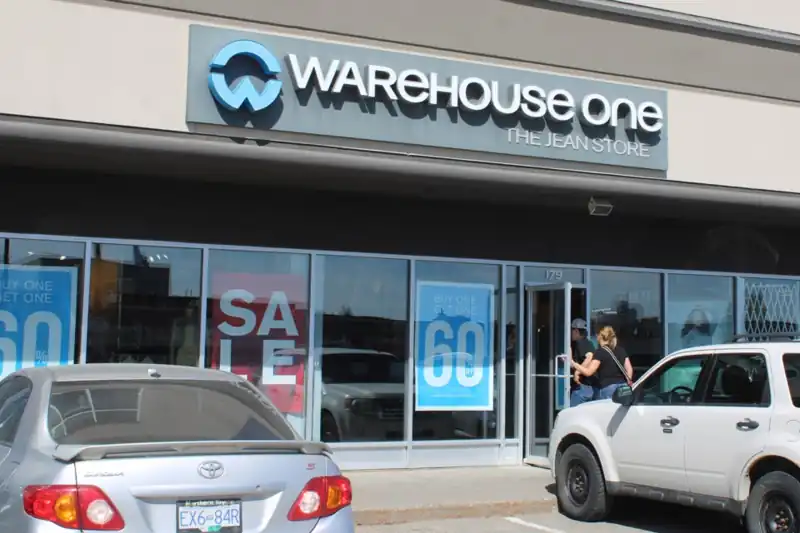

Warehouse One Clothing Ltd., the company behind Warehouse One and Bootlegger, is moving toward the closure of all 128 stores across Canada after entering proceedings under the Companies’ Creditors Arrangement Act, commonly known as the CCAA.
The move places two familiar Canadian clothing names on the edge of disappearance, with locations in Alberta, British Columbia, Saskatchewan, Manitoba, Ontario, Newfoundland and Labrador, Nova Scotia, New Brunswick and Yukon expected to be affected. The company is seeking court approval in Manitoba for an orderly wind-down of its business, including the liquidation of all Warehouse One and Bootlegger retail stores.
The announcement is especially painful for shoppers who have relied on both chains for denim, casual wear and everyday clothing at accessible prices. Warehouse One and Bootlegger were not luxury names, but that was part of their appeal. They served customers looking for jeans, basics and seasonal fashion without the high price tags often attached to larger international brands.
According to the company, the decision came after a review of available options. In its statement, Warehouse One said it had made the difficult choice to start CCAA proceedings so it could carry out an orderly wind-down of operations. The CCAA applies to insolvent Canadian companies with more than $5 million in debt and is designed to give businesses court protection while they restructure or arrange a managed exit.
The process does not always mean a company disappears. Some retailers use creditor protection to renegotiate debt, close weaker stores and continue operating. In this case, however, the company’s plan points toward a full liquidation of its store network.
Customers still have a short window to use gift cards, complete returns and exchanges, and access benefits under the company’s Perks program. Court-appointed monitor Alvarez & Marsal Canada Inc. has said those services will be honoured through May 13, 2026. After that date, all sales are expected to become final.
That deadline is important for shoppers. Anyone holding a Warehouse One or Bootlegger gift card should act quickly rather than waiting for a final closing sale. Once liquidation begins in full, customer policies often become stricter, and merchandise is usually sold on a final-sale basis.
A Long Canadian Retail Story Nears Its End
Bootlegger has been part of Canada’s apparel market since 1971, when it was founded in Vancouver. Over the decades, it became closely associated with denim and casual fashion, building recognition in malls and shopping centres across the country.
Warehouse One followed a few years later, launching in Manitoba in 1977. Its strongest footprint developed in Western Canada, where it became a familiar name in smaller and mid-sized communities. The chain built its business around practical clothing, frequent promotions and a customer base that valued fit, price and convenience.
The current closure plan comes only about a year after Bootlegger changed hands during another retail restructuring. Bootlegger had previously been part of Comark Holdings Inc., the company that also operated Ricki’s and Cleo. After Comark ran into financial trouble, an Ontario court approved the sale of Bootlegger to Warehouse One Clothing Ltd.
At the time, that deal appeared to give Bootlegger another chance. Some stores were expected to convert to Warehouse One locations, while others continued under the Bootlegger name. Ricki’s and Cleo were sold separately to Putman Investments, the owner of Toys “R” Us Canada, in a deal reported at $14.4 million.
But the retail environment has not become easier. Apparel chains that depend on malls and physical stores continue to face pressure from rising rent, labour costs, shipping costs and changing shopping habits. Many consumers are spending more carefully as household budgets remain stretched, while online platforms continue to compete aggressively on price.
The result is a difficult middle ground for brands like Warehouse One and Bootlegger. They are not high-end fashion labels with luxury margins, and they are not ultra-low-cost online sellers with massive scale. They sit in the part of retail that has been hit hardest: traditional, mid-market apparel.
For more retail and business updates, readers can also follow related coverage on Swikblog, where consumer, market and company news stories are regularly tracked.
Read More
Local Communities Could Feel the Closures
The impact will not be limited to national retail headlines. In communities such as Prince George, British Columbia, the closures could remove both a Warehouse One store and a Bootlegger location from the local shopping scene. The Warehouse One location on 15th Avenue and the Bootlegger store at Pine Centre Mall are among the stores facing uncertainty as the company moves through court proceedings.
Local reaction has already shown how closely these stores were tied to everyday shopping habits. Some customers described the brands as reliable places for affordable clothing, broader sizing and friendly service. Others used the news to call for stronger support of independent local shops as national chains continue to disappear from smaller markets.
Employees are also facing an uncertain period. While the company has not publicly detailed the total number of workers affected across all 128 stores, the scale of the closure suggests hundreds of retail jobs could be at risk. In Prince George, a Bootlegger employee reportedly said nine people worked at that local store.
The situation also adds pressure to shopping centres. When a recognizable apparel tenant closes, malls must not only replace lost rent but also deal with reduced foot traffic. Smaller regional malls may find that especially difficult, as many national retailers have become more selective about where they operate.
The collapse of Warehouse One and Bootlegger fits into a wider shift in Canadian retail. Consumers have not stopped buying clothing, but they are buying differently. More purchases now happen online, shoppers compare prices faster, and loyalty to mall-based fashion brands has weakened over time.
Industry groups such as the Retail Council of Canada have continued to highlight the challenges retailers face from cost pressures, shifting consumer behaviour and the need for stronger digital strategies. For older store-based chains, adapting quickly enough can be expensive and difficult.
Warehouse One’s filing is a reminder that brand history alone is no longer enough to protect a retailer. Bootlegger had more than five decades of name recognition. Warehouse One had nearly 50 years in the Canadian market. Both had loyal customers. Yet the financial weight of modern retail appears to have overtaken the business.
The next major step is expected in Manitoba court, where the company is seeking permission to proceed with the closure and liquidation plan. Until more details are released, shoppers should check their nearest store directly for sale timing, inventory availability and policy updates.
For now, the message for customers is clear: use gift cards and complete returns or exchanges before the May 13 deadline, because once liquidation moves ahead, the remaining sales are expected to be final.

Make Swikblog your go-to source on Google for reliable updates, smart insights, and daily trends.