
A historic Lake District pub that once brought villagers, walkers and tourists together has become a fresh warning sign for Britain’s struggling hospitality industry after closing under the weight of rising costs and a sharp rent increase.
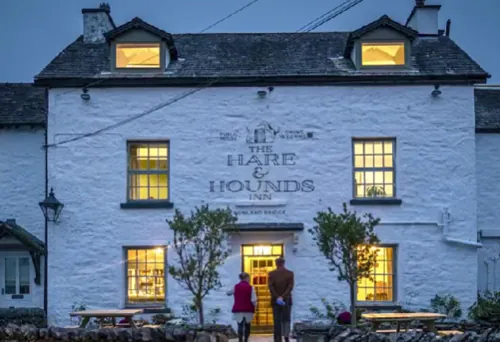
The Hare and Hounds in Bowland Bridge, a 17th-century inn near Windermere, has stood for more than 400 years. Once a lively coaching stop on the old Manchester-to-Glasgow route, it later became a much-loved rural pub known for its whitewashed stone walls, cosy fireplace, rooms for visitors and views across the Cumbrian fells.
Now the building is shut, the garden is empty and a “For Sale” sign has replaced the normal rhythm of drinkers, diners and guests. For people living nearby, the closure is not simply the loss of a business. It is the loss of a meeting place in a village where social spaces are already disappearing.
Former publican Simon Rayner had a long personal connection with the Hare and Hounds before he ever ran it. As a teenager growing up in Windermere, he used to ride through Bowland Bridge, tie up his horse outside the pub and stop for a Coca-Cola. In those days, the inn was busy, familiar and full of life.
After spending 25 years in London, Rayner returned to Cumbria in 2020. When the pub tenancy became available, he and business partner Andrew Black decided to take on the challenge they had often talked about: running a country pub of their own.
They reopened the Hare and Hounds in September 2021 after renovating the property and building it around food, rooms and community events. The timing initially looked promising. With many people still holidaying in Britain after Covid restrictions eased, Lake District inns and rural stays were in high demand.
The pub attracted strong attention. It offered five rooms, a restaurant, traditional interiors and a modern food-led approach without losing the feel of a proper village local. Events became part of its identity, from kitchen takeovers and Lebanese nights to butchery masterclasses, quizzes and drag bingo.
Rayner and Black even created their own gin, while regulars gathered at the bar and visitors used the pub as a base for exploring the surrounding countryside. For a time, it looked like the kind of rural hospitality success story many villages hope for.
But the numbers behind the business told a different story.
According to Rayner, the pub’s rooms had around 80% occupancy across the year, yet profit margins kept shrinking. Staffing a remote rural pub proved expensive, with labour costs reportedly reaching 35% to 40% of revenue. Energy bills also rose sharply, climbing from about £1,500 a month to nearly £3,500.
Those pressures were already difficult. Then came the rent increase. The property was owned by Admiral Taverns, and Rayner said the rent was doubled. That change made the business impossible to continue, despite strong customer demand and long working weeks from the operators.
The Hare and Hounds closed in November 2025, joining a growing list of pubs across England and Wales that have shut or been put up for sale as costs rise and consumer spending weakens.
The wider figures show why the closure has struck a nerve. The British Beer and Pub Association has warned that pubs in England and Wales are closing at a rate of around two a day, while thousands have disappeared since the pandemic. Industry leaders point to higher energy bills, food inflation, wage costs, business rates and tax pressures as major reasons even busy pubs are finding it hard to survive.
Large pub groups have also been selling sites. Stonegate, Greene King and Admiral Taverns have all moved to offload pubs as the sector adjusts to lower margins, changing drinking habits and higher borrowing costs.
For rural communities, the impact is especially severe. A city can lose a pub and still have cafés, restaurants, libraries, cinemas and other public spaces nearby. A small village may have only one place where people naturally meet without planning weeks ahead.
Read More
That is why the Hare and Hounds mattered. It was not only a bar or restaurant. It was where long-time residents met newcomers, where walkers crossed paths with farmers, and where people living in scattered homes around Bowland Bridge could gather informally.
Nearby residents Molly and John Wood, who live just across the road, have described how quiet the village now feels. The pub once brought movement, conversation and visitors into the area. Without it, the village feels still in a way that worries locals.
A group of around 30 residents is now trying to stop the building from being lost permanently as a community space. Led by local resident Martin Scovell, they have submitted an Asset of Community Value application to Westmorland and Furness Council.
If the application succeeds, the community would get time to prepare a bid if the pub is sold. Their concern is clear: without protection, the building could be converted into holiday flats, second-home accommodation or short-term rentals, further reducing everyday village life.
Community-owned pubs are becoming one answer to this problem. According to Plunkett UK, hundreds of pubs across Britain are now run under community ownership models, often serving as pubs, cafés, shops and local hubs at the same time.
That model could give the Hare and Hounds another chance. Without private rent pressure and with volunteers helping reduce staffing costs, locals believe the building could once again serve Bowland Bridge throughout the day, not just in the evening.
The story also reflects a bigger question about the future of the Lake District. Tourism brings money and jobs, but villages can become hollowed out when too many buildings shift toward holiday use and too few remain part of daily community life.
For more updates on UK business, local communities and changing consumer trends, visit Swikblog.
The Hare and Hounds has survived centuries of change, from coaching routes to modern tourism. Its closure shows that history alone cannot protect a pub when costs rise faster than revenue. But the community campaign also shows that, for many people in Bowland Bridge, the old inn is still worth fighting for.
Because when a village pub closes, Britain does not just lose another hospitality venue. It loses a place where ordinary life used to happen.

Make Swikblog your go-to source on Google for reliable updates, smart insights, and daily trends.