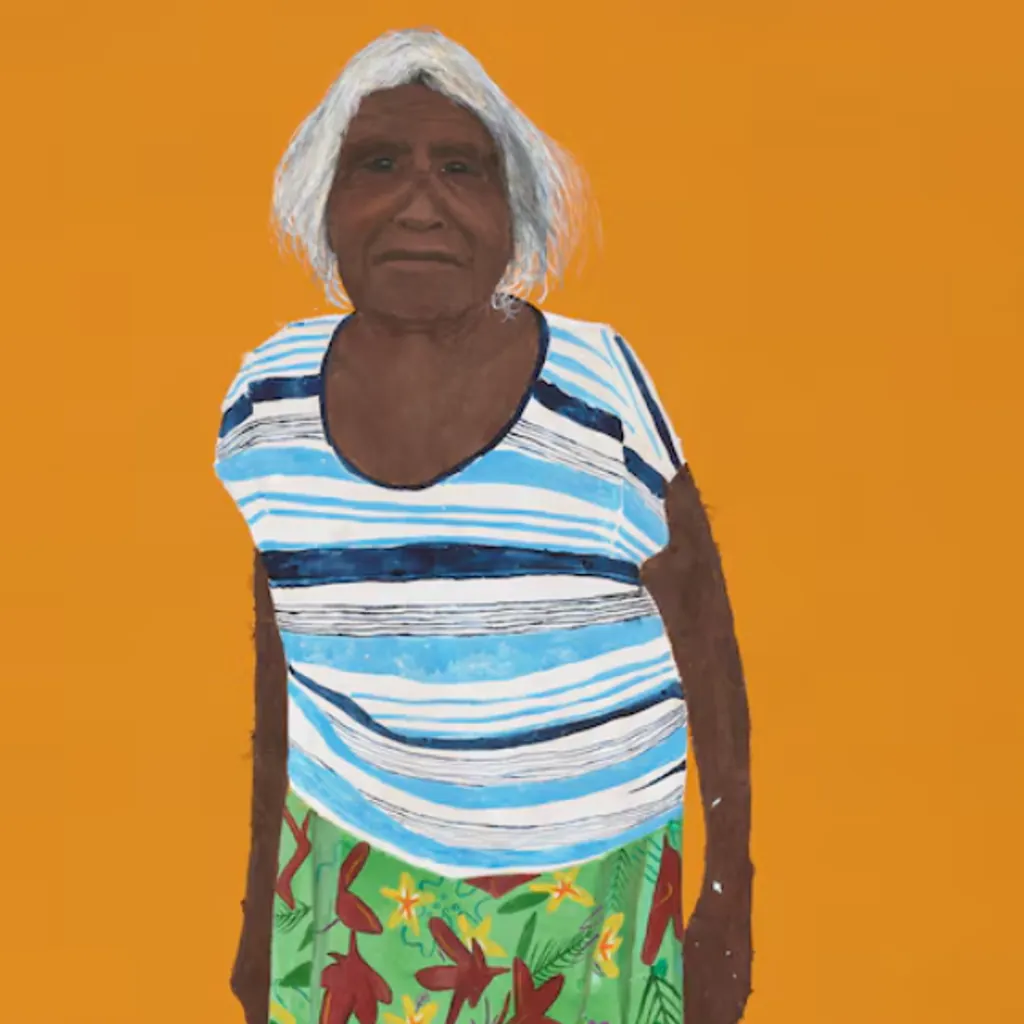

Richard Lewer’s 2026 Archibald Prize victory is more than a headline about Australia’s most famous portrait award. It is a moment that brings together contemporary portraiture, First Nations representation, regional art practice and the continuing influence of the APY Lands on Australia’s cultural landscape.
The Melbourne-based artist has won the $100,000 Archibald Prize for Iluwanti Ken, a synthetic polymer painting on canvas of Pitjantjatjara elder and senior artist Iluwanti Ken. The portrait was chosen from 1,034 entries, with 59 works making the final selection at the Art Gallery of New South Wales.
Lewer’s win stands out not only because of the scale of the prize, but because of the story carried by the sitter. Ken is a respected artist connected with Tjala Arts in Amata, in the Aṉangu Pitjantjatjara Yankunytjatjara Lands of South Australia. Her own practice is known for strong, often monochromatic works that feature Tjilpul, or hunting eagles, as symbols of care, protection and resilience.
That background gives the winning portrait a deeper force. This is not a celebrity portrait built around instant recognition. It is a direct, grounded image of an artist whose authority comes from Country, community, cultural knowledge and decades of creative work.
Why Richard Lewer’s portrait of Iluwanti Ken matters
The Archibald Prize often attracts attention for portraits of politicians, actors, athletes and media figures. In 2026, however, the winning work has shifted attention toward a senior First Nations artist whose presence on the canvas feels calm, watchful and commanding.
Lewer spent time with Ken at Tjala Arts before creating the painting. That decision matters. Instead of working from a distance, he built the portrait around time, observation and respect. The final work shows Ken life-size, allowing the viewer to meet her directly rather than look at her as a distant subject.
The vivid yellow background is one of the painting’s most memorable features. It reflects the heat, light and atmosphere of the APY Lands, giving the portrait a sense of place without crowding the sitter. The simplicity of the composition makes Ken’s expression, posture and presence the centre of the work.
Small details also carry meaning. Lewer included flecks of paint on Ken’s arm, presenting her not only as an elder and cultural figure, but as a working artist. That choice adds honesty to the portrait. It reminds viewers that Ken is not simply being represented by another artist; she is an artist herself, with her own visual language and creative authority.
The win is also historically significant. Lewer’s portrait becomes only the fifth Archibald-winning painting of a First Nations person in the prize’s 105-year history. That places Iluwanti Ken in a small but important group of past winning portraits featuring figures such as Adam Goodes, Gurrumul, David Gulpilil and Karla Dickens.
Read More
A competitive Archibald field with a clear winner
The 2026 Archibald Prize attracted more than 1,000 entries, making Lewer’s victory especially notable. The trustees of the Art Gallery of New South Wales selected his portrait unanimously from the 59 finalists, a strong signal of how clearly the work stood apart in this year’s field.
Other portraits in the exhibition feature well-known public figures including Governor-General Sam Mostyn, swimmer and singer Cody Simpson, champion surfer Layne Beachley, Bondi hero Ahmed Al-Ahmed and journalist Virginia Trioli.
Lewer was already familiar with the Archibald before this win, having been a finalist multiple times. His 2026 success gives his career a major national milestone and places his work at the centre of Australia’s biggest annual art conversation.
For readers following Australian art, the result also highlights the growing visibility of artists and art centres from remote and regional communities. Tjala Arts, where Lewer spent time with Ken, has long played an important role in supporting artists from the APY Lands and bringing their work to wider audiences.
The Archibald announcement was made alongside other major Australian art prize results. Gaypalani Waṉambi won the Wynne Prize for The Waṉambi tree, a metal work made with spray paint on etched steel and discarded road signs. Lucy Culliton won the Sulman Prize for Toolah, artist model, a painting of her rescue greyhound resting in her studio.
Together, the results point to a strong year for Australian art, with works that draw from Country, personal memory, studio life and cultural storytelling rather than simple public fame.
The Archibald, Wynne and Sulman Prizes 2026 exhibition opens at the Art Gallery of New South Wales on May 9 and runs until August 16.
For Lewer, Iluwanti Ken is likely to become one of the defining works of his career. For the Archibald Prize, it is a winner that feels timely, visually strong and culturally important. It gives the 2026 exhibition a clear centrepiece: a portrait that does not rely on spectacle, but on presence.

Make Swikblog your go-to source on Google for reliable updates, smart insights, and daily trends.