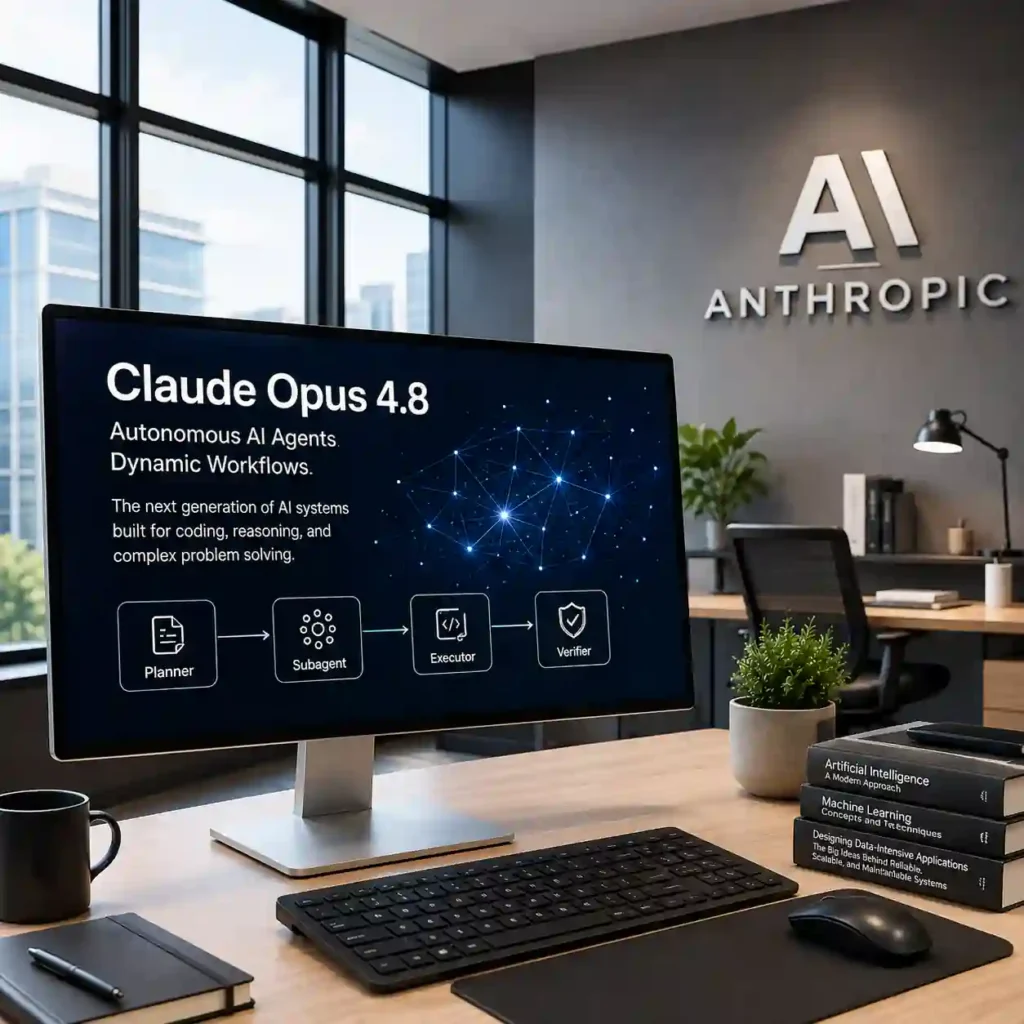

Anthropic released Claude Opus 4.8 on May 28, 2026, upgrading its premium artificial intelligence model with stronger coding, reasoning and agent-based work capabilities. The launch focused on helping Claude manage complex assignments involving planning, tool use and multiple stages of verification.
Opus 4.8 succeeded Claude Opus 4.7 and became available through Claude’s consumer products and API. Anthropic kept regular API pricing unchanged at $5 per million input tokens and $25 per million output tokens.
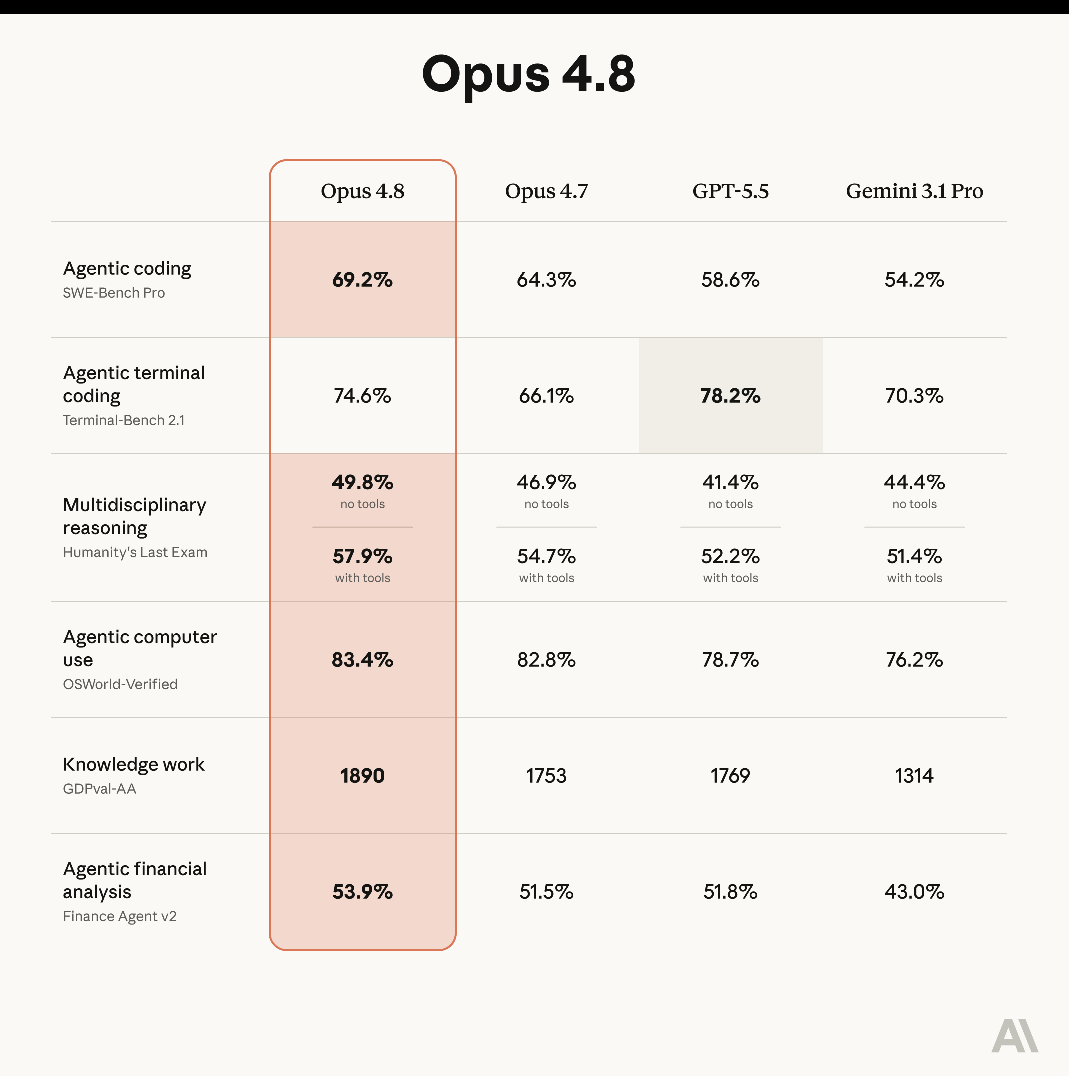
Claude Opus 4.8 pricing and fast mode
Anthropic introduced an optional fast mode priced at $10 per million input tokens and $50 per million output tokens. The company said this setting could operate at approximately 2.5 times the standard speed and cost three times less than fast mode on previous models.
The faster option was designed for time-sensitive work, but it did not remove the need to check important outputs. Businesses still had to consider token consumption, data-handling requirements and the cost of running lengthy automated tasks.
Dynamic workflows expanded Claude Code
The most significant addition was dynamic workflows, launched as a research-preview feature for Claude Code. It allowed Claude to plan a large project, distribute parts of the work among hundreds of parallel subagents and verify the combined output before presenting its findings.
Anthropic said the system could support codebase-scale migrations involving hundreds of thousands of lines of code. Dynamic workflows launched for Claude Code users on Enterprise, Team and Max plans.
This approach went beyond asking a chatbot to generate a short code snippet. A workflow could examine dependencies, modify files, run tests and check whether the completed work satisfied the original instructions.
Effort controls gave users more choice
Claude.ai and Cowork received an effort control that determines how much computation Claude applies to a task. Lower settings provide quicker responses and use account limits more slowly, while higher settings spend more tokens on difficult problems.
Opus 4.8 used high effort by default. Extra and max settings were intended for demanding coding work and longer asynchronous assignments where additional analysis could improve the result.
Anthropic highlighted reliability improvements
In its official Claude Opus 4.8 announcement, Anthropic said the model was more likely to identify uncertainty and less likely to make claims without sufficient support.
Company evaluations found that Opus 4.8 was approximately four times less likely than Opus 4.7 to leave flaws in its generated code unmentioned. This was Anthropic’s own evaluation result and did not guarantee that the model would detect every coding error.
How Opus 4.8 fitted into the AI competition
The release arrived as AI developers competed on coding performance, tool use, operating costs and the ability to complete longer assignments. Capacity was another concern, demonstrated when demand placed pressure on Moonshot AI’s Kimi K3 service.
Anthropic later extended its model range with Claude Fable 5 and Mythos-class capabilities. Those developments showed how quickly advanced models could move from experimental cybersecurity work into broader business and research applications.
Opus 5 has since succeeded Opus 4.8
Claude Opus 4.8 is no longer Anthropic’s newest Opus model. The company released Claude Opus 5 on July 24, 2026, keeping the same standard API pricing while introducing stronger performance across coding, knowledge work and longer agent-based tasks.
Opus 4.8 remains important in Claude’s development because it introduced dynamic workflows and broader effort controls. However, anyone comparing Anthropic’s current premium models should treat Opus 5 as its direct successor.
Read More
Why human oversight remains important
Parallel agents can complete more work, but they can also repeat the same incorrect assumption across several connected tasks. Passing a software test does not necessarily prove that the original design, security controls or business requirements were correct.
Teams using autonomous AI for production systems should maintain code reviews, access restrictions, audit logs and independent security checks. These models can reduce manual work, but responsibility for approving consequential changes remains with the people and organisations deploying them.
Claude Opus 4.8 helped move AI assistants from isolated answers toward longer, coordinated workflows. Its lasting importance is the direction it established: AI systems that plan, use tools and verify work while still requiring clear human accountability.

Make Swikblog your go-to source on Google for reliable updates, smart insights, and daily trends.