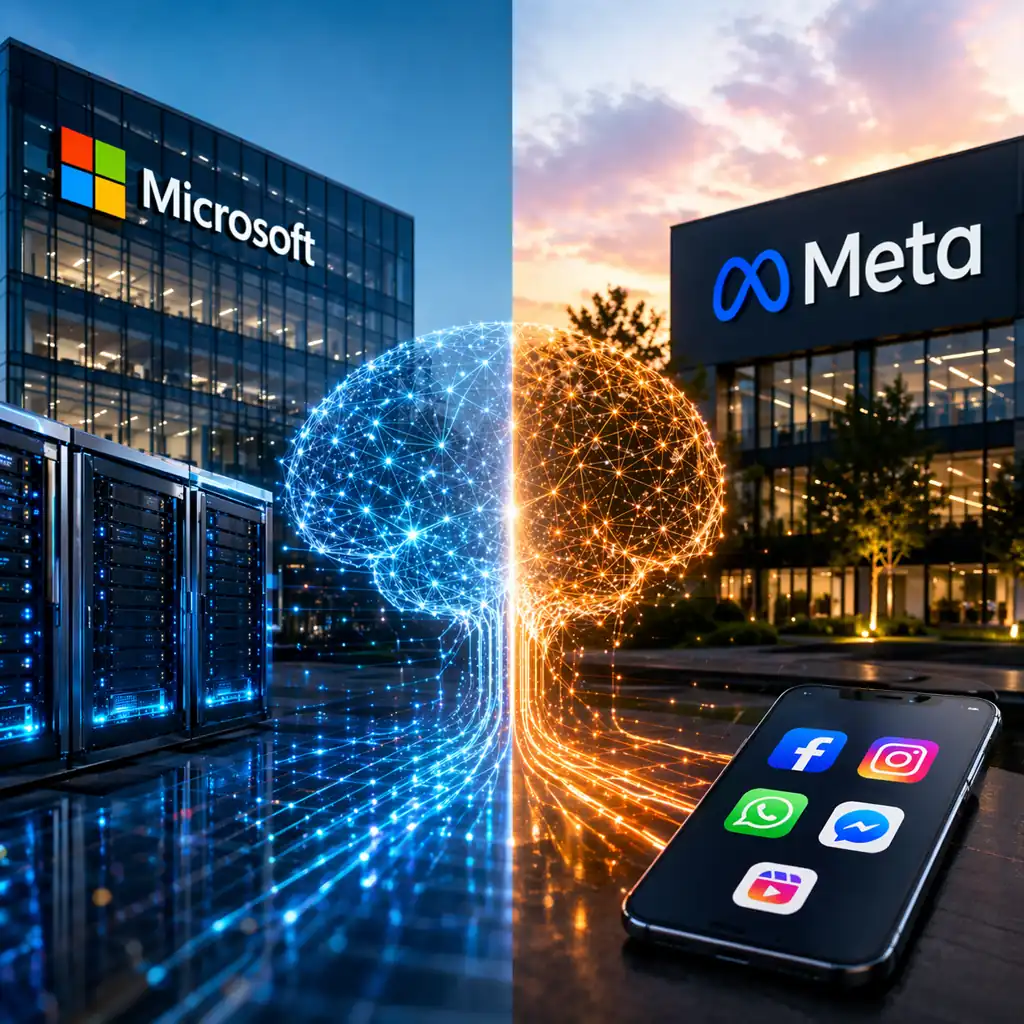

Microsoft and Meta Platforms will both step into the spotlight on April 29, and this round of earnings matters for more than the usual quarterly numbers. Investors are looking for proof that the billions pouring into artificial intelligence are translating into stronger businesses, not just bigger spending plans. That is what makes this comparison so compelling right now. These are two of the most influential companies in tech, both racing to shape the AI future, yet the ways they are trying to win could hardly be more different.
Microsoft is pushing AI through the enterprise route. It is embedding copilots across software, deepening its cloud footprint, and turning Azure into a core platform for companies that want to build, train, and run AI tools. Meta is approaching the opportunity from the consumer internet side. It is using AI to improve recommendations, make ads more efficient, and keep users more engaged across Facebook, Instagram, and its wider family of apps. In other words, Microsoft is selling AI productivity and infrastructure, while Meta is using AI to sharpen the economics of its existing digital empire.
Both cases are attractive, but heading into earnings, the question is which stock looks better positioned for investors right now.
Microsoft still has scale, trust, and cloud momentum on its side
There is a lot to like in Microsoft’s recent performance. In its fiscal second quarter of 2026, the company reported adjusted earnings per share of $4.14, up 24% year over year. Revenue increased 17%, showing that even at its size, Microsoft is still delivering the kind of growth investors expect from a top-tier AI name.
A big part of that strength has come from Azure. The cloud platform continues to benefit from businesses building and deploying machine learning models, AI assistants, and broader data-driven tools. Microsoft’s edge is not just technical infrastructure. It also comes from trust and integration. Large customers already rely on its cloud, office software, developer tools, and security products. That makes it easier for Microsoft to roll out AI features across an installed base that is already paying attention.
But the challenge is that Microsoft is operating in one of the most competitive corners of technology. Alphabet and Amazon are investing heavily in cloud and AI, and generative AI is also making software development faster and cheaper. That changes the landscape. It may not weaken Microsoft overnight, but it does mean the company has to keep investing aggressively just to stay ahead of equally well-funded rivals.
Valuation adds another layer to the debate. Microsoft trades around 26 times earnings, which is not excessive for a business of this quality. Still, that multiple assumes the company can continue defending share, expanding AI demand, and growing earnings at a healthy pace. Investors are not paying for a turnaround story here. They are paying for continued execution.
Meta’s AI story looks more direct, and the growth has been harder to ignore
Meta’s investment case feels different because AI is not creating a new business from scratch. Instead, it is strengthening the one Meta already has. The company’s platforms attract nearly 3.6 billion daily active users, and that reach gives it one of the strongest network effects in global technology. When AI makes feeds more relevant, videos more engaging, and ad targeting more precise, the payoff can show up quickly in user time spent and advertiser demand.
That is exactly why Meta’s recent numbers have stood out. In its latest reported quarter, revenue climbed nearly 24% year over year to almost $60 billion. That top-line momentum is especially notable because it comes from a business that is already operating at huge scale. Meta also carries a gross margin of roughly 82%, comfortably above Microsoft’s roughly 68.59%, which speaks to the strength of its advertising model when engagement trends are moving in the right direction.
Of course, Meta is not getting this growth for free. The company has signaled an enormous jump in spending, forecasting 2026 capital expenditures of $115 billion to $135 billion, excluding principal payments on finance leases. That figure alone is enough to remind investors that this is still a high-stakes bet. The company is spending heavily to build the infrastructure it believes will support its next chapter in AI, including Mark Zuckerberg’s push around personal superintelligence.
That level of investment can pressure free cash flow and test patience if returns do not show up fast enough. Still, Meta’s advantage is that its AI use case is easier for the market to understand in the near term. Better recommendations drive more engagement. Better engagement supports more ads. Better ad performance supports revenue. It is a straightforward link between technology and monetization.
So which stock has the edge ahead of April 29?
Microsoft remains one of the strongest long-term AI plays in the market. It has the enterprise reach, cloud depth, and financial strength to stay central to this shift for years. Investors looking for stability, diversification, and a more software-and-infrastructure-led AI story still have a strong case for owning it.
But if the decision is about which company looks more attractive heading into these specific earnings reports, Meta appears to have the edge. The reason is not that Microsoft is weak. It is that Meta’s momentum is currently stronger and its AI benefits are showing up in a way that looks more immediate. Revenue growth is faster, the ecosystem is deeply entrenched, and AI seems to be reinforcing Meta’s core moat rather than threatening it.
Microsoft is trying to sell more software and cloud services in a market where AI is also making it easier for others to build competing tools. Meta is taking a giant audience it already owns and using AI to extract more value from it. That distinction matters.
Investors will be watching Azure growth, advertising trends, margins, and capital spending efficiency when the numbers land. Those details will shape the next move in both stocks. Ahead of the reports, though, Meta looks like the more compelling near-term AI name, while Microsoft remains the steadier all-weather giant.
For official earnings-related updates and event details, investors can track Microsoft Investor Relations. You can read more market and earnings coverage in our latest stock market news section.
You may also like: Cyberpunk Night City 2045 Sourcebook Reveals 600 Locations Ahead of June Release

Make Swikblog your go-to source on Google for reliable updates, smart insights, and daily trends.