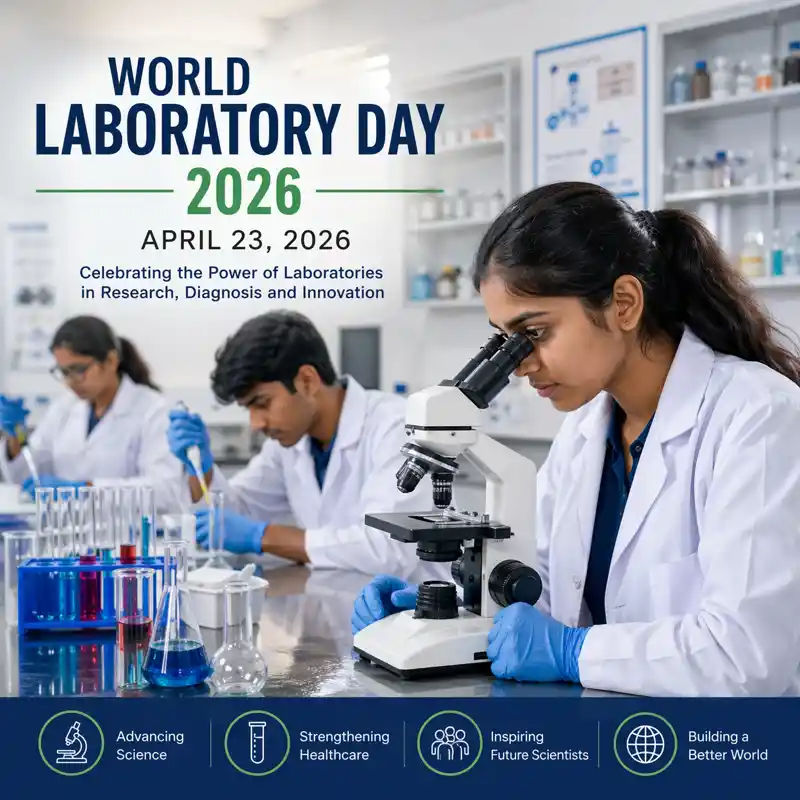

International University, Nagaland (IUN), will observe World Laboratory Day 2026 on April 23 with a campus programme designed to bring students closer to the real-world value of laboratory science. The event will begin at 10 a.m. at the university’s 6th Mile campus in Dimapur and will be led under the aegis of the Department of Medical Laboratory Science.
Rather than treating the day as a routine academic observance, the university is using it as an opportunity to connect science education with public awareness. In a press release, registrar Dr. Roopam Bachhil and Director of Vocational Education Prof. Zavise Rume said the programme will combine expert interaction with student competitions, with the larger aim of encouraging scientific thinking and highlighting the role laboratories play in healthcare and research.
That makes the event timely. Laboratories rarely attract public attention in the way hospitals, universities or major research breakthroughs do, yet they sit at the centre of all three. Behind every reliable diagnosis, disease screening process, clinical investigation and scientific test is careful laboratory work carried out by trained professionals. World Laboratory Day offers a useful reminder that this work is not secondary to medicine and science; it is one of the foundations on which both depend.
IUN to combine expert interaction with inter-school participation
A major highlight of the programme will be the participation of Nungsangmeren Jamir, Microbiologist at the TB Culture & Drug Susceptibility Testing Laboratory, Naga Hospital Authority Kohima, who will attend as the resource person. His presence adds practical relevance to the event, especially for students interested in laboratory medicine, microbiology and public health.
The university has also planned inter-school competitions as part of the celebration. These include an Extempore Speech Competition and a Poster-Making Competition, both intended to encourage students to think beyond textbooks and engage with science as a living, applied field.
The poster-making competition will revolve around three themes: “Myths vs. Science in Healthcare,” “Fighting Emerging Diseases through Science,” and “Medical Laboratory Science: The Backbone of Diagnosis.” Each school has been asked to send three participants. Posters must be original and handmade, a requirement that gives the exercise more educational value by pushing students to develop their own ideas instead of relying on copied material.
Those themes reflect concerns that go far beyond the classroom. Misinformation in healthcare, the continuing challenge of emerging diseases and the often-overlooked importance of diagnostics are all issues that shape public life. By bringing them into a student competition, IUN is creating space for young participants to approach these subjects in a thoughtful and creative way.
The university has invited media representatives, educational institutions and the general public to attend the event, suggesting that the programme is intended not only for its own academic community but also for a wider audience. That broader outreach matters because public trust in science often grows when institutions open their doors and explain why scientific work matters in daily life.
Why laboratory science deserves more public attention
World Laboratory Day is observed annually on April 23 to recognise laboratories as essential spaces for discovery, testing and evidence-based progress. Laboratories support work across medicine, biology, chemistry, engineering, environmental science and industry. They are used to identify infections, confirm medical conditions, monitor public health threats, test materials, improve technologies and support research that can take years to deliver visible results.
In healthcare especially, laboratory systems are central to decision-making. Doctors rely on laboratory findings to detect disease, guide treatment and monitor recovery. Researchers depend on laboratory processes to validate hypotheses, develop diagnostic tools and understand how diseases spread. Public health agencies also depend on laboratory capacity to track infections and strengthen response systems. The World Health Organization’s overview of laboratory services highlights how laboratory networks remain critical to disease detection, surveillance and the delivery of safe, effective healthcare.
The value of a laboratory is not only in its equipment, but in the discipline behind it. Accuracy, consistency, trained personnel and ethical practice are what make laboratory results trustworthy. This is why observances like World Laboratory Day continue to matter. They help shift attention toward the people and systems that quietly support scientific progress every day.
For a university, the observance also has another role. It can encourage students to see science as something active and relevant rather than distant or abstract. Competitions, talks and theme-based activities create entry points for students who may not yet have considered careers in laboratory science, pathology, diagnostics, microbiology or biomedical research. Exposure at this stage can shape both interest and ambition.
In Nagaland, where educational outreach and scientific awareness can make a meaningful local impact, programmes like this help connect higher education with the wider community. A well-planned university event may appear modest on the surface, but its influence can extend well beyond one day if it prompts students to think differently about science, evidence and public health.
IUN’s World Laboratory Day 2026 programme does exactly that. By combining expert guidance, student participation and public engagement, it turns a global observance into a practical local initiative. The focus is not only on celebrating laboratories as places of research, but also on recognising them as spaces that support diagnosis, improve healthcare and strengthen society in ways many people rarely see. Readers looking for more science and public health coverage can also explore our related article on World Health Day.
Also read: Perth to Bunbury Train Services to Resume June 2026 After Australind Upgrade

Make Swikblog your go-to source on Google for reliable updates, smart insights, and daily trends.