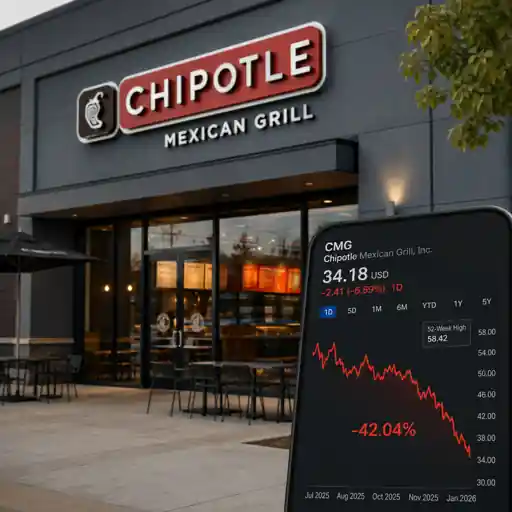

Chipotle Mexican Grill has moved from Wall Street favorite to a stock under pressure, after a sharp pullback erased a large portion of its recent gains. The fast-casual chain’s shares are now down about 42% from their 52-week high of $58.42, reached in July 2025, as investors question whether slowing sales and cautious guidance signal a temporary pause or a deeper reset in growth expectations.
The concern is not that Chipotle has suddenly become a weak business. The concern is that the company’s earlier valuation depended on near-perfect execution, steady traffic, and continued pricing power. Recent results have made that story harder to defend.
Chipotle’s Growth Story Faces a Reality Check
Chipotle reported a 2.5% decline in comparable restaurant sales for the fourth quarter of 2025, while full-year comparable sales slipped 1.7%. That is a notable shift for a company that has spent years convincing investors it could grow through a combination of new restaurants, loyal customers, digital ordering, and menu pricing.
The bigger issue came from management’s outlook. Chipotle guided for flat same-store sales in 2026, missing Wall Street expectations for roughly 1.8% growth. For a stock priced like a premium growth company, flat comparable sales are difficult for the market to ignore.
The immediate reaction showed how sensitive investors have become to even small cracks in the story. Shares fell around 7% in after-hours trading after the update, adding to a broader slide that has pushed the stock near the mid-$30 range.
Chipotle’s challenge is tied closely to the consumer. Lower- and middle-income customers are facing pressure from higher living costs, and many are becoming more selective about where they spend money. A burrito bowl that once felt like an easy lunch choice can look expensive when household budgets are tight.
This does not mean customers are abandoning Chipotle. It means the company may no longer have the same freedom to raise prices without risking slower traffic. That is an important change because pricing power has been one of the biggest reasons investors assigned Chipotle a premium valuation for years.
Industry data from the U.S. Census Bureau retail sales reports also shows why restaurant investors are watching consumer spending closely. When discretionary demand weakens, restaurant traffic and value perception become much more important than brand strength alone.
Expansion Plans Still Give Chipotle a Long Runway
Even with weaker comparable sales, Chipotle is not standing still. The company still plans to open 350 to 370 new restaurants in 2026, mostly in the United States. That level of expansion supports annual unit growth of roughly 8% to 10%, which remains impressive for a chain of Chipotle’s size.
The company’s Chipotlane format is another important part of the growth plan. Chipotle reached its 1,000th Chipotlane milestone in late 2024, and management has said restaurants with these digital pickup lanes tend to generate stronger volumes and better returns. At least 80% of new restaurant openings are expected to include a Chipotlane, making the format central to the company’s future store economics.
Chipotle is also looking beyond the U.S. market. Development agreements in the Middle East, along with expansion efforts in Canada and Europe, give the company long-term optionality. International growth remains early, but it could become more meaningful if domestic sales trends remain uneven.
Management has also set ambitious longer-term targets, including $16.1 billion in revenue and $2.0 billion in earnings by 2029. Those goals suggest confidence that the brand can continue scaling, but investors will want proof that new restaurants can perform well without relying too heavily on price increases.
Shareholder returns remain part of the story too. Chipotle’s board authorized an additional $1.8 billion in share repurchases in December 2025, leaving roughly $1.85 billion in remaining buyback capacity at that time. Buybacks can support earnings per share, but they cannot replace the need for stronger traffic and healthier same-store sales.
Is CMG Stock a Buy After the 42% Drop?
The 42% decline makes Chipotle look more attractive than it did near its peak, but cheaper does not automatically mean cheap. The stock still carries high expectations because investors continue to view Chipotle as one of the strongest brands in fast casual dining.
The bull case is clear. Chipotle has a powerful brand, strong restaurant economics, a proven digital ordering system, and a long runway for new locations. If consumer pressure eases and traffic stabilizes, the stock could regain investor confidence over time.
The bear case is also credible. Flat same-store sales, weaker traffic, and customer resistance to higher menu prices could keep earnings growth under pressure. If margins tighten or the company needs more promotional activity to protect traffic, the recovery may take longer than many investors expect.
For long-term investors, the current price may be suitable for gradual accumulation rather than aggressive buying. A dollar-cost averaging approach could make sense for those who believe Chipotle can reach its 2029 targets and expand successfully outside its core U.S. market.
For short-term traders, the setup is less straightforward. Until same-store sales improve or management offers stronger evidence of traffic recovery, the stock could remain volatile. A further test of the low-$30 range would not be surprising if market sentiment toward consumer stocks weakens.
Investors following restaurant and consumer stocks can also compare Chipotle’s setup with broader market trends through our stock market News coverage.
Chipotle remains a high-quality company, but the market is no longer giving it unlimited benefit of the doubt. The next phase of the stock story will depend less on how many new restaurants the company opens and more on whether customers keep showing up often enough to justify its premium valuation.
You may like: Alaska Air Stock Fuel Shock Analysis

Make Swikblog your go-to source on Google for reliable updates, smart insights, and daily trends.