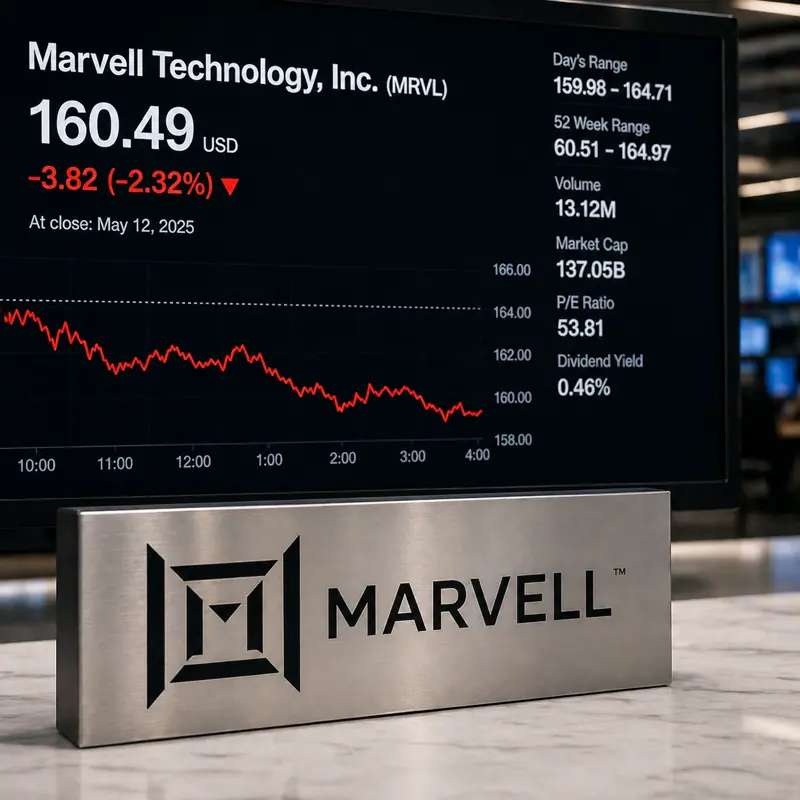

Marvell Technology, Inc. (NASDAQ:MRVL) moved lower on Monday, falling 2.32% to $160.49 as investors pulled back from semiconductor stocks after a strong stretch for AI-linked names. The drop did not come from a single negative company update. Instead, it looked more like a valuation reset in a stock that has already priced in a large part of the artificial intelligence growth story.
The move put Marvell in a familiar position for high-growth chip stocks: strong long-term demand, but short-term pressure from profit-taking. MRVL has been trading close to its 52-week high, and that often makes the stock more sensitive when the broader market cools or traders decide to reduce exposure after a rally.
Marvell’s latest decline also came despite a generally supportive backdrop for the chip industry. Taiwan Semiconductor Manufacturing Company (NYSE:TSM), one of the most important suppliers in the global semiconductor chain, reported Q1 2026 revenue of $35.90 billion and guided for Q2 revenue between $39.0 billion and $40.2 billion. TSMC also reported a Q1 gross margin of 66.2%, while its Q2 gross margin outlook stood between 65.5% and 67.5%, according to the company’s investor materials.
That matters for Marvell because TSMC’s numbers are often read as a signal for broader chip demand. When the world’s largest contract chipmaker points to strong revenue and margins, investors usually take it as confirmation that demand from AI, cloud computing, and advanced data-center customers remains healthy.
Still, Marvell’s stock reaction shows that good industry data does not always protect a highly valued stock from a pullback. The market is becoming more selective inside semiconductors. Investors are still willing to pay for AI growth, but they are also asking whether share prices have already moved too far ahead of earnings.
MRVL’s valuation is one reason for that caution. Recent market data showed Marvell trading at a price-to-earnings ratio of about 53.81x, above the industry peer average of roughly 50.84x. That premium is not extreme for a company tied to AI infrastructure, but it does mean investors expect Marvell to deliver strong growth over the next several years.
Wall Street remains broadly constructive on the company. On April 13, B. Riley raised its price target on Marvell to $156 from $135 and maintained a Buy rating. The firm pointed to strength in the semiconductor supply chain, including TSMC’s improved outlook, as a positive read-through for Marvell’s business.
RBC Capital has also taken a bullish view, lifting its price target on MRVL to $170 from $115 while maintaining an Outperform rating. That call was tied partly to rising confidence around AI infrastructure spending and the potential benefits for suppliers connected to large cloud platforms. Stifel and Oppenheimer have also been cited among firms with a more upbeat stance on Marvell’s AI-driven outlook.
The main reason analysts continue to watch Marvell closely is its position in data infrastructure. The company is not just another chip designer chasing the AI trend. Its portfolio includes custom silicon, ethernet controllers, data processing units, optical connectivity, switching, photonics, storage-related chips, security solutions, and other components used to move and process data across cloud and enterprise networks.
That role has become more important as AI workloads grow larger. Training and running advanced AI models requires enormous amounts of data to move quickly between processors, memory, servers, and storage systems. Faster chips are only part of the equation. Data centers also need high-speed interconnects and networking systems that can reduce bottlenecks and improve power efficiency.
Marvell’s April 22 acquisition of Polariton Technologies fits directly into that strategy. Polariton develops high-speed, low-power plasmonics-based silicon photonics devices. Marvell said the acquisition adds advanced modulation capabilities and a specialized engineering team to support its optical roadmap. The company also said the technology can help scale optical performance to 3.2T and beyond, a key benchmark for next-generation AI and cloud infrastructure.
The financial terms of the Polariton deal were not disclosed, which means investors do not yet have a clear near-term revenue contribution to model. But strategically, the acquisition strengthens Marvell’s position in optical interconnects, an area expected to become more important as AI clusters demand higher bandwidth and lower power consumption.
Marvell’s own investor messaging also reflects this shift. The company describes its portfolio as focused on accelerated infrastructure across compute, connectivity, and storage, with AI as a major growth driver. Its technology is used across data center, cloud, carrier, enterprise, and network-edge markets, giving the company multiple ways to benefit from rising data traffic.
Compared with other major semiconductor names, Marvell sits in a different part of the AI stack. Nvidia (NASDAQ:NVDA) remains the dominant name in AI accelerators. Broadcom Inc. (NASDAQ:AVGO) is heavily exposed to custom silicon and networking. Advanced Micro Devices, Inc. (NASDAQ:AMD) is trying to expand its AI accelerator business. TSMC (NYSE:TSM) manufactures advanced chips for many of the biggest players. Marvell’s opportunity is centered more on connectivity, custom silicon, and data movement inside high-performance infrastructure.
That positioning gives MRVL a clear long-term growth story, but it also raises the bar. Investors now expect Marvell to turn AI demand into stronger revenue, improved margins, and larger design wins. If that happens, the current valuation may look easier to justify. If growth disappoints, the stock could remain vulnerable to sharp pullbacks, especially after strong rallies.
Monday’s 2.32% drop to $160.49 therefore looks less like a rejection of Marvell’s AI story and more like a pause after a powerful run. The company still has several supportive factors: analyst targets as high as $170, stronger sector signals from TSMC, a strategic optical technology acquisition, and rising demand for AI data-center connectivity.
At the same time, investors have reasons to stay cautious. The stock is trading near elevated levels, its valuation is above the industry average, and much of the AI optimism may already be reflected in the share price. That combination can create volatility even when the business outlook remains healthy.
For now, Marvell remains one of the more closely watched semiconductor stocks tied to AI infrastructure. The stock’s fall shows that the market is no longer rewarding every chip name equally, but the broader story around MRVL remains intact: strong demand, aggressive analyst expectations, and a business model increasingly tied to the future of cloud and AI data movement.
Investors will now be watching whether Marvell can convert its Polariton acquisition, custom silicon pipeline, and optical connectivity portfolio into measurable growth. Until then, MRVL may continue to trade between two competing forces: the excitement around AI infrastructure and the pressure of a valuation that already assumes a lot of success.
Key stats: Marvell Technology (NASDAQ:MRVL) fell 2.32% to $160.49. B. Riley raised its MRVL target to $156 from $135. RBC Capital lifted its target to $170 from $115. TSMC (NYSE:TSM) reported Q1 2026 revenue of $35.90 billion and guided Q2 revenue between $39.0 billion and $40.2 billion.
For official company details, investors can review Marvell’s investor relations page at Marvell Technology Investor Relations and TSMC’s latest quarterly results at TSMC Investor Relations.
For more stock market updates and semiconductor analysis, visit Swikblog.
You may like: Domino’s (DPZ) Stock Falls as Q1 Earnings Miss Despite 0.9% Sales Growth

Make Swikblog your go-to source on Google for reliable updates, smart insights, and daily trends.