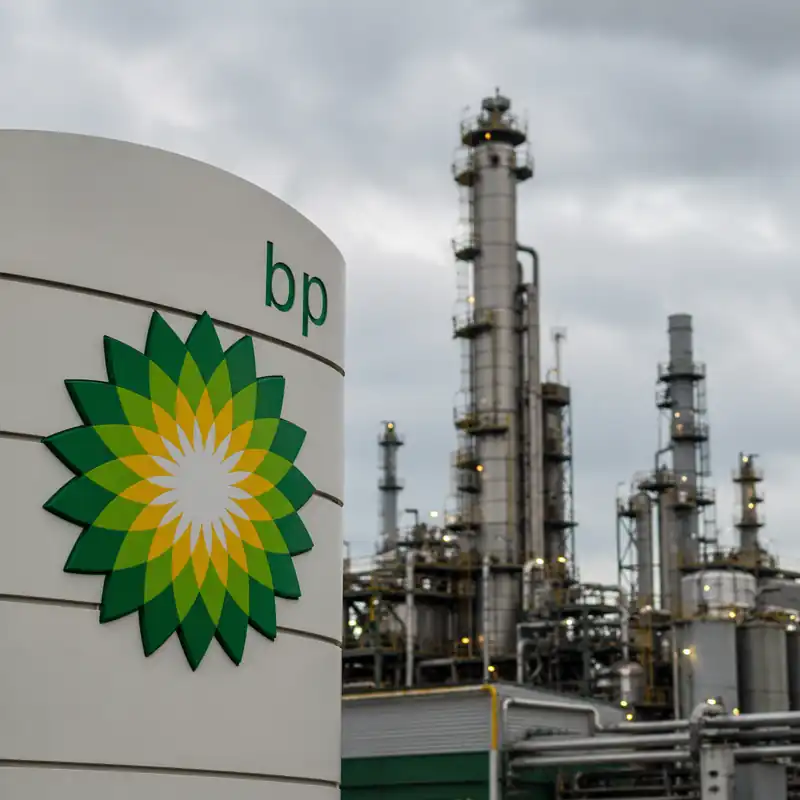

BP.L shares moved slightly higher in London trading on Tuesday after BP delivered a stronger-than-expected first-quarter profit, helped by a sharp rise in crude prices and a powerful performance from its oil trading business during a period of heavy geopolitical disruption.
The FTSE 100 energy major reported underlying replacement cost profit of $3.2 billion for the first quarter of 2026, more than doubling from $1.38 billion in the same period last year. The result also improved sharply from $1.54 billion in the previous quarter and came in ahead of analyst expectations of about $2.67 billion.
For investors watching BP.L, the latest earnings update was less about production growth and more about how quickly a large integrated oil company can benefit when energy markets become volatile. Crude prices climbed during the quarter as the Iran war disrupted supplies and raised concerns over flows through the Strait of Hormuz, one of the world’s most important routes for oil and liquefied natural gas.
BP’s trading operation was the clear standout. Its customers and products division, which includes oil trading, posted profit of around $2.5 billion. That compares with $1.4 billion in the previous quarter and only $103 million a year earlier. The scale of that increase shows how much the company gained from rapid price moves across global energy markets.
Oil traders typically benefit when prices swing sharply between regions, contracts and delivery periods. In BP’s case, the company described the quarter as having an “exceptional” contribution from oil trading, a signal that market dislocation played a bigger role than normal in lifting earnings.
BP’s statutory numbers also showed a major rebound. Profit attributable to shareholders reached $3.8 billion, compared with a $3.4 billion loss in the previous quarter and a profit of $687 million a year earlier. That turnaround gives the company more room to defend shareholder payouts, although debt remains an important part of the story.
Net debt rose to $25.3 billion at the end of the quarter, up from $22.2 billion at the end of 2025. BP said cash generation was lower, while capital expenditure stood at around $3.3 billion. Operating cash flow came in at $2.9 billion, meaning investors will continue to watch how quickly the company can reduce leverage while maintaining dividends and investment spending.
The dividend was held at 8.32 cents per share, a move that may reassure income-focused shareholders after a volatile period for the wider energy sector. BP has also reiterated its plan to bring net debt down to between $14 billion and $18 billion by 2027, a target that remains central to management’s credibility with investors.
Tax was another key detail in the update. BP said its North Sea taxable profits faced a headline tax rate of 78%, reflecting the UK’s energy profits levy. However, the company’s overall effective tax rate fell to 43%, compared with 69% in the same quarter last year.
Operationally, the company continued to run at strong reliability levels. Upstream plant reliability improved to 95.7%, while refining availability reached 96.3%, slightly above BP’s target. Production was broadly flat, with stronger output from the Gulf of America and BP’s US onshore business helping offset disruption in the Middle East and the impact of a North Sea disposal.
Chief Executive Meg O’Neill said BP is moving in the right direction as it works to simplify the business, strengthen the balance sheet and improve returns. Her comments come at a crucial point for the company, which is trying to balance investor demand for cash returns with pressure to manage long-term energy transition risks.
The latest quarter also arrives shortly after BP faced shareholder unrest, adding extra attention to its execution under new leadership. A large profit beat may calm some concerns in the near term, but the market will likely judge the company on whether it can repeat strong cash generation without relying too heavily on crisis-driven oil volatility.
BP has already warned that the second quarter may be weaker. Management expects lower upstream production because of maintenance and continued disruption in the Middle East. Refining throughput is also expected to fall due to planned turnaround activity, which could reduce the benefit from strong margins.
For the full year, BP expects production to remain broadly flat compared with 2025. Earnings are likely to remain sensitive to oil prices, supply costs, refining margins and geopolitical developments. That makes BP.L a stock closely tied not only to crude prices but also to how long the current energy disruption lasts.
For readers tracking broader market moves, BP’s update fits into a wider pattern across global energy stocks. Oil majors with strong trading desks can outperform during periods of supply stress, while companies with weaker balance sheets or heavier refining exposure may see more uneven results. More market coverage can be found in Swikblog’s finance and stock market section.
Investors may also want to follow official company filings and market releases through the London Stock Exchange BP company page, which provides share price data, announcements and regulatory updates for BP.L.
For now, BP.L remains in focus because the company has shown how quickly earnings can expand when crude prices rise and trading conditions turn favorable. The challenge is whether BP can convert this profit surge into lasting balance-sheet improvement while navigating a weaker second-quarter outlook and an uncertain oil market shaped by conflict, supply risk and shifting investor expectations.
You may like: Rivian Stock Rises as R2 SUV Production and $1.25B Robotaxi Deal Boost Outlook

Make Swikblog your go-to source on Google for reliable updates, smart insights, and daily trends.