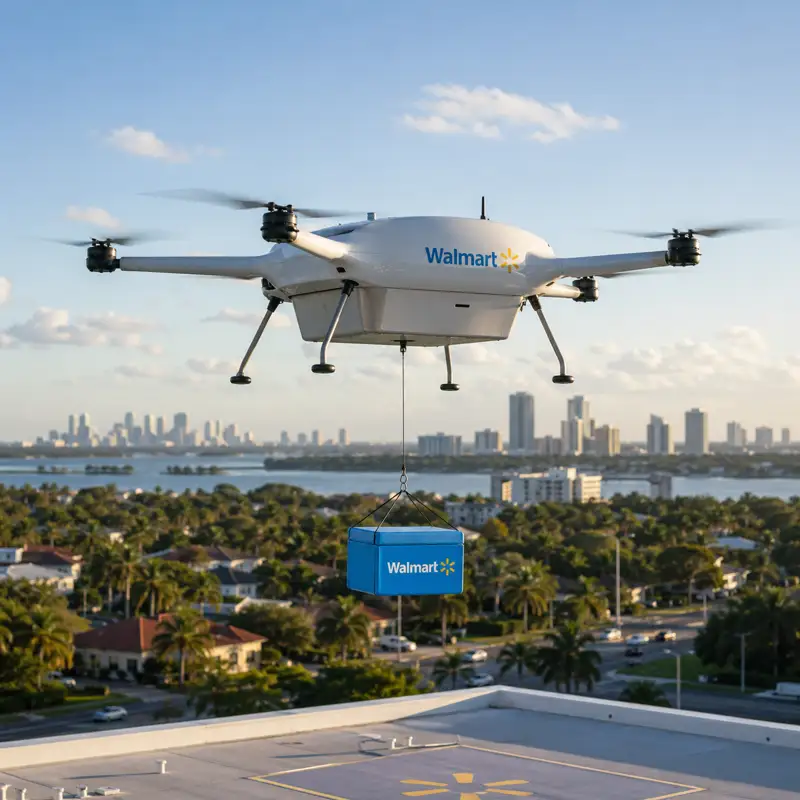

Walmart’s drone delivery push is beginning to look less like a futuristic trial and more like the next stage of U.S. retail logistics. The company is preparing to expand its partnership with Alphabet-owned Wing into more American markets, with Florida becoming one of the most important regions in the rollout. Miami is expected to be part of the next wave, with a launch planned for 2027 as Walmart works to connect stores, customers and faster delivery technology in a more practical way.
The move comes as shoppers increasingly expect speed without giving up convenience. Walmart already has a strong physical store network, and that gives it a major advantage in same-day and short-distance delivery. Drone delivery adds another layer to that strategy by allowing small orders to move directly from nearby stores to homes without relying entirely on road traffic, drivers or traditional delivery routes.
Walmart and Wing have already brought drone delivery to markets including Atlanta, Charlotte, Dallas-Fort Worth and Houston. Now, the companies are looking toward a broader coast-to-coast expansion that includes Florida cities such as Miami, Orlando and Tampa, along with other major markets including Los Angeles, Cincinnati and the Bay Area. According to Wing’s official updates, the expanded partnership aims to scale drone delivery access across more U.S. communities.
For Miami, the planned 2027 launch could be an important moment. South Florida has a mix of dense neighborhoods, suburban communities, busy roads and a strong demand for convenience shopping. That makes it a useful market for testing whether drone delivery can work at scale in a real urban environment. A recent demonstration at CoMOTION Miami at Miami Dade College’s Wolfson Campus showed how Walmart and Wing expect the system to operate when the service arrives in the region.
The drones are built for small, time-sensitive orders. They weigh just over 11 pounds and can fly at speeds of up to 60 mph while cruising around 150 feet above the ground. When they reach the delivery point, they do not need to land. Instead, the drone hovers at about 23 feet and lowers the package gently using a tether. This approach is meant to keep the aircraft away from people, pets, cars and yards while still allowing customers to receive items quickly.
The service is not meant to replace a full grocery trip. Its strength is speed for everyday essentials. Eligible Walmart products can include grocery items, household goods and over-the-counter medicine. That could make the service useful for customers who need a missing dinner ingredient, cold medicine, baby supplies, batteries, personal care products or another small item without making a last-minute store run.
Central Florida may also play a major role in Walmart’s drone delivery plans. In Seminole County, officials are reviewing a proposal for a drone delivery operation at a Walmart near State Road 426 and Deep Lake Road, close to Oviedo. The plan includes a drone nest that would support operations, storage and charging for multiple drones. The area would also be enclosed with security fencing to keep the operation controlled and separated from regular customer access.
Local approval will be an important part of how quickly drone delivery expands. Even as the technology improves, companies still need to work with counties and cities on zoning, safety, site design and community concerns. Residents will likely want clear answers on noise, privacy, flight paths and how often drones may operate near homes. Walmart and Wing’s ability to address those issues will help determine whether the service becomes widely accepted.
The bigger story is Walmart’s fight for the last mile. Retailers are competing not only on price, but also on how quickly they can get products to customers. Amazon has invested heavily in drone and fast delivery technology, while companies such as DoorDash, Instacart and Uber have changed how consumers think about quick orders. Walmart’s advantage is that many of its stores are already close to millions of households. By turning more stores into fulfillment points, the company can make faster delivery more efficient.
Walmart is also remodeling stores and expanding online pickup and delivery capacity in South Florida and other regions. Drone delivery fits naturally into that broader strategy. A customer may still walk the aisles for a weekly shop, use pickup for a planned order, or choose drone delivery when life gets busy and a small item is needed quickly. The goal is not one shopping method replacing another, but a more flexible retail system built around customer habits.
There are still limits. Drone delivery depends on weather, airspace rules, payload size and local infrastructure. Not every customer will live inside a delivery zone, and not every product will qualify. Heavy items, large grocery baskets and many household products will still need traditional delivery or pickup. But for smaller orders, the service could reduce friction and make Walmart more competitive in convenience retail.
For more retail and business updates, readers can follow Swikblog, where we cover major changes in companies, markets and consumer trends shaping the economy.
If Walmart can make drone delivery reliable in Florida, the company may prove that the technology is no longer just a headline-grabbing experiment. Miami’s planned 2027 launch, combined with possible operations in Central Florida, shows how seriously Walmart is treating aerial delivery. The next test will be whether customers use it often enough to make drones a normal part of local shopping.
Florida could become one of the clearest examples of that shift. If the rollout succeeds, Walmart’s drones may soon be seen less as a novelty in the sky and more as another delivery option for everyday essentials.
You may like: Amazon Under Pressure as Walmart Expands Same-Day Delivery in the US

Make Swikblog your go-to source on Google for reliable updates, smart insights, and daily trends.