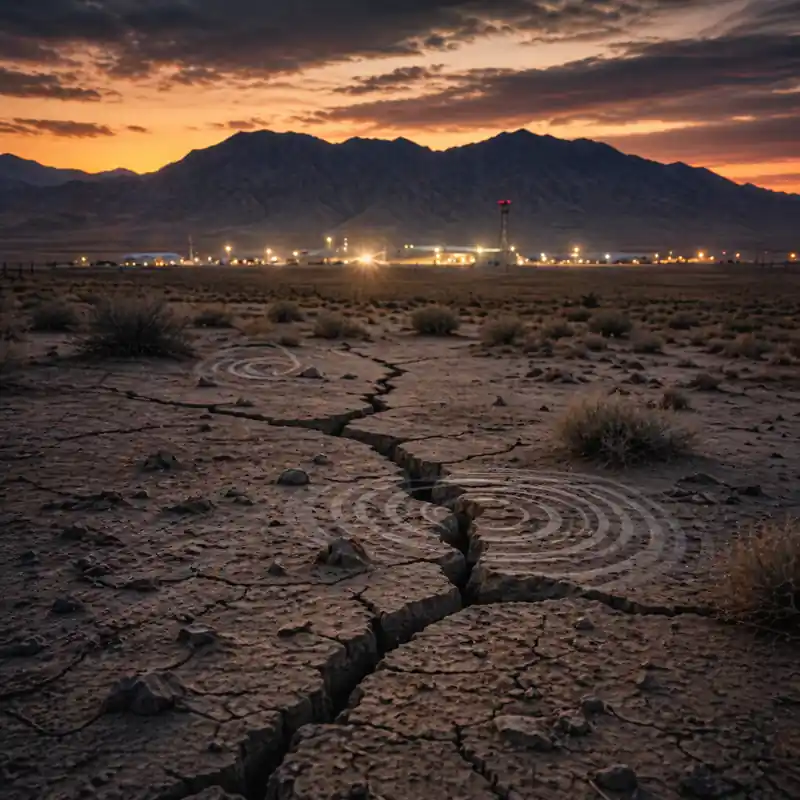

A series of small earthquakes near Nevada’s restricted Area 51 region has renewed public interest in the desert base and the geology beneath it. Seventeen tremors were reported in a 24-hour period around the highly monitored military zone, with the strongest event measured at magnitude 4.4. The shaking was felt by more than 100 people, according to reports based on seismic data, while most of the later events were weaker aftershocks or smaller companion tremors.
The location of the activity is what turned a regional earthquake update into a national talking point. Area 51 has spent decades at the center of military secrecy, aircraft testing, UFO folklore and online conspiracy theories. So when the ground moved repeatedly near the base, the public reaction quickly moved beyond geology and into questions about underground activity, classified testing and the facility’s still-secret operations.
Why the Nevada earthquake swarm drew attention
Earthquake swarms are not automatically unusual. They happen when multiple quakes occur close together in time and location, often without one clearly dominant mainshock. Nevada is also one of the more seismically active states in the U.S. because it sits within the Basin and Range region, where the Earth’s crust is slowly stretching and breaking along faults.
Still, this particular sequence stood out because of where it happened. The initial tremor was reported at a shallow depth of about 2.5 miles, which can make shaking easier to notice at the surface. A magnitude 4.4 quake is not typically destructive, but it is strong enough to be felt across nearby communities, especially in remote desert terrain where even moderate seismic activity can attract attention.
The U.S. Geological Survey earthquake program tracks quake locations, magnitudes and depths across the country, giving scientists a clearer picture of whether an event is isolated or part of a broader pattern. In this case, the cluster of 17 events created enough curiosity for experts and observers to examine whether the shaking followed a typical natural pattern.
Some geophysicists have noted that the area is not usually known for frequent earthquake clusters compared with other parts of Nevada. That does not mean the swarm was artificial, but it does explain why the event attracted extra scientific and public attention. In earthquake science, location, depth, waveform and sequence pattern all matter when trying to understand what caused the ground to move.
Natural fault movement remains the strongest explanation
The most likely explanation remains natural seismic activity. Nevada’s crust is under ongoing tension, and stress can shift suddenly along old or hidden faults. When that happens, a swarm of smaller earthquakes may follow as the crust adjusts. These clusters can appear dramatic on a map, but they are often part of normal tectonic behavior.
The Area 51 connection, however, makes the story more complicated in the public imagination. Underground explosions, mining activity or military tests can also create seismic signals, and experts sometimes compare waveforms to separate natural earthquakes from human-made events. That process requires careful analysis, not speculation.
At this stage, there is no confirmed evidence that the Nevada swarm was caused by covert underground testing. The stronger, evidence-based interpretation is that the quakes were related to stress changes along fault systems in an active geological region. Still, because the activity occurred near one of the most secretive military locations in the world, the debate was almost guaranteed to spread online.
Area 51’s secrecy keeps every event under the spotlight
Area 51, located at Groom Lake in Nevada, was created in the 1950s as a remote testing ground for advanced U.S. aircraft. It became closely linked to Cold War aviation programs, including the U-2 spy plane, the A-12 Oxcart and later stealth aircraft development. For years, the government said little publicly about the site, which helped turn it into a symbol of secrecy.
That secrecy also helped fuel UFO stories. For decades, unusual aircraft tested in the Nevada desert were sometimes mistaken for unidentified flying objects. Later declassified records showed that some public confusion over UFO sightings overlapped with classified aviation work. As a result, even ordinary events near Area 51 can quickly become part of a much larger cultural narrative.
The latest swarm followed that familiar pattern. Some online users questioned whether underground military activity could be involved, while others joked about aliens shaking the desert floor. The humor may be light, but it reflects how deeply Area 51 is embedded in popular culture. Few other military sites can turn a moderate earthquake cluster into a viral mystery.
A separate recent incident involving a YouTuber who bought a small plot of land near the Area 51 boundary has added to the renewed attention. The land, reportedly near the Rachel Gate, sits outside the restricted zone but close enough to highlight the heavy security presence around the base. During his visit, he described being watched by a white Ford F-150 security vehicle and seeing F-16 fighter jets fly overhead.
Such patrols and military flights are not surprising near an active defense installation. The surrounding region includes restricted land and airspace, and security teams regularly monitor visitors who approach the perimeter. However, the incident shows why Area 51 remains so compelling to the public: even activity outside the fence can feel like part of a larger mystery.
What happens next
For scientists, the next step is continued monitoring. If the swarm fades, it will likely be treated as a short-lived natural sequence. If more tremors follow, researchers may study the area more closely to identify the fault structure involved and determine whether stress is migrating underground.
For the public, the story is likely to remain a mix of science, secrecy and speculation. The earthquake data points toward a natural event, but the location ensures that questions will continue. Area 51’s history makes that unavoidable.
The most responsible conclusion is also the simplest one: Nevada is earthquake country, and swarms can happen. But when 17 tremors occur near a base known for classified aircraft, strict security and decades of secrecy, even a geological event becomes a national conversation.
You may like: Amazon AWS Data Centers Hit by Drone Strikes in UAE & Bahrain, Cloud Disruptions Spread

Make Swikblog your go-to source on Google for reliable updates, smart insights, and daily trends.