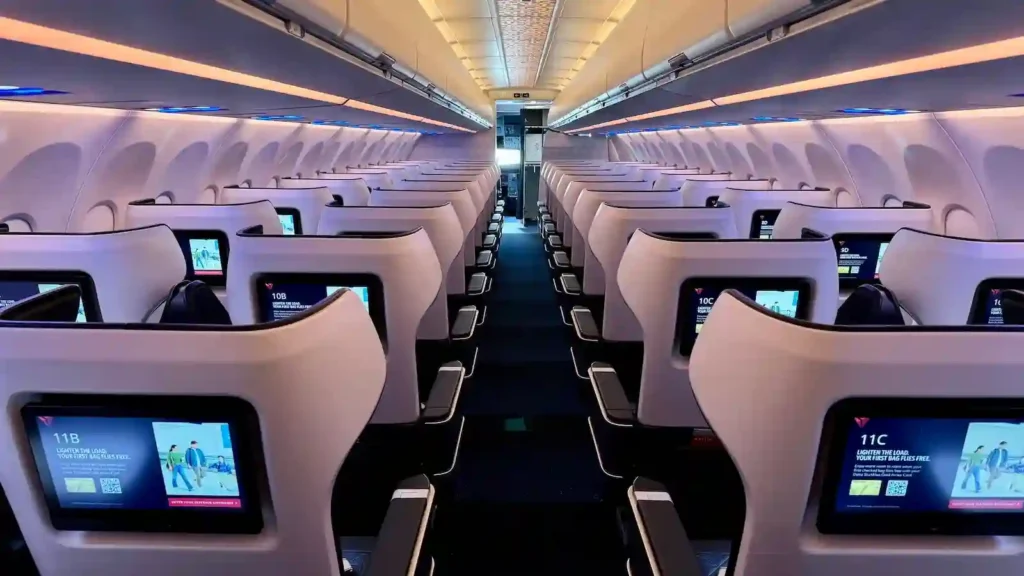

Delta Air Lines is preparing to put a very unusual Airbus A321neo into regular passenger service, and the cabin layout is already drawing attention from frequent flyers. The aircraft will carry 44 domestic first-class recliner seats, a figure that is far above what travelers normally see on a single-aisle jet in the U.S.
The layout is not just a small upgrade or a few extra premium rows. Delta has effectively turned the front half of the aircraft into a large first-class cabin, with 11 rows of recliners arranged in a 2-2 setup. On many domestic aircraft, first class ends after a handful of rows. On this A321neo, it stretches far deeper into the plane, making the premium cabin the main story of the aircraft.
The move comes as Delta works around delays tied to its planned lie-flat business-class seats for select Airbus A321neo aircraft. Those jets were originally expected to receive a more premium long-haul-style cabin, but the intended seats have not been ready for service. Rather than leave new aircraft sitting idle, Delta has chosen a temporary configuration that can be flown during the busy summer schedule.
According to Delta Air Lines’ official announcement, the airline will place seven A321neo aircraft into service with this expanded Delta First layout before the aircraft are later reconfigured with the originally planned premium product.
Delta’s Temporary A321neo Layout Shows a Bigger Industry Shift
The new Delta A321neo configuration will carry 164 passengers in total. That includes 44 First Class seats, 54 Comfort+ seats and 66 Main Cabin seats. By comparison, Delta’s standard Airbus A321neo layout has 194 seats, including 20 First Class seats, 60 Comfort+ seats and 114 Main Cabin seats.
That means Delta is removing 30 total seats from the aircraft, but the real change is where those seats are disappearing. The Main Cabin is being reduced sharply, while First Class more than doubles. For passengers, this shows how much airline economics have shifted toward premium demand.
Airlines once focused heavily on packing more economy seats into narrowbody aircraft. Now, major carriers are increasingly trying to sell more premium seats, extra-legroom rows and upgraded cabin products. Delta’s 44-seat First Class A321neo is an extreme example of that strategy, even if the airline describes it as a temporary solution.
The aircraft is expected to begin flying from Atlanta to major West Coast markets, including Los Angeles, San Francisco, Seattle and San Diego. These are not random routes. They are long domestic sectors with strong business traffic, premium leisure demand and large numbers of elite frequent flyers.
That route choice matters. A 44-seat First Class cabin would be difficult to justify on many short or lower-yield routes. But on Atlanta-to-West Coast flights, Delta has a better chance of filling a large number of premium seats through paid bookings, upgrades and corporate travel demand.
Swikblog recently covered a similar premium-cabin trend in Air Canada Unveils 14 Lie-Flat Seats on A321XLR in Major Premium Travel Push, where another airline is using narrowbody aircraft to target higher-paying long-haul passengers.
What Makes This Aircraft So Different
The most striking part of Delta’s new layout is the scale of the front cabin. Standard Delta A321neo aircraft have five rows of First Class. The temporary premium-heavy version has 11 rows. That gives the aircraft 44 First Class recliners, compared with 20 on the current layout.
Comfort+ also changes, but less dramatically. The extra-legroom section drops from 60 seats to 54. The biggest cut comes in Main Cabin, where the seat count falls from 114 to just 66. That leaves regular economy occupying a much smaller share of the aircraft than usual.
The temporary layout looks like this:
- First Class: 44 recliner seats across 11 rows
- Comfort+: 54 extra-legroom seats
- Main Cabin: 66 standard economy seats
- Total capacity: 164 passengers
The final planned layout is expected to look very different. Once Delta receives certification and completes installation of its lie-flat premium seats, the aircraft are expected to move toward a three-class configuration with 16 lie-flat business-class suites, 12 premium economy seats, 54 Comfort+ seats and 66 Main Cabin seats.
That future layout explains why the temporary version has such an unusual structure. Delta appears to be using the cabin space that was intended for a more premium product, but filling it for now with domestic First Class recliners instead of keeping the aircraft out of service.
Read More
- Visit Swikblog Homepage
- Marvel’s Wolverine Release Date PS5: September 2026
- CSIRO to Slash 350 Jobs Despite $387 Million Federal Funding Boost
- Palantir’s Viral $239 Chore Coat Sparks Backlash
- IKEA Garlic Press Recall Over Metal Fragment Risk
- Sydney Chinatown Golden Water Mouth Sculpture Removal Raises Heritage Concerns
For travelers, this creates a rare short-term opportunity. Some passengers may get access to a much larger premium cabin than usual, while elite members could see better upgrade chances if Delta does not sell every First Class seat on a given flight.
That point is especially important for Delta Medallion members. Complimentary upgrades have become harder to clear in recent years as airlines have become better at selling premium seats before departure. A 44-seat First Class cabin does not guarantee upgrades, but it does increase the number of premium seats available on those flights.
Service Will Be the Real Test
The cabin may look impressive on paper, but the passenger experience will depend on execution. Serving 44 First-class passengers on a narrowbody aircraft is not the same as serving five rows at the front of the plane.
Delta is expected to add a fifth flight attendant on these aircraft, with three crew members focused on the enlarged First Class cabin. The airline has also added extra oven capacity in the front galley so hot meals can be served to the larger premium section.
That will be important on long routes such as Atlanta to Los Angeles and Atlanta to Seattle, where passengers expect a more complete onboard service. Travelers paying for First Class will expect more than a bigger seat. They will expect efficient meal service, drinks, pre-departure attention and a smoother cabin experience.
The challenge is that the aircraft remains a single-aisle narrowbody. Galley space is limited, cabin movement can become crowded, and lavatory access may be watched closely by passengers. The aircraft reportedly has three lavatories in total, with one positioned at the front of the cabin. With 44 First Class passengers seated ahead of the rest of the aircraft, that could become one of the practical pressure points on longer flights.
Delta’s decision still makes business sense. New aircraft sitting in storage do not generate revenue. By putting these jets into service with a temporary cabin, the airline can add capacity on high-demand routes while keeping its premium strategy moving.
The bigger question is whether passengers will view this aircraft as a genuine upgrade or simply an unusual stopgap. If the service runs smoothly, Delta may earn goodwill from premium flyers and elite members. If meal timing, lavatory access or boarding feels strained, the large First Class cabin could become more controversial.
This is why the aircraft is more than just a seating oddity. It is a real-world test of how far U.S. airlines can push premium seating on narrowbody jets without weakening the onboard experience.
The timing also reflects where the airline industry is heading. Premium cabins are becoming more important across domestic and international networks. Carriers are chasing travelers who will pay more for comfort, flexibility and loyalty benefits, while standard economy cabins face tighter capacity decisions.
For Delta, the 44-seat First Class A321neo solves an immediate fleet problem and creates a highly visible premium product for major domestic routes. For passengers, it could mean more upgrade chances, more premium availability and a very different cabin experience on selected Atlanta flights.
Still, travelers should remember that this aircraft is not expected to be permanent in its current form. Delta’s long-term plan remains focused on installing lie-flat premium seats once certification and supply issues are resolved. That means this 44-seat First Class layout may become a short-lived but memorable chapter in Delta’s fleet strategy.
For more airline industry updates, read Swikblog’s coverage of Delta Cancels 400+ Flights as Delays Top 1,000 Amid Staffing Issues and United Airlines Expands Free Starlink Wi-Fi Rollout Across Fleet.

Make Swikblog your go-to source on Google for reliable updates, smart insights, and daily trends.