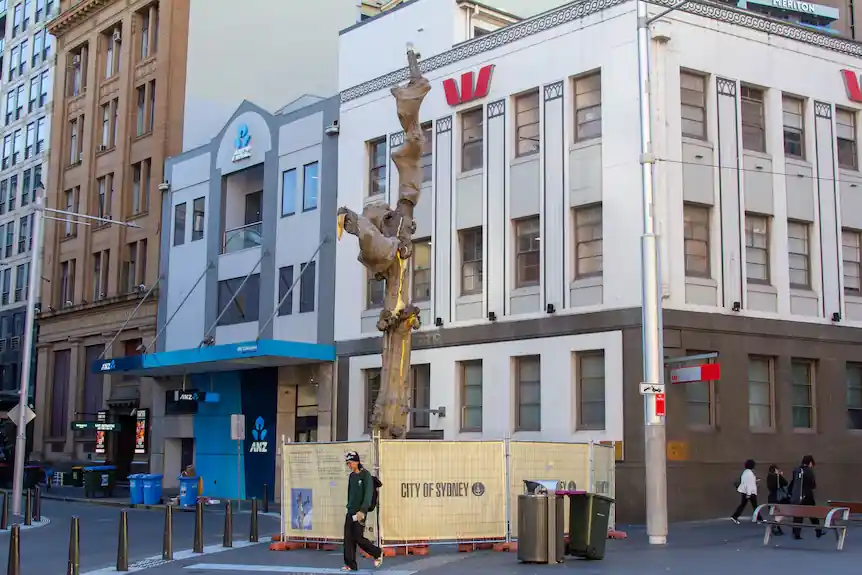

Sydney’s Chinatown is facing a sensitive cultural question as uncertainty grows over the future of the Golden Water Mouth sculpture, a public artwork that has stood at the corner of Sussex Street and Hay Street since 1999.
For visitors, the 10-metre-high tree sculpture may look like one of the many public artworks scattered through Sydney’s busy inner-city streets. For many Chinese-Australians, however, it is much more personal. The sculpture has long marked the informal entrance to Chinatown and has become a symbol of identity, memory and belonging for a community whose history in Australia stretches back generations.
The artwork has now been fenced off by the City of Sydney after concerns were raised about the condition of the timber structure. Council signage at the site points to structural integrity issues, while officials have said the natural timber is cracking and degrading, with evidence of termite activity.
The possibility that the sculpture may not remain in its current form has unsettled local community members, who fear Chinatown could lose one of its most meaningful landmarks without a proper replacement.
Why the Golden Water Mouth sculpture carries deep meaning
The Golden Water Mouth sculpture was created by the late artist Lin Li and reflects important ideas from Chinese culture and feng shui. The work brings together the five natural elements — fire, earth, water, gold and wood — through a design that is both artistic and spiritual.
One of its most distinctive features is the use of water, which flows down the tree and is circulated back through the sculpture. In feng shui, water is often linked with prosperity, movement and energy. At the entrance to Chinatown, that detail gave the artwork a stronger symbolic role than a standard city monument.
The tree used in the sculpture came from Condobolin in central-western New South Wales, a place connected to Chinese miners who travelled through regional Australia during the 19th century. That history gives the artwork a bridge between Sydney’s Chinatown and the wider Chinese-Australian story.
Long-time Chinatown figure George Wing Kee, who has worked in the area since 1946, said the tree was chosen because it represented resilience after surviving floods and fire. That symbolism has made the artwork especially powerful for older generations who see it as a reminder of the determination shown by Chinese migrants building lives in Australia.
Community advocate Kevin Cheng, co-founder of Soul of Chinatown, has said the possible removal feels like taking something from the “heart of Chinatown”. His concern is not only that the sculpture may be removed, but that nothing culturally meaningful may take its place.
That fear is understandable. Chinatown is not just a dining precinct or a tourist stop. It is a living cultural district shaped by family businesses, migration stories, festivals, language, food and public spaces that carry memory. When a landmark like Golden Water Mouth is placed at risk, the debate becomes about more than timber damage.
It becomes a question of how Sydney protects cultural identity while modernising its streets.
City renewal must not erase cultural memory
The City of Sydney has said all options are being considered, including keeping most of the artwork in place. Officials have also suggested that if removal becomes necessary, parts of the sculpture could be preserved elsewhere or remembered at the original site.
That approach may ease some concerns, but many locals want a stronger commitment. If the sculpture cannot be saved in full, they want any replacement to honour Lin Li’s original work, not simply fill the space with benches, signs or ordinary street furniture.
This comes at an important time for the precinct. The City of Sydney is investing around $44 million into the revitalisation of Haymarket and Chinatown, including improvements to public areas around Dixon Street. More details about the city’s broader work can be found through the City of Sydney.
Read More
Investment in Chinatown should be welcomed, especially if it supports local businesses, improves pedestrian spaces and brings more visitors into the area. But redevelopment can create tension when communities feel that heritage is being treated as decoration rather than a foundation.
For Chinatown, public art matters because it helps tell stories that may not be visible in shopfronts or street signs. The Golden Water Mouth sculpture speaks to migration, survival, prosperity and the spiritual traditions that shaped parts of the Chinese diaspora. Removing it without a thoughtful cultural response would risk weakening the character that makes the precinct distinct.
There is also an opportunity here. If the sculpture is unsafe and cannot remain exactly as it is, Sydney could use the moment to create a stronger public heritage experience. The site could include preserved elements from the original artwork, new interpretive signage, digital storytelling and input from Chinese-Australian artists, historians and community groups.
Such a response would allow the city to respect safety concerns while also showing that Chinatown’s cultural landmarks are not disposable.
It would also help visitors understand what the artwork represents. Many people walking through Haymarket may not know why the tree was installed, where it came from, or how it connects to Chinese miners in regional NSW. Better storytelling could turn the site into a richer cultural stop for tourists, students and locals.
The future of Golden Water Mouth remains uncertain, but the community response has already shown how deeply the sculpture is valued. Whether it is repaired, partly preserved or replaced with a new artwork, the outcome will send a clear message about how Sydney sees Chinatown’s past and future.
A city can renew its streets without losing its soul. For many in Sydney’s Chinese community, saving the meaning of Golden Water Mouth is now just as important as deciding what happens to the structure itself.

Make Swikblog your go-to source on Google for reliable updates, smart insights, and daily trends.