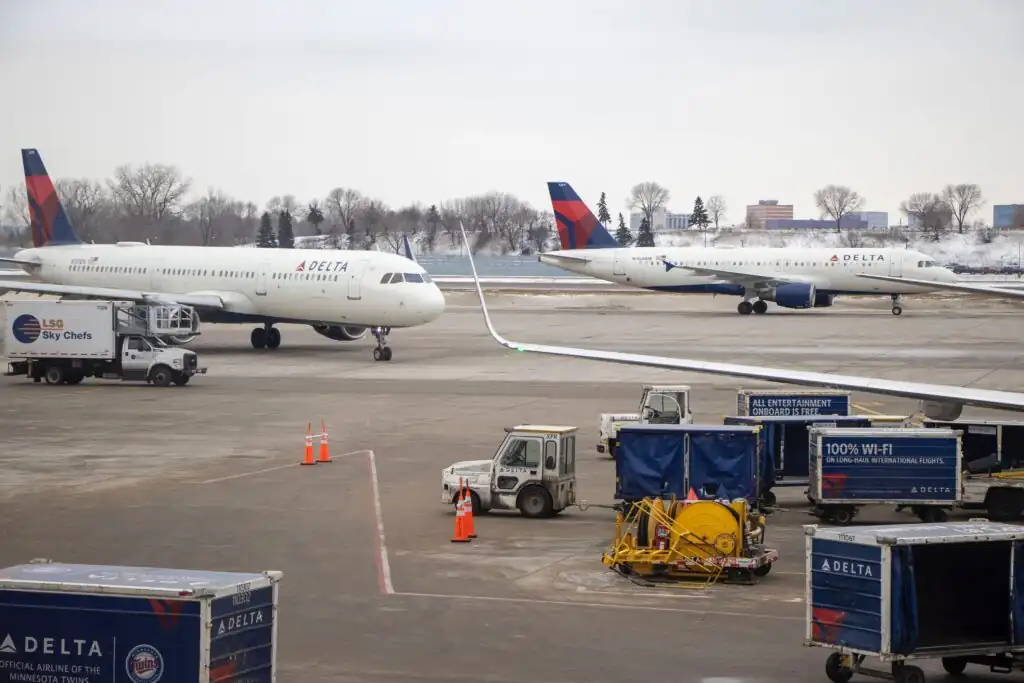

Delta Air Lines is dealing with a painful workplace tragedy after one of its ground employees was killed in a tug vehicle accident at Orlando International Airport on Thursday night, May 7, 2026. The incident happened during ramp activity at MCO and briefly forced the Atlanta-based airline to pause its Orlando operations while investigators responded.
The accident occurred at around 10:55 p.m. local time when an aircraft tug vehicle struck a jet bridge, according to reports from local and national outlets. The Delta employee involved in the collision died following the incident. The worker’s name has not been publicly released.
Aircraft tugs are powerful ground-support vehicles used to move planes around airport ramps, including pushing aircraft back from gates or towing them between gates, hangars and parking positions. A jet bridge is the enclosed movable walkway that connects a terminal gate to an aircraft door. Both are routine parts of airport operations, but the ramp area where they operate is one of the most tightly controlled and high-risk spaces in aviation.
Delta confirmed the employee’s death and said the company was focused on supporting the worker’s family and colleagues in Orlando.
“The Delta family is heartbroken at the loss of a team member while on the job at Orlando International Airport on the evening of May 7,” a Delta spokesperson said in a statement reported by PEOPLE.
The airline said it is cooperating with local authorities as they investigate how the collision happened. Officials have not announced a final cause, and no further details about the employee’s role or the condition of the tug vehicle have been released.
Delta Paused Orlando Operations After Fatal Ramp Accident
Delta temporarily stopped activity at its Orlando station after the accident so ground crews could cooperate with investigators. The suspension was limited, but it still affected the airline’s operation at one of Florida’s busiest airports.
Only one Delta flight was canceled during the pause, and affected passengers were rebooked on other airlines. Normal operations resumed by Friday afternoon, May 8, 2026.
Orlando International Airport also issued condolences after the fatal accident, describing the Delta employee as part of the airport’s extended aviation family.
“The Orlando International Airport community is deeply saddened about the loss of a team member from one of our airline partners, a member of our extended airport family,” an airport spokesperson said. “We send our condolences to his family and friends.”
MCO is a major Florida airport serving heavy domestic and international traffic. For Delta, the airport is an important East Coast station, connecting leisure and business travelers through one of the country’s most active travel markets.
The incident adds fresh attention to the risks faced by airline ground employees, who often work close to aircraft, baggage carts, fuel trucks, catering vehicles, passenger bridges and other heavy equipment. Unlike passengers, who mostly experience aviation through terminals and aircraft cabins, ramp crews work in a fast-moving environment where safety depends on visibility, training, communication and strict movement procedures.
According to the Occupational Safety and Health Administration, airline industry workplaces are covered by a range of safety standards related to equipment, working conditions and employee protection. Ground handling accidents are often reviewed through workplace-safety and aviation-operation lenses, depending on the exact circumstances.
Read More
- Visit Swikblog Homepage
- Marvel’s Wolverine Release Date PS5: September 2026
- CSIRO to Slash 350 Jobs Despite $387 Million Federal Funding Boost
- Palantir’s Viral $239 Chore Coat Sparks Backlash
- IKEA Garlic Press Recall Over Metal Fragment Risk
- Sydney Chinatown Golden Water Mouth Sculpture Removal Raises Heritage Concerns
Investigation May Focus on Training, Equipment and Ramp Procedures
Investigators are expected to examine several possible factors, including tug operation, employee positioning, visibility near the jet bridge, communication between ramp workers and the condition of the equipment involved. In similar workplace incidents, authorities may also review surveillance video, radio communications, maintenance logs, shift timing and safety procedures used during nighttime operations.
Night ramp work can carry added risk because crews must operate under artificial lighting while meeting tight departure and arrival schedules. Even when aircraft are parked, the surrounding gate area can remain active with service vehicles, baggage operations, maintenance checks and passenger-boarding equipment.
For airlines, a fatal ramp incident can lead to internal safety reviews beyond the airport where it happened. Carriers often examine whether local procedures need to be changed, whether employees require additional training, or whether equipment movement rules near gates and jet bridges should be tightened.
The Orlando accident is separate from Delta’s broader network disruptions reported earlier this year, but it comes during a period when airline operations remain under close scrutiny. Swikblog recently reported on Delta flight cancellations and delays linked to staffing issues, showing how operational pressure can quickly affect passengers across the network.
In this case, however, the main concern is not passenger disruption but the death of a worker during normal airport duties. The limited number of canceled flights shows that Delta restored service quickly, but the human impact on the employee’s family, colleagues and airport community is far greater than the operational delay.
Ramp workers play a critical role in keeping flights moving safely. They guide aircraft, move bags, operate ground equipment, handle towing tasks and support gate activity before passengers ever board. Their work is often physically demanding, time-sensitive and performed in noisy areas where communication must be clear and procedures must be followed closely.
As the investigation continues, Delta has not said whether it will make immediate changes to its Orlando ramp procedures. Any future updates will likely depend on the findings from local authorities and internal safety teams.
For now, the fatal accident at Orlando International Airport stands as a reminder that commercial aviation safety is not limited to pilots, aircraft systems and passengers. Much of the industry’s daily risk is carried by the workers on the ground, whose jobs keep flights operating but often place them closest to heavy equipment and moving aircraft support systems.

Make Swikblog your go-to source on Google for reliable updates, smart insights, and daily trends.