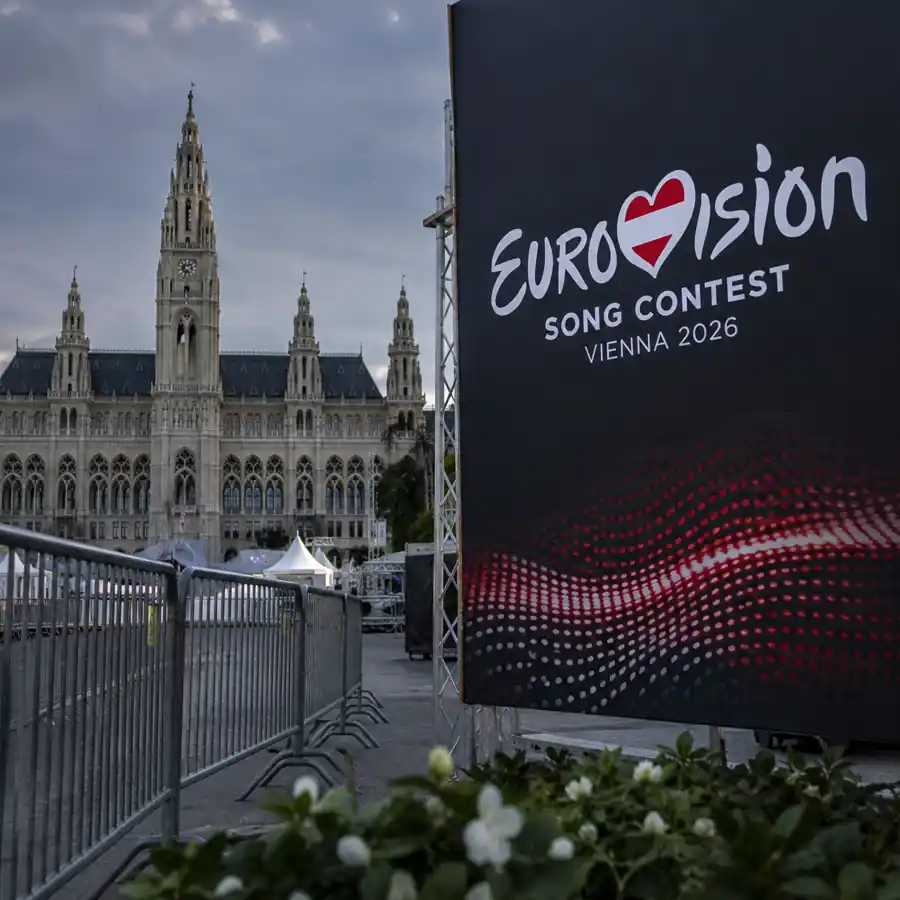

Israel’s place at Eurovision 2026 has turned a music contest into a test of how far cultural institutions are willing to go when war, public anger and politics collide. The 70th edition of the Eurovision Song Contest is scheduled to reach its grand final in Vienna on May 16, but the build-up has been dominated less by songs and more by the decision to allow Israel to compete despite growing calls for a ban.
Five countries — Ireland, Spain, the Netherlands, Slovenia and Iceland — are boycotting this year’s contest after the European Broadcasting Union, better known as the EBU, cleared Israel’s participation. Their broadcasters have pointed to the war in Gaza, the humanitarian crisis and concerns that the contest is being used for political messaging rather than cultural unity.
Israel will be represented by singer Noam Bettan with the pop song Michelle. But for many viewers and campaigners, the debate is not about one performer. It is about whether Israel should be given one of the world’s most watched entertainment platforms while its military campaign in Gaza remains under intense international scrutiny.
Why Israel Can Still Take Part in Eurovision
The reason Israel is allowed to compete starts with Eurovision’s structure. The contest is not officially a competition between governments. It is organised by the EBU and its member broadcasters. Israel takes part through KAN, the Israeli public broadcaster, which remains a member of the EBU.
That distinction matters. Eurovision eligibility is tied mainly to broadcaster membership and EBU approval, not simply to geography. Israel has competed in Eurovision since 1973 and has won the contest multiple times. It also hosted the event in Tel Aviv in 2019. The contest has never been limited strictly to European Union countries or even countries located fully inside Europe. Australia, for example, has also competed after being invited by the EBU.
The official Eurovision Song Contest website describes the event as a production of the EBU and participating broadcasters. That framework gives the EBU the authority to decide who remains eligible, and for now it has chosen not to suspend KAN.
The EBU has argued that Eurovision should remain a neutral cultural event and that the competition must not become a political battleground. It has also said additional safeguards are being used to protect the contest’s fairness and integrity, especially after concerns over voting patterns and political campaigning around Israel’s previous participation.
But the neutrality argument has not satisfied critics. The strongest criticism is that Russia was removed from Eurovision in 2022 after invading Ukraine, while Israel has not faced the same punishment over Gaza. That comparison has become the centre of the dispute.
When Russia was banned, the EBU said its participation could bring the competition into disrepute. Campaigners now say the same reasoning should apply to Israel. Human rights organisations and pro-Palestinian groups argue that allowing Israel to perform gives the country cultural legitimacy at a time when Gaza has suffered mass civilian deaths, displacement and destruction.
Amnesty International has accused the EBU of double standards and said Israel’s participation risks normalising grave violations against Palestinians. More than 1,000 musicians and cultural workers have also backed boycott calls, arguing that Eurovision cannot claim to be politically neutral while making different decisions in different conflicts.
The boycott has placed real pressure on the contest. Ireland’s RTÉ said it could not take part because of the humanitarian situation in Gaza. Spain’s RTVE argued that Israel’s presence makes it harder to keep Eurovision separate from politics. Slovenia’s broadcaster linked its withdrawal to the deaths of children in Gaza, while Iceland’s RÚV said public anger at home made participation untenable. The Netherlands’ AVROTROS also raised concerns about alleged interference and press freedom during the war.
For readers following the wider fallout, Swikblog has also reported on the Eurovision 2026 boycott involving Spain, Ireland and Israel, as the dispute spread across broadcasters before the Vienna final.
Support for Israel’s inclusion has also been visible. Germany, one of Eurovision’s most important financial backers, has said Israel belongs in the contest and warned against excluding it. A separate open letter from entertainment figures, including well-known actors and industry names, defended Israel’s right to participate and argued that music events should bring people together rather than become tools of exclusion.
That split shows why the EBU has avoided a ban. Removing Israel would please some broadcasters and campaigners, but it could trigger another backlash from countries that see exclusion as political punishment. Keeping Israel in the contest, however, has already damaged Eurovision’s image among viewers who believe the event is applying its values selectively.
Read More
Former Eurovision winners have added symbolic weight to the protest. Nemo, who won for Switzerland in 2024, said the trophy no longer felt right to keep because of Israel’s continued participation. Irish winner Charlie McGettigan also supported returning his trophy in solidarity with Palestinians. Their actions have made the backlash harder to dismiss as ordinary political noise.
The controversy has also revived a bigger question: was Eurovision ever truly apolitical? The contest was created in 1956 in the aftermath of World War II as a way to connect European audiences through broadcasting and music. Since then, national identity, alliances, public voting and diplomatic tensions have often shaped how Eurovision is watched and interpreted.
That is why many critics say the EBU’s “neutrality” defence feels incomplete. Eurovision may be built around songs, but it also gives countries visibility, soft power and a moment of global attention. In a conflict as polarising as Gaza, even allowing a country to appear on stage can be read as a political choice.
At the same time, the EBU’s defenders argue that punishing a broadcaster or artist for the actions of a state creates a dangerous precedent. They say Eurovision should not become an international court and that cultural events lose their purpose if every global conflict becomes a reason for exclusion.
That tension is why Israel remains in the contest despite the boycotts. Under the current rules, KAN still qualifies. A majority of EBU members have not supported suspension. And the countries refusing to participate, while significant, have not created enough pressure to force the EBU into the kind of decision it made over Russia.
Eurovision 2026 will still have its lights, staging, fan votes and final-night drama. But the contest’s 70th anniversary is now carrying a heavier meaning. It has become a referendum on whether global entertainment platforms can separate culture from war, and whether Eurovision’s rules are strong enough to survive accusations of hypocrisy.
For the EBU, allowing Israel to compete may be a rules-based decision. For boycotting countries and many artists, it is a moral failure. That gap is why this year’s Eurovision is not just another song contest. It is a cultural flashpoint watched far beyond the music world.

Make Swikblog your go-to source on Google for reliable updates, smart insights, and daily trends.