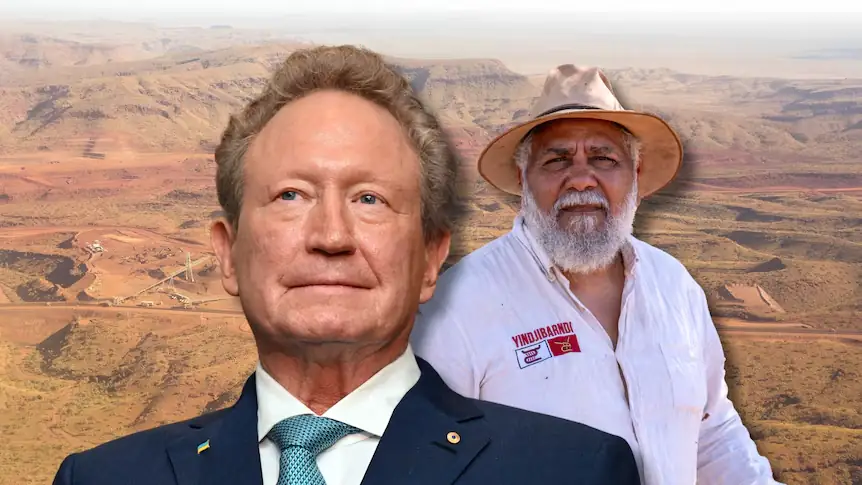

Andrew Forrest’s Fortescue has been handed a record $150.1 million compensation order in a landmark native title case that could reshape how Australia’s mining industry deals with traditional owners before major projects are built.
The Federal Court ruling centres on Fortescue’s Solomon Hub iron ore operations in Western Australia’s Pilbara, where the company mined on Yindjibarndi country without reaching an agreement with the people later recognised as the exclusive native title holders of the land.
The award is the biggest native title compensation payout ever ordered by an Australian court. Justice Stephen Burley found Fortescue liable for $150 million in cultural loss and $150,000 in economic loss, drawing a legal line under one of the country’s longest and most closely watched Indigenous land rights disputes.
The Yindjibarndi people had sought $1.8 billion, arguing that Fortescue’s mining activity caused deep cultural harm, economic loss and damage to sites connected to law, identity and country. Fortescue had argued the figure should be far lower, at about $8.1 million.
The Solomon Hub mines have been operating since 2013 and have produced enormous volumes of iron ore from the Pilbara, one of the world’s most profitable mining regions. The project is expected to remain active into the mid-2040s, making the case significant not only for its legal outcome but also for the scale of the resource development involved.
According to ABC News, the Federal Court heard that Fortescue built its lucrative Solomon Hub operations despite being unable to secure an agreement with the Yindjibarndi traditional owners.
Why the Yindjibarndi ruling matters beyond Fortescue
This case is more than a dispute over money. It tests how Australian law values cultural connection to land when that land is changed permanently by industrial development.
In his summary judgment, Justice Burley said the Yindjibarndi people had a “deep and visceral connection” to country that affected all aspects of life. That finding is central to the importance of the ruling because the largest part of the compensation was not for lost commercial opportunity, but for cultural loss.
For mining companies, the message is direct. Government approvals and project permits may allow development to proceed, but they do not erase native title risk when proper agreement with the recognised traditional owners has not been reached.
The Yindjibarndi Ngurra Aboriginal Corporation was recognised in 2017 as the exclusive native title holder over a 2,700-square-kilometre area in the Pilbara. By then, Fortescue’s Solomon Hub had already been built after the company obtained approvals from the state and dealt with a different local Aboriginal representative group.
That timeline sits at the centre of the dispute. Fortescue had a legal pathway to build, but the court has now recognised that the Yindjibarndi people suffered compensable loss from mining on their country without their consent.
The full judgment has not been publicly released in full because commercially sensitive material is suppressed. The Federal Court has maintained a public case file for the matter through its Yindjibarndi v State of Western Australia online file, reflecting the public importance of the case.
The ruling is also nearly three times larger than the previous biggest court-mandated native title compensation payout, which was awarded earlier this year to the Gudanji, Yanyuwa and Yanyuwa-Marra peoples over Glencore’s McArthur River mine in the Northern Territory.
That comparison matters because it suggests courts are becoming more willing to place substantial financial value on cultural damage. In practical terms, it may encourage traditional owner groups to revisit unresolved claims tied to mines, ports, rail lines, energy projects and other large developments built on native title land.
For the wider resources sector, the decision adds another layer of risk to project planning. Investors usually focus on production costs, commodity prices, approvals and export demand. After this ruling, native title compensation exposure is likely to receive closer attention, particularly for projects developed before disputes with traditional owners were fully settled.
Australia’s mining giants remain central to the ASX and the national economy. Swikblog recently covered that strength in its report on BHP overtaking CBA as Australia’s biggest company on the ASX, showing how resource companies continue to dominate investor attention.
Read More
A historic win with a complicated reaction
Inside the Perth courtroom, the moment was not described as a simple celebration. Yindjibarndi representatives and supporters filled the court as Justice Burley read the summary decision. Michael Woodley, chief executive of the Yindjibarndi Ngurra Aboriginal Corporation and a central figure in the fight for more than two decades, sat near the front with members of his family.
The subdued reaction was understandable. The award is historic, but it is still far below the $1.8 billion the Yindjibarndi had argued was needed to reflect the scale of cultural loss, economic loss and harm to country.
That gap will likely shape how the decision is interpreted. For traditional owners, the ruling is a powerful acknowledgment that cultural harm has real legal value. For Fortescue, it is a major financial and reputational setback, but one that came in far below the amount claimed.
The case also raises difficult questions about how compensation should be calculated when the damage is not only physical or financial. A mine can be measured in tonnes, revenue and operating life. Cultural loss is different. It involves relationships with places, stories, obligations and inherited knowledge that cannot be rebuilt once country is disturbed.
That is why the Fortescue ruling could become a reference point for future native title cases. It gives lawyers, mining companies, governments and traditional owner groups a new benchmark for cultural loss in a large-scale mining context.
For Andrew Forrest’s Fortescue, the decision lands at a time when resource companies are under growing pressure to show stronger Indigenous engagement and better cultural heritage practices. The legal risk is now clear: failing to secure a strong agreement with recognised native title holders can carry consequences long after production begins.
For the Yindjibarndi people, the case represents recognition after years of resistance. The compensation figure may not match what they sought, but the ruling confirms that mining on traditional land without proper consent can carry a historic cost.

Make Swikblog your go-to source on Google for reliable updates, smart insights, and daily trends.