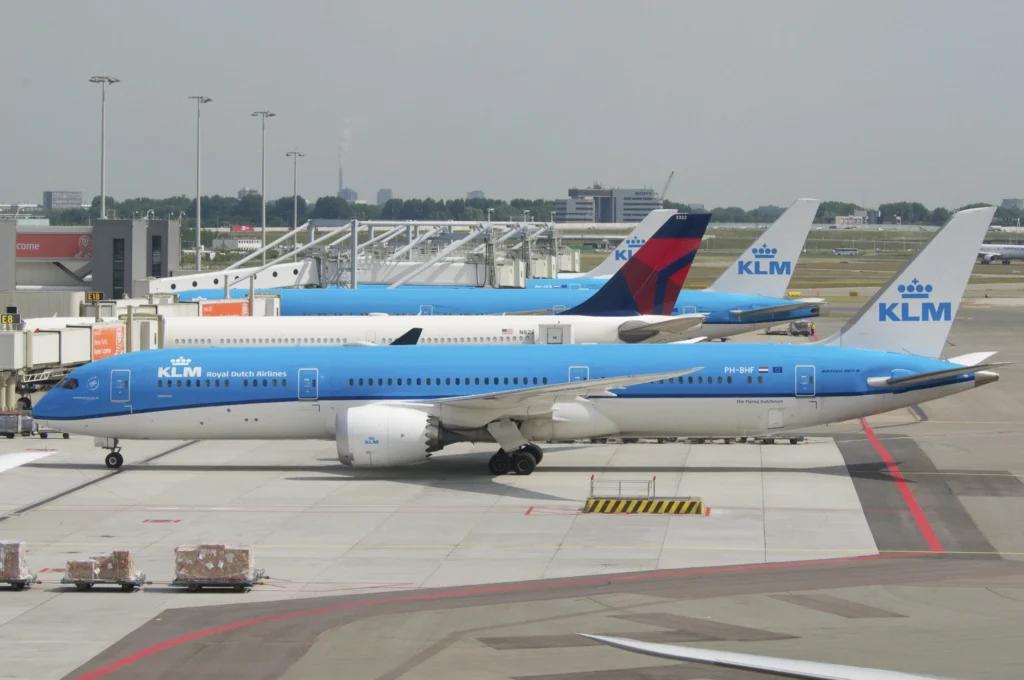

A KLM Royal Dutch Airlines flight from Málaga to Amsterdam was held on the ground for several hours after a threatening Wi-Fi hotspot name appeared before departure, forcing airport authorities in Spain to evacuate the aircraft and carry out a full security inspection.
The aircraft was preparing to leave Málaga-Costa del Sol Airport (AGP) for Amsterdam Airport Schiphol (AMS) on Saturday evening when the suspicious network name became visible on passengers’ devices. The hotspot reportedly contained a bomb-related message, prompting crew members to alert security officials before the flight could take off.
The KLM service was scheduled to depart at around 8:30 p.m. local time. Instead, passengers were taken off the aircraft while Spanish authorities activated security procedures. According to DutchNews.nl, the aircraft was searched on the ground in Málaga after the Wi-Fi name suggested there was a bomb on board.
The inspection covered the passenger cabin, baggage areas, cargo hold, and luggage linked to the flight. Security teams found no explosive device or suspicious material, and the aircraft was later cleared to continue its journey. The flight eventually reached Amsterdam at around 3 a.m., more than three hours later than planned.
How a Phone Hotspot Became an Aviation Security Alert
The incident shows how a simple phone setting can quickly turn into a major airport security operation. Most smartphones, tablets, and laptops allow users to rename a personal hotspot within seconds. In ordinary settings, that may seem harmless. Inside an aircraft, however, any message referring to explosives, weapons, or death is treated as a possible threat until proven otherwise.
Airline crew cannot immediately know whether a hotspot name is a prank, a deliberate hoax, or a warning connected to a real risk. That uncertainty is enough to stop a departure. Once a bomb-related message is reported, airport police and security teams usually need to inspect the aircraft before passengers can fly.
For KLM, the decision to delay the flight was not optional. Commercial aviation operates under strict safety procedures, and airlines are expected to treat every bomb threat seriously. Even if the message appears digital and anonymous, the aircraft cannot simply depart while the source remains unknown.
Spanish security officials removed passengers from the aircraft and checked the plane before giving clearance. The operation caused a long wait for travelers, but it also allowed the flight to continue only after authorities were satisfied there was no danger.
KLM said it follows fixed safety procedures whenever a security concern is raised and works with local authorities before allowing a flight to depart. In this case, those procedures meant passengers had to remain on the ground while the aircraft and luggage were checked.
Passengers Faced Late-Night Disruption Before Safe Arrival
Passengers traveling to the Netherlands faced several hours of uncertainty in the terminal while the investigation was carried out. Although the aircraft later departed safely, the delay pushed the arrival into the early morning hours at Schiphol, creating added inconvenience for travelers with onward transport or connections.
These incidents can also affect airline operations beyond a single flight. A grounded aircraft can disrupt crew duty limits, gate planning, baggage handling, and aircraft rotation. At busy airports such as Málaga and Amsterdam Schiphol, even one delayed evening departure can create pressure on airline schedules.
Spanish outlet Cadena SER reported that the aircraft involved was a Boeing 737 and that bomb disposal specialists were deployed as part of the response. The report said the flight did not depart until after midnight, once authorities had completed checks and ruled out danger.
No injuries were reported, and there was no confirmation of any security breach. Authorities have not publicly identified who created the hotspot name, and no arrest had been announced at the time of reporting. Investigators are expected to examine the origin of the message and determine whether any passenger or device can be linked to it.
Read More
False threats involving aircraft are treated as serious offenses because they create panic, disrupt airport operations, and require emergency resources. In the Netherlands and across Europe, hoax bomb threats can lead to criminal penalties, large fines, and possible airline bans. Even when no device is found, the disruption itself can be enough to trigger legal consequences.
The Málaga case is part of a wider pattern of aviation security alerts where airlines must respond quickly to potential threats, even when the danger later proves unfounded. In a similar case covered by Swikblog, a Turkish Airlines flight made an emergency landing in Barcelona after a reported security threat, showing how seriously airlines and authorities treat any possible risk involving passengers and aircraft.
For travelers, the message is clear: jokes or threatening words linked to bombs, terrorism, or violence have no place in an airport or aircraft environment. A Wi-Fi hotspot name may look like a private phone setting, but once it appears on other passengers’ screens, it becomes part of the security environment around the flight.
The KLM flight eventually landed safely in Amsterdam, but the delay underlined how quickly digital behavior can create real-world consequences in aviation. A few words typed into a device were enough to stop a commercial aircraft, remove passengers, involve security teams, and delay an international flight by several hours.

Make Swikblog your go-to source on Google for reliable updates, smart insights, and daily trends.