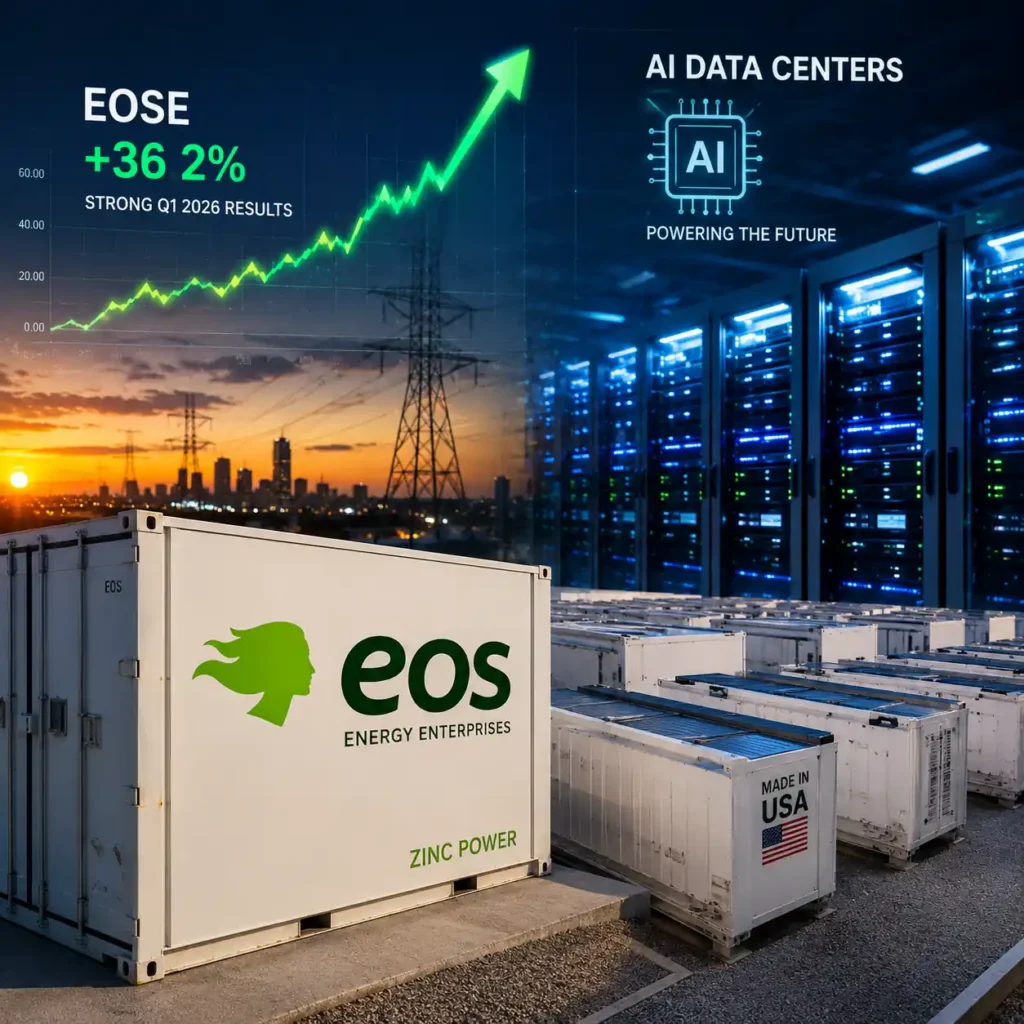

Eos Energy Enterprises stock moved sharply higher this week as investors rotated aggressively into companies tied to the rapidly expanding AI power infrastructure market. Shares of EOSE surged more than 36% following a combination of stronger-than-expected preliminary first-quarter 2026 results, improving manufacturing efficiency, and a new AI-focused energy partnership that has suddenly pushed the battery storage company back into Wall Street’s spotlight.
The rally reflects a broader shift happening across the market. Investors are increasingly searching for companies positioned to benefit from soaring electricity demand from hyperscale artificial intelligence data centers, where reliable backup power and long-duration battery systems are becoming critical infrastructure.
Eos Energy’s latest updates gave traders something they had not seen consistently from the company before: measurable operational execution backed by real manufacturing growth.
According to the company’s preliminary Q1 2026 update, Eos expects quarterly revenue of approximately $56 million to $57 million, ahead of analyst expectations near $54 million. The company also reported a 17% sequential increase in shipments, while battery output increased 10.4% and bipolar production rose 10.6%. Automation yield improvements climbed another 22% quarter over quarter as Eos continued scaling manufacturing operations at its Pennsylvania facility.
For investors who spent much of the last two years questioning whether Eos could manufacture batteries at scale without severe cash burn, the operational metrics mattered more than the revenue headline itself.
The company additionally confirmed that its second manufacturing line successfully completed Factory Acceptance Testing, with production expected to begin before the end of Q2 2026. Management said the upgraded production design reduces raw material travel distance by approximately 86% while shortening battery line layouts by roughly 40%, improvements aimed directly at lowering manufacturing costs and improving production consistency.
The operational turnaround narrative became even more powerful after Eos announced a joint development agreement with TURBINE-X Energy targeting private power systems for AI-focused data centers and other mission-critical infrastructure.
Under the agreement, TURBINE-X is targeting up to 2 GWh of Eos battery storage capacity over a three-year project pipeline beginning in 2027. The projects are expected to combine gas-fired generation with Eos’s zinc-based long-duration battery systems to create behind-the-meter power infrastructure capable of supplying hyperscale AI data centers.
The partnership immediately repositioned Eos inside one of the market’s hottest themes: AI electricity demand.
Large AI training clusters require enormous amounts of uninterrupted electricity, and power constraints are becoming one of the biggest bottlenecks facing data center expansion across the United States. Traditional grid interconnections can take years to complete, forcing technology companies and infrastructure providers to search for faster private energy alternatives.
Eos and TURBINE-X are effectively attempting to build deployable power systems that can be installed in months rather than waiting years for new utility-scale grid capacity. That narrative sharply changed how traders viewed Eos. Instead of being treated as another speculative clean-energy company, the stock suddenly entered the rapidly growing AI infrastructure trade.
The shift comes at a time when analysts and energy researchers are increasingly warning about the strain AI facilities may place on the US electrical grid. Recent academic research examining AI data center integration found that large-scale battery energy storage systems could become essential for stabilizing future AI-driven electricity demand spikes and maintaining grid reliability.
Eos’s zinc battery technology also offers differentiation from traditional lithium-ion systems dominating today’s storage market. The company markets its batteries as non-flammable, long-duration storage systems manufactured entirely within the United States using domestically sourced materials. That positioning has become increasingly important as concerns over lithium supply chains, battery fire risks, and US energy security continue growing.
Institutional support has further strengthened the bullish case around the stock. Cerberus Capital Management has emerged as one of Eos Energy’s most important financial backers after previously committing up to $315.5 million to support manufacturing expansion and commercialization efforts. Cerberus now controls roughly one-third of the company and recently gained board representation, developments investors interpreted as a major institutional endorsement of Eos’s long-term manufacturing strategy.
Despite the sharp rally, risks around the company remain substantial. Eos is still not consistently profitable, gross margins remain under pressure, and the company continues facing skepticism regarding long-term execution. Several Wall Street firms have also maintained cautious ratings due to the company’s history of manufacturing delays and operational volatility.
Short interest has remained elevated as well, with some reports estimating short positioning above 30% of float earlier this year. That has amplified volatility during the recent rally as momentum traders and short-covering activity accelerated the stock’s gains.
Still, investor sentiment around the company has clearly shifted over the past several weeks. Earlier concerns focused almost entirely on liquidity risk and manufacturing struggles. The current conversation is increasingly centered around AI infrastructure demand, long-duration battery deployment, and whether Eos can secure a meaningful position inside the next generation of private data-center power systems.
For now, Wall Street appears willing to give the company another chance as AI-related electricity demand transforms from a niche energy discussion into one of the market’s biggest infrastructure themes.
Investors will now focus closely on Eos Energy’s full Q1 2026 earnings report and future backlog updates to determine whether the company can convert its growing AI infrastructure narrative into sustained commercial growth.
For additional details on the company’s preliminary Q1 operational update, investors can review Eos Energy’s latest release via Eos Energy Enterprises.

Make Swikblog your go-to source on Google for reliable updates, smart insights, and daily trends.