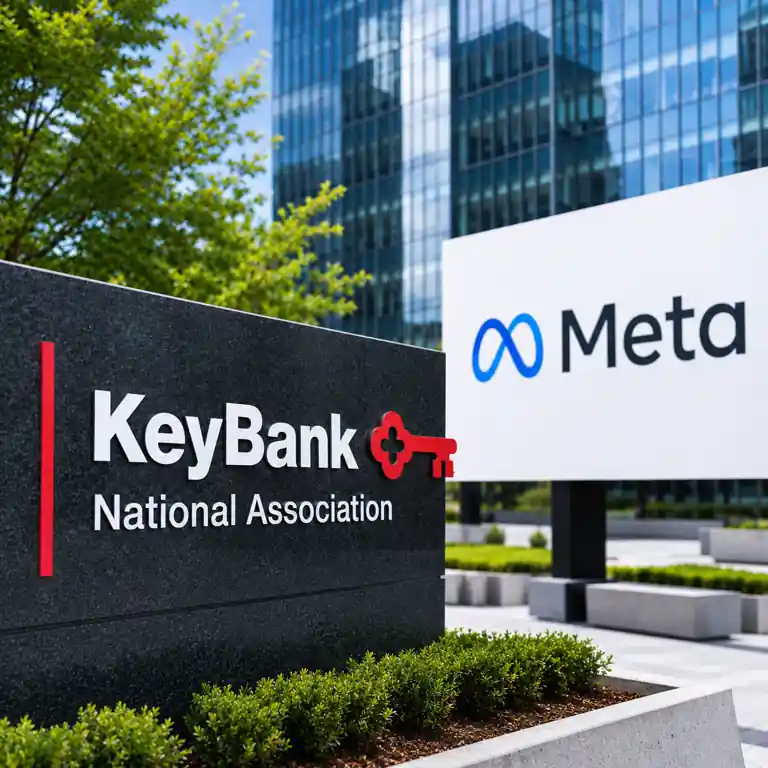

Keybank National Association OH has raised its exposure to Meta Platforms, adding 18,169 shares during the fourth quarter and lifting its total position by 15.7%. The fund now owns 133,798 shares of the Facebook and Instagram parent, with the holding valued at about $88.3 million at the end of the latest reporting period.
The purchase is not just another institutional filing. It comes at a sensitive point for Meta, where strong earnings, heavy artificial intelligence spending, insider sales, analyst target changes, and renewed institutional demand are all shaping the investment story at the same time.
Large investors appear to be treating Meta as a long-term AI and advertising platform rather than simply a social media company. Institutional investors now own roughly 79.91% of Meta’s outstanding shares, showing that professional money managers continue to maintain significant confidence in the company despite rising questions over its future spending plans.
Keybank’s increased stake also fits into a wider pattern. Vanguard Group raised its Meta position by 3.8% in the fourth quarter and now owns 199,995,630 shares valued at about $132.01 billion. State Street Corp holds 86,925,674 shares worth approximately $64.16 billion, while Capital World Investors owns 39,247,690 shares valued at around $28.82 billion.
Other major holders also remain heavily exposed. Invesco Ltd. owns 17,153,754 shares worth about $12.6 billion, while Legal & General Group Plc increased its stake by 4.1% to 14,332,168 shares valued near $10.53 billion. Together, these positions show that Meta remains deeply embedded in institutional portfolios.
Meta’s earnings strength gives institutions a reason to stay
The renewed institutional interest follows another strong quarterly performance from Meta. The company reported earnings per share of $10.44 for the latest quarter, beating analyst estimates of $6.67 by a wide margin. Revenue came in at $56.31 billion, above expectations of $55.56 billion.
That revenue figure represented 33.1% year-over-year growth, an important signal for investors because it shows Meta’s advertising business is still expanding at a healthy pace. The company also reported a return on equity of 36.93% and a net margin of 32.84%, figures that point to a highly profitable core business even as spending rises.
Meta’s family of apps remains the foundation of that performance. Facebook, Instagram, WhatsApp, and Messenger continue to provide the company with one of the largest consumer attention networks in the world. That scale gives Meta a powerful advantage in digital advertising, creator tools, messaging, and AI-driven recommendation systems.
For investors, the key question is whether Meta can use that scale to turn artificial intelligence spending into stronger revenue over time. AI is already being used across ad targeting, feed recommendations, content discovery, creative tools, and business messaging. If those systems keep improving ad returns for businesses, Meta could justify a large part of its infrastructure investment through better monetization of existing products.
Meta’s official investor updates remain an important source for tracking the company’s financial performance and management commentary. Readers can review Meta’s latest financial releases through its official investor relations page.
AI spending is now the main risk investors are watching
The bullish institutional activity does not remove the biggest concern around Meta: capital expenditure. Reports cited in recent market commentary suggest Meta’s 2026 capex plan could reach between $125 billion and $145 billion. That level of spending has become one of the most closely watched issues for shareholders.
Investors are not rejecting Meta’s AI strategy outright. Instead, they are questioning the timing and size of the spending cycle. Building AI models, data centers, and advanced computing infrastructure can support long-term growth, but it can also weigh on free cash flow and margins before the benefits become visible.
This is why Meta’s current market story is more complex than a simple earnings beat. The company is profitable, growing, and still supported by analysts, but it is also entering a period where management must prove that AI investment can create measurable returns.
Swikblog has previously covered how Meta’s AI spending has influenced investor sentiment, including the company’s growth outlook and pressure from rising infrastructure costs. You can read that related coverage here: Meta Platforms stock falls as AI spending and growth outlook remain in focus.
Meta is also reportedly working on AI agents and improved internal models, including projects such as Muse Spark. These efforts could eventually support new consumer products, business tools, and advertising services. However, the market will likely remain cautious until investors see clearer evidence of revenue contribution from these AI initiatives.
Analysts remain positive, but targets show caution
Wall Street sentiment toward Meta remains broadly favorable, though recent target changes show analysts are not ignoring the spending debate. Bank of America lowered its target price from $885 to $820 while keeping a buy rating. UBS reduced its target from $908 to $865 and also maintained a buy rating.
Royal Bank of Canada kept an outperform rating with an $810 target, while Raymond James lowered its price objective from $825 to $800 but maintained a strong-buy rating. Canaccord Genuity moved in the other direction, raising its target from $900 to $930 and keeping a buy rating.
Read More
Overall, Meta has four strong-buy ratings, thirty-four buy ratings, and nine hold ratings, giving it a Moderate Buy consensus. The average target price stands at around $840.31, well above the recent opening price of $609.63 cited in the report.
That gap between the share price and analyst targets explains why institutions may still be adding exposure. Meta’s valuation has moved lower from its highs, while earnings growth remains strong. At the same time, the stock is no longer being priced only on current profits. Investors are now trying to value Meta’s AI future, and that future carries both upside and cost risk.
Meta recently traded with a market capitalization of about $1.54 trillion. The stock has a price-to-earnings ratio of 22.16, a PEG ratio of 1.07, and a beta of 1.25. Its 52-week range stands between $520.26 and $796.25, while its 50-day moving average is $627.67 and its 200-day moving average is $645.30.
Dividend and insider activity add more context
Meta also recently paid a quarterly dividend of $0.525 per share. On an annualized basis, that equals $2.10 per share and a yield of about 0.3%. The company’s dividend payout ratio is 7.63%, leaving Meta with significant flexibility to keep investing in AI, infrastructure, buybacks, or future shareholder returns.
Insider selling has also been part of the recent update. Chief Operating Officer Javier Olivan sold 926 shares at an average price of $607.74, for a total value of about $562,767. Director Robert M. Kimmitt sold 580 shares at an average price of $667.00, worth approximately $386,860.
Both transactions were carried out under pre-arranged Rule 10b5-1 trading plans. That detail matters because such plans are commonly used by executives and directors to schedule sales in advance. Over the last 90 days, insiders sold 168,193 shares valued at about $107.64 million. Insiders still own 13.61% of the company.
The broader picture is that Meta is entering a high-stakes phase. Its core advertising business is performing well, institutions are still adding shares, and analysts remain mostly positive. But the company’s AI ambitions are expensive, and investors will expect proof that spending today can support higher earnings tomorrow.
For now, Keybank’s larger position adds another signal that major investors are willing to stay patient with Meta. The company’s ability to maintain strong margins while scaling AI infrastructure will likely decide whether that confidence continues through the next several quarters.

Make Swikblog your go-to source on Google for reliable updates, smart insights, and daily trends.