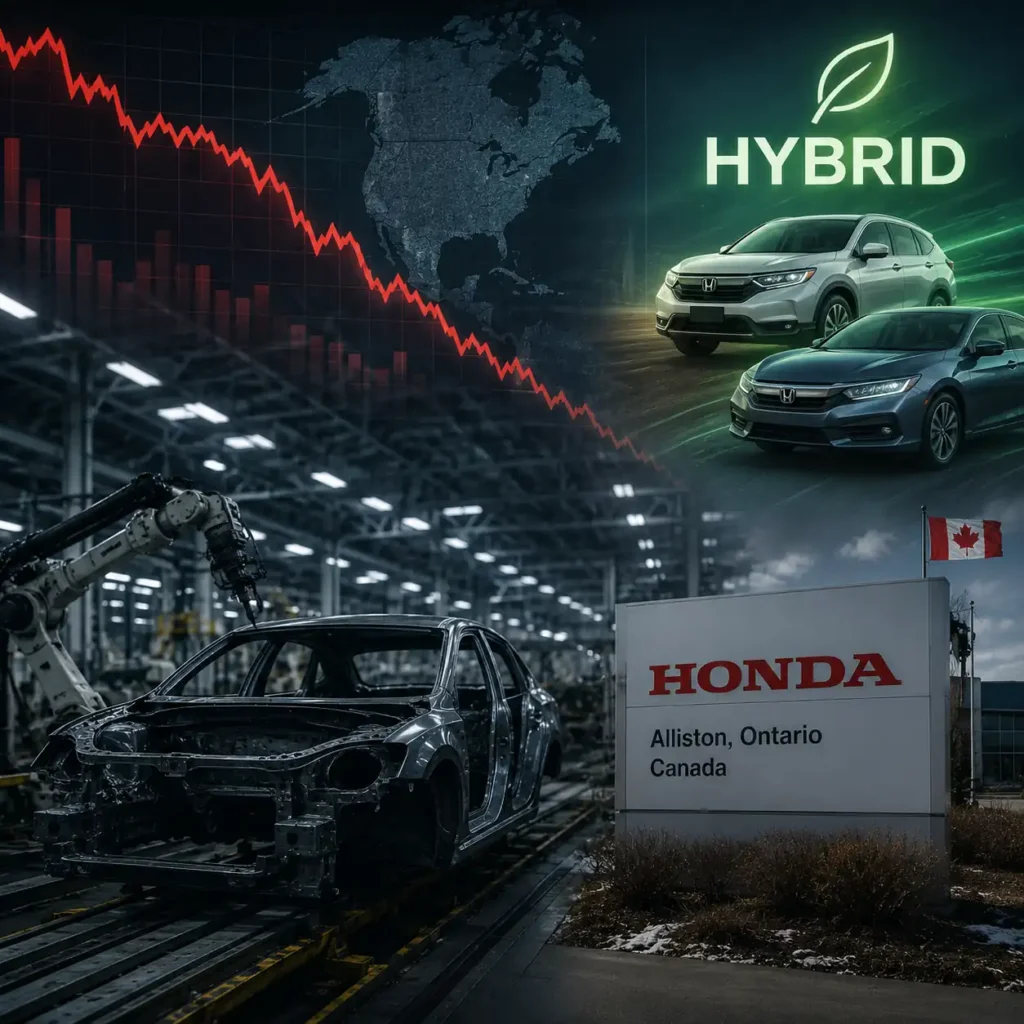

Honda’s decision to indefinitely suspend its massive $15 billion electric vehicle project in Ontario is rapidly becoming one of the clearest signs yet that the North American EV industry is entering a major reset period.
The Japanese automaker confirmed this week that it is halting development of the planned EV manufacturing chain in Canada, a project that was originally expected to create around 1,000 manufacturing jobs and produce up to 240,000 vehicles annually by 2028.
The suspension comes as Honda posted a staggering 423.9 billion yen ($3.68 billion CAD) annual loss, the first full-year loss in the company’s history. Executives pointed to slowing electric vehicle demand, changing U.S. environmental policies, and rising market uncertainty as major reasons behind the decision.
Honda said the suspension will not impact current operations at its existing Alliston manufacturing plant in Ontario, where gasoline and hybrid models continue to be produced.
Hybrid vehicles are suddenly outperforming expectations
While electric vehicle growth continues globally, automakers across North America are increasingly shifting focus toward hybrid vehicles instead of fully electric lineups.
Honda chief executive Toshihiro Mibe said the company still plans to pursue carbon neutrality goals, but future investment will increasingly prioritize hybrids as consumer demand patterns change.
Industry analysts say hybrids have become one of the strongest-performing vehicle segments in North America because buyers continue to worry about charging infrastructure, higher EV prices, and battery range concerns.
Many of Honda’s hybrid models, including the CR-V Hybrid and Civic Hybrid, have continued posting strong sales momentum across the U.S. and Canada.
According to Reuters, several global automakers are now reassessing earlier EV expansion plans as market growth slows compared with aggressive forecasts made during the post-pandemic boom.
Honda’s Ontario project had become a major Canadian investment story
The Ontario EV project was originally announced in April 2024 during a high-profile event attended by then-prime minister Justin Trudeau and Ontario Premier Doug Ford.
Both federal and provincial governments pledged approximately $2.5 billion each toward the project. Honda has now confirmed that none of that government funding had yet been received.
The proposed manufacturing chain was expected to include:
- EV assembly operations
- Battery production facilities
- Battery component processing
- Expanded automotive supply infrastructure
The suspension now raises broader questions about Canada’s long-term EV manufacturing strategy as competition intensifies globally.
Other automakers are also slowing EV expansion plans
Honda’s move is not happening in isolation.
Ford has previously adjusted EV production plans in Ontario, while General Motors recently scaled back parts of its BrightDrop electric delivery van operations amid weaker-than-expected demand.
Across the auto industry, companies are increasingly balancing EV investments with hybrid production instead of rapidly transitioning to fully electric fleets.
Trade tensions between the United States and Canada have also added new uncertainty for automakers because many vehicles built in Canada are ultimately sold in the American market.
Analysts say tariff concerns, shifting environmental regulations, and rising manufacturing costs are making large-scale EV investments harder to justify in the short term.
Political reaction grows after Honda announcement
Canadian leaders reacted quickly to the announcement, with Prime Minister Mark Carney calling Honda’s decision disappointing while insisting the global shift toward lower-emission transportation is still moving forward.
Manufacturing groups in Canada also warned that long-term investment decisions could remain difficult until trade relationships with the United States become more stable.
The broader concern for policymakers is that Ontario had positioned itself as a major North American EV manufacturing hub, and Honda’s reversal may affect confidence around future projects.
At the same time, industry experts believe the pause does not necessarily signal the end of EV growth altogether. Instead, it may represent a slower and more cautious transition than many automakers originally expected.

Make Swikblog your go-to source on Google for reliable updates, smart insights, and daily trends.