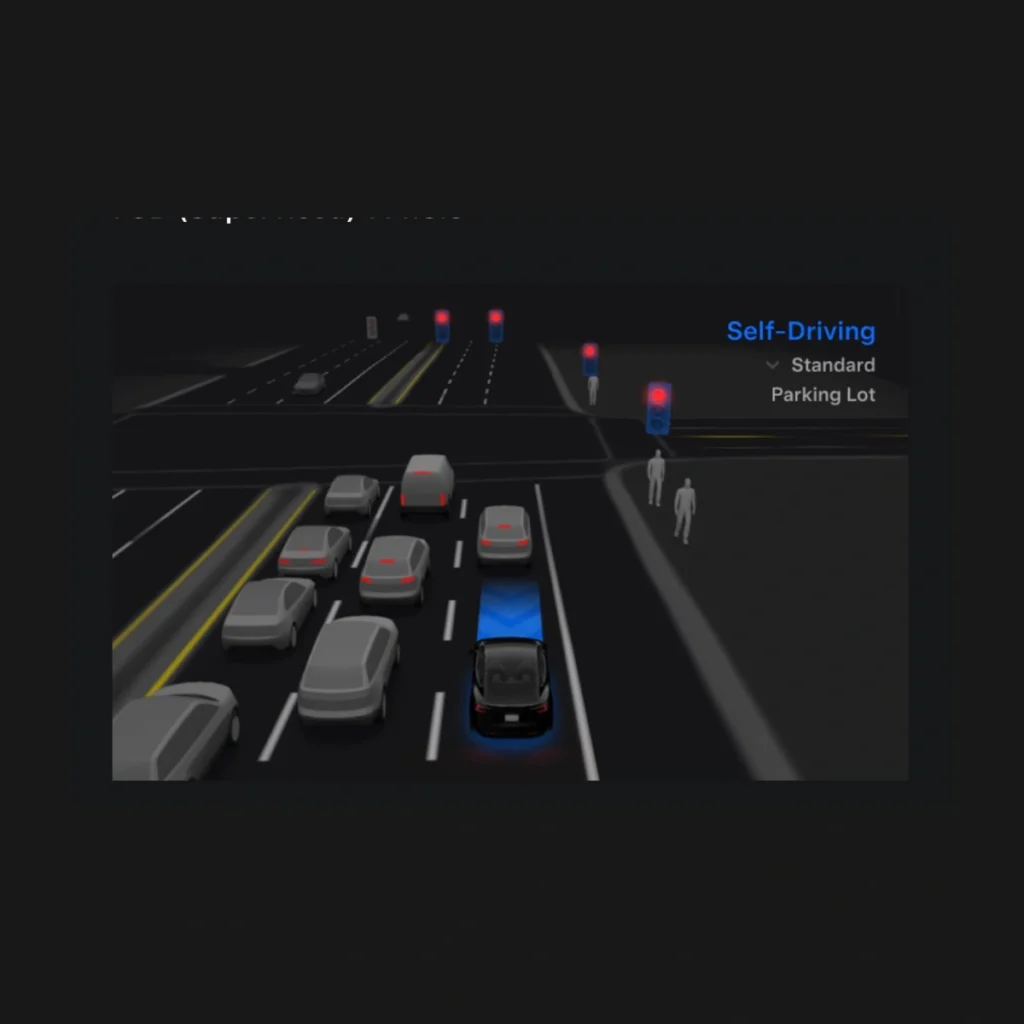

Tesla FSD V14.3.3 has started rolling out with the Spring Update, bringing software version 2026.14.6.6 and a wider set of Full Self-Driving improvements focused on reaction time, parking behavior, rare-road scenarios and driver feedback.
The rollout was highlighted by Tesla watcher Sawyer Merritt, who said the update was downloading on his Model Y. The update also raises the top speed of Actually Smart Summon to 8 mph, up from 6 mph, giving Tesla’s parking-lot summon feature a slightly quicker operating limit.
For Tesla owners, the speed increase is only one part of the update. The visible release notes point to a broader FSD upgrade that touches neural-network training, the vehicle’s reaction time, parking decisions, traffic-light handling and how the car manages unusual or difficult road situations.
Key details: Tesla FSD V14.3.3 is rolling out with software version 2026.14.6.6, Actually Smart Summon now reaches 8 mph, and Tesla says the update includes a 20% faster reaction time after rewriting the AI compiler and runtime with MLIR.
FSD V14.3.3 Brings Faster Reaction Time and Wider Driving Improvements
The release notes say Tesla has upgraded the reinforcement learning stage used for training the FSD neural network, with improvements across a wide variety of driving scenarios. That suggests the update is not limited to one narrow behavior, but instead targets the broader decision-making stack used during supervised driving.
Tesla also says it upgraded the neural network vision encoder, improving understanding in rare and low-visibility scenarios. The update specifically mentions stronger 3D geometry understanding and expanded traffic sign understanding, both of which are important for complex roads, unusual layouts and conditions where visibility is limited.
One of the biggest technical changes in the notes is Tesla’s rewrite of the AI compiler and runtime from the ground up using MLIR. Tesla says the change results in a 20% faster reaction time and improves model iteration speed, giving the system a faster path from perception to decision-making.
The update also says Tesla has mitigated unnecessary lane biasing and minor tailgating behavior. These two changes are important because they deal with how natural the car feels in everyday driving. A system that avoids drifting too strongly toward one side of a lane and keeps a more comfortable following distance can feel smoother and more predictable to the driver.
Parking behavior is another major part of the release. Tesla says FSD V14.3.3 increases decisiveness when selecting a parking spot and improves parking maneuvering. It also improves parking location pin prediction, with the selected parking location now shown on the map using a P icon.
The notes also point to improved handling of emergency vehicles, school buses, right-of-way violators and other rare vehicles. These are the kinds of situations that can be difficult for automated driving systems because they do not always follow normal traffic patterns.
Tesla says the update improves handling of small animals by focusing reinforcement learning training on harder examples and adding rewards for better proactive safety. The release also lists better traffic light handling at complex intersections, including compound lights, curved roads and yellow-light stopping, driven by training on hard reinforcement-learning examples sourced from the Tesla fleet.
Rare objects also receive attention in this build. The notes say FSD V14.3.3 improves handling of unusual objects extending, hanging or leaning into the vehicle path by sourcing infrequent events from the fleet. This could cover edge cases where a vehicle encounters something that does not look like a normal car, pedestrian, cone or sign, but still affects the drivable path.
The update also improves handling of temporary system degradations. Tesla says the system can maintain control and automatically recover without driver intervention, reducing unnecessary disengagements. For supervised FSD users, that type of recovery is important because it can reduce abrupt handoff moments when the system faces a temporary perception or confidence issue.
Another important change is that Tesla has unified the model between Actually Smart Summon, FSD and Robotaxi for more capable and reliable behavior. This is one of the more significant lines in the release notes because it suggests Tesla is continuing to bring its parking-lot, supervised-driving and future ride-hailing systems closer together under a shared model direction.
The most visible consumer-facing change is the Actually Smart Summon speed increase. Tesla says the maximum speed is now 8 mph, or 13 km/h. That is up from the previously mentioned 6 mph limit and should make short low-speed movements feel slightly less slow in supported parking-lot situations.
Tesla is also adding more driver feedback after takeovers. Owners can now help Tesla improve Self-Driving by selecting an intervention reason on the main screen after taking over. This gives Tesla more direct context about why a driver interrupted FSD behavior instead of relying only on vehicle data.
The Self-Driving app will also show the distance traveled in FSD without an intervention. It will additionally show the driver’s longest intervention-free streak, giving owners a clearer view of how long the system is operating without requiring a takeover.
The release notes also include an upcoming improvement: Tesla plans to expand reasoning to all behaviors beyond destination handling. That points to a broader push toward more reasoning-based behavior across the driving stack, not just route or destination decisions.
The update continues Tesla’s larger effort to improve Full Self-Driving (Supervised) while keeping the system under driver supervision. Tesla’s official wording remains important: FSD does not make the vehicle autonomous, and drivers are still responsible for monitoring the car and taking over when needed.
For Tesla owners receiving 2026.14.6.6, FSD V14.3.3 appears to be a broad Spring Update release rather than a small patch. It combines a faster Actually Smart Summon limit with deeper FSD upgrades across neural-network training, reaction time, rare-object handling, parking behavior, intervention tracking and future Robotaxi-related model unification.

Make Swikblog your go-to source on Google for reliable updates, smart insights, and daily trends.