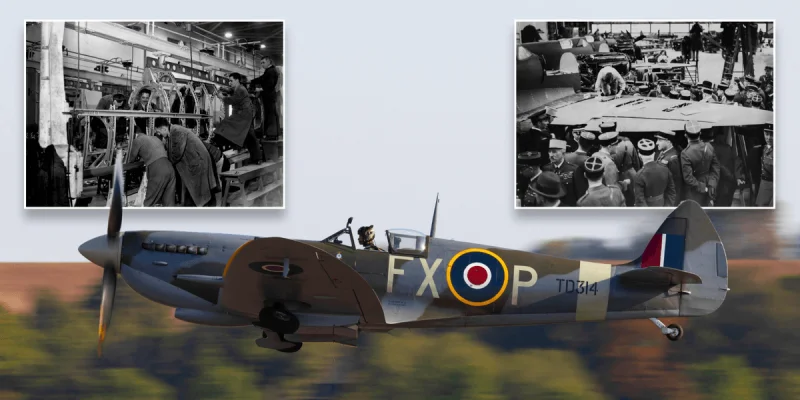

A modern version of the Supermarine Spitfire could bring one of Britain’s most famous aircraft names back into production nearly 90 years after the original fighter first flew. The new project, known as the Aerolite Spitfire Type 433, is being presented as a contemporary two-seat aircraft inspired by the wartime icon rather than a direct copy of it.
The full-scale concept model has been revealed in Bodmin, Cornwall, by a team working with Great British Supermarine Ltd. The company is now looking for investor support to move the aircraft from concept stage toward a flying prototype and, eventually, limited production.
The proposal arrives at a time when original Spitfires have become extremely rare, expensive and difficult to access. A genuine flying Spitfire can cost more than £3 million, while the Aerolite concept has been developed around a much lower estimated figure of about £750,000. That difference is central to the company’s pitch: a Spitfire-style aircraft that could be within reach of private flying groups, aviation syndicates and enthusiast owners rather than only major collectors.
The aircraft is designed as a recreational machine, not a military aircraft. It aims to capture the visual character and flying appeal of the original Spitfire while using modern composite materials, updated propulsion systems and intelligent avionics. The result is being positioned as a heritage-inspired aircraft built for today’s pilots, rather than a museum replica with modern paperwork.
The Spitfire’s place in aviation history gives the project unusual public appeal. First flown in 1936, the original Supermarine Spitfire became one of the defining British aircraft of the Second World War. Its speed, handling and famous elliptical wing helped turn it into a symbol of Britain’s wartime resistance, particularly during the Battle of Britain. The Imperial War Museums notes that the Spitfire played a central role in Britain’s air defence during that period, cementing its reputation far beyond aviation circles.
The Aerolite Spitfire Type 433 also draws from a little-known wartime engineering idea. During the early 1940s, British officials considered using a composite material called Gordon Aerolite to reduce reliance on aluminium for aircraft fuselages. Aluminium was a critical wartime resource, and alternative materials were explored as pressure on supplies increased. The plan was later abandoned, but the new project has returned to that concept using modern composite technology.
That material choice could be one of the most important differences between the new aircraft and the historic Spitfire. Composite construction can make the aircraft more weather resistant and easier to maintain. The team behind the project says this could remove the need for permanent hangar storage, a major practical and financial burden for many aircraft owners.
Great British Supermarine Ltd also believes the design could help fill a gap in the warbird market. Original two-seat Spitfires are exceptionally scarce, with only around a dozen believed to remain operational. Those aircraft are prized by collectors and are rarely available to ordinary pilots. A modern two-seat Spitfire-style aircraft could therefore appeal to people who want the experience of flying something close in spirit to the original, without the cost and limitations of owning a historic machine.
Jeremy Meeson, chief executive of Great British Supermarine Ltd, has described the timing as right for a new interpretation of the Spitfire. His argument is that modern materials and digital engineering now make it possible to preserve the aircraft’s essential character while improving durability, systems and production practicality. The company wants the aircraft to retain the qualities associated with the Spitfire name: lightness, balance, responsive handling and a strong connection between pilot and machine.
The project also has support from figures connected to Spitfire heritage. David Spencer Evans, a former chairman of the Spitfire Society and the Spitfire Heritage Trust, has worked with Meeson on the effort. He has described the aircraft as a continuation of the Spitfire story in composite form, reflecting how strongly the aircraft still resonates with British aviation enthusiasts.
Read More
- Visit Swikblog Homepage
- New Zealand Fuel Prices Drop: Diesel and Unleaded 91 Fall
- Xbox Game Pass June 2026: Five Games Confirmed
- Amazon Alexa AI Shopping Assistant Can Track Deals and Auto-Buy Products
- Ram 2500 Recall Over Tire Speed Rating Issue
- Swatch x Audemars Piguet Royal Pop Watch Sparks Crowds and Resale Frenzy
The next phase will be crucial. The concept model is expected to tour the UK through spring and summer, appearing at up to 10 air shows, military festivals and classic motor events. That tour is not only about publicity. It will also test whether there is enough buyer and investor interest to justify the cost of developing a flying prototype.
The team hopes to move toward a working aircraft within roughly two and a half years, although that target will depend on funding, engineering progress and regulatory requirements. Building a modern aircraft, even one inspired by an established design, remains a demanding and expensive process.
For aviation fans, the appeal is easy to understand. The Spitfire is not just another aircraft name. It carries history, emotion and national memory. But for the project to succeed commercially, nostalgia alone will not be enough. The Aerolite Spitfire Type 433 will need to prove that it can offer genuine flying capability, manageable ownership costs and enough authenticity to satisfy people who care deeply about the original machine.
Swikblog has also covered other aviation-related stories, including this report on a plane crash near Littleborough in Greater Manchester.
If Great British Supermarine Ltd can secure investment and move the Aerolite Spitfire beyond the display circuit, the aircraft could become one of the most distinctive aviation revival projects in Britain. It would not replace the original Spitfires that still fly at historic events, but it could offer a new way for pilots and enthusiasts to connect with a design that remains instantly recognisable nearly a century after its first flight.

Make Swikblog your go-to source on Google for reliable updates, smart insights, and daily trends.