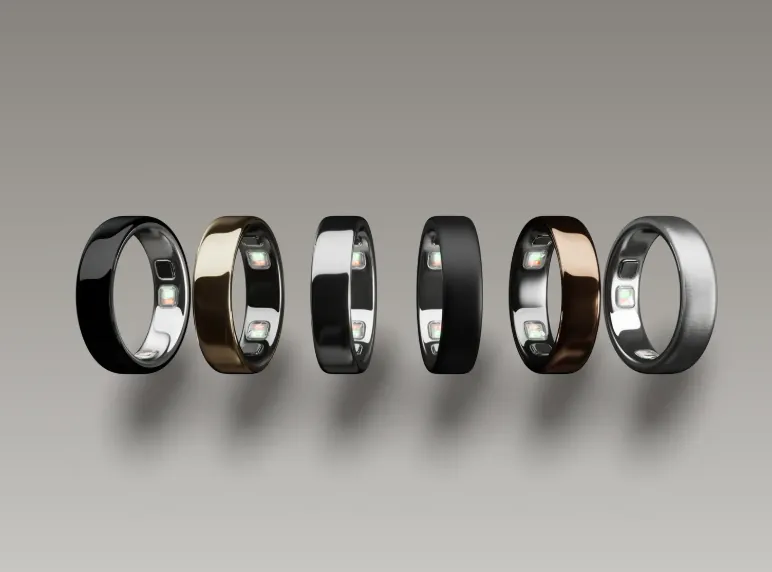

Oura has officially unveiled the Ring 5, its newest smart ring that arrives with a thinner design, upgraded health tracking and a major push into AI-powered wellness tools. The Finnish-American company says the Ring 5 is 40% smaller than the previous generation, making it the world’s smallest smart ring at just 2.28mm thick.
The launch comes at an important moment for Oura as competition in the smart ring market continues to grow rapidly. Rivals such as Ultrahuman, RingConn and Samsung are all expanding their wearable ambitions, but Oura is betting that comfort, health insights and AI features will help it stay ahead.
The Oura Ring 5 starts at $399 for the Silver and Black models, while premium finishes including Gold, Deep Rose, Stealth and Brushed Silver cost $499. The device begins shipping on June 4 and still requires Oura’s $5.99 monthly subscription to unlock its full software experience.
Smaller Design With Bigger Health Features
Despite becoming much slimmer and lighter, Oura says the Ring 5 improves both accuracy and battery life. The company redesigned the internal architecture, upgraded the sensors and added LEDs that are four times more powerful than the previous model. Oura says the ring now delivers more accurate readings across different finger sizes and skin tones.
Battery life has also improved from five-to-eight days on the Ring 4 to six-to-nine days on the Ring 5. A new portable charging case is also launching alongside the ring and can reportedly deliver around five full charges.
The titanium ring now includes a new scratch-resistant PVD coating and carries an IP68 water resistance rating up to 100 meters. Oura is also introducing multi-ring support, allowing users to switch between multiple Oura rings on the same account.
According to The Guardian, Oura has sold more than 5.5 million rings globally and now has nearly 5 million paying subscribers. The report also noted the company generated around $1 billion in revenue in 2025 ahead of a possible IPO later this year.
Read More
AI Health Tracking Is Now the Main Focus
While the smaller hardware is grabbing attention, the bigger story may be Oura’s new AI health platform. The company is expanding its “Oura Advisor” assistant, which uses AI to provide health guidance, answer wellness questions and connect users with licensed medical professionals through a new partnership with Counsel Health.
Oura is also introducing “Health Radar,” a background monitoring system designed to identify biometric changes before they become larger health issues. At launch, the feature focuses on Blood Pressure Signals and Nighttime Breathing tracking.
Blood Pressure Signals monitors overnight cardiovascular patterns to detect possible hypertension trends, while Nighttime Breathing looks for breathing disruptions during sleep that may be linked to sleep apnea or other health concerns. Users can also manually add blood pressure cuff readings inside the app for additional context.
The company is expanding into metabolic health as well. New GLP-1 tracking tools allow users to monitor medication schedules, side effects and weight changes over time. Oura is also adding lab upload support and personal health records for eligible users in the United States.
Fitness tracking is receiving upgrades too. Users can now access live activity tracking with real-time pace, heart rate and distance metrics through lock-screen widgets. Oura also improved its Automatic Activity Detection system for lower-motion exercises such as yoga and pilates.
Smart rings are quickly becoming one of the fastest-growing wearable categories, especially among users who want health tracking without wearing a smartwatch all day. Swikblog recently explored this growing trend in Google Launches Fitbit Air With Gemini AI Coach and 7-Day Battery Life, which highlighted how AI-powered wellness tools are becoming the next major battleground in wearable technology.
With the Ring 5, Oura is clearly aiming beyond sleep tracking. The company wants its smart ring to become a full-time personal health companion that quietly monitors wellness in the background while looking more like traditional jewellery than technology.
“`
Make Swikblog your go-to source on Google for reliable updates, smart insights, and daily trends.