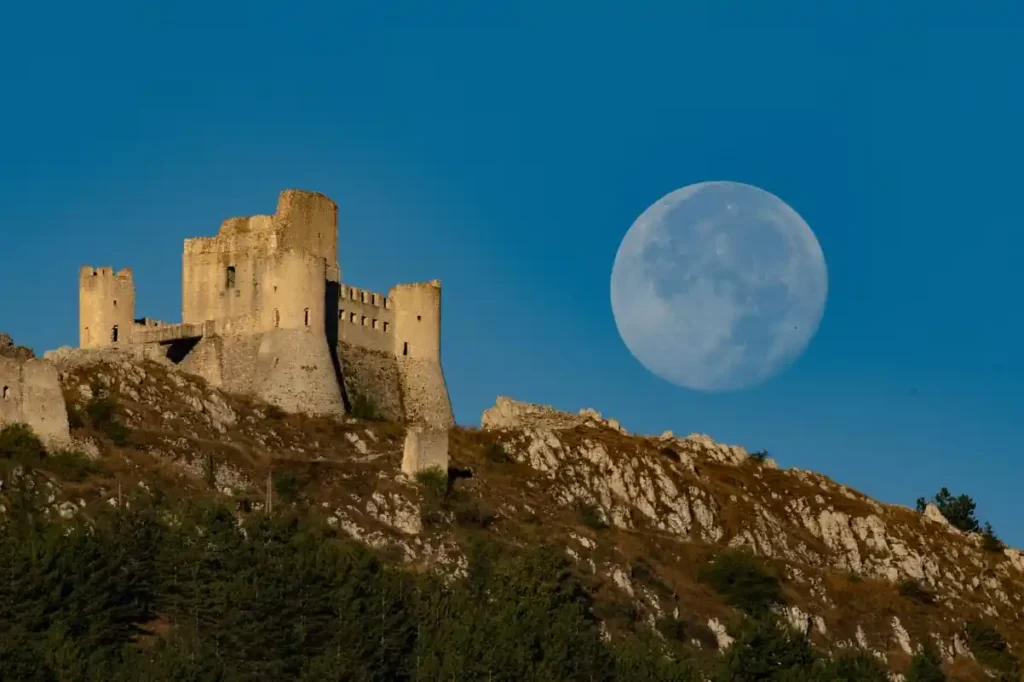

The final night of May is bringing a sky event with two names attached to it: a Blue Moon and a micromoon. The full moon on May 31, 2026, is unusual because it is the second full moon in the same calendar month and it arrives while the moon is near its farthest point from Earth.
For casual skywatchers, that makes this one of the easiest celestial events of the year to enjoy. No telescope, app or special filter is required. A clear sky and an open view of the eastern horizon will be enough.
May 2026 has two full moons. The first reached full phase on May 1, and the second arrives on May 31 at 08:45 UTC, according to timeanddate.com. That second full moon is what gives this weekend’s lunar event its “Blue Moon” label.
Why May 31 is called a Blue Moon
A Blue Moon does not usually describe the moon’s color. In modern astronomy coverage, it most often means the second full moon in a single calendar month. Since a lunar cycle takes about 29.5 days, a full moon that appears at the start of a long month can be followed by another before the month ends.
That is exactly what happens in May 2026. The month opens with the Flower Moon and closes with a second full moon, giving skywatchers a calendar Blue Moon. This type of event happens only occasionally, which is why the phrase “once in a blue moon” became attached to rare moments.
There is also a second definition. A seasonal Blue Moon happens when four full moons occur within one astronomical season instead of the usual three. In that case, the third full moon in the season is called the Blue Moon. The next seasonal Blue Moon is expected on May 20, 2027.
Why this Blue Moon is also a micromoon
This weekend’s Blue Moon has another feature that makes it stand out. It is also a micromoon, meaning the full moon occurs near apogee, the farthest point in the moon’s orbit around Earth.
The moon does not travel around Earth in a perfect circle. Its distance changes throughout the month. When a full moon happens near perigee, the closest point to Earth, it is often called a supermoon. When it happens near apogee, the farthest point, it is called a micromoon.
During this event, the moon will be about 252,334 miles, or 406,093 kilometers, from Earth. That is farther than its average distance of roughly 238,855 miles, or 384,400 kilometers. The difference can make the lunar disk appear slightly smaller, but most people will not notice it without comparing photographs taken under the same conditions.
That does not make the event less interesting. In fact, the combination of a calendar Blue Moon and a micromoon gives this full moon a stronger astronomy angle than a normal monthly full moon.
Will the Blue Moon actually look blue?
In normal viewing conditions, no. The moon should look white, silver, pale yellow or orange, depending on its height in the sky and local atmospheric conditions. The best color often comes shortly after moonrise, when the moon sits low on the horizon and its light passes through more of Earth’s atmosphere.
A genuinely blue-looking moon is possible, but it is rare. It usually requires smoke, volcanic ash or dust particles in the atmosphere to scatter light in an unusual way. One famous historical example followed the 1883 eruption of Krakatoa, when people in some places reported a bluish moon.
For this weekend, the name is about timing rather than color. Anyone expecting a bright blue lunar disk may be disappointed, but anyone looking for a striking full moon should still have a good reason to step outside.
Best time to watch the Blue Moon
The moon reaches its exact full phase at 08:45 UTC on May 31, 2026. In practical terms, it will look full to most observers from the night of May 30 through June 1. For the Americas, Europe and Africa, the most convenient viewing window will be the night of May 30. For Asia, Australia and New Zealand, the brightest view will fall on the night of May 31.
The best viewing time is shortly after moonrise. Look east as the moon comes above the horizon. At that point, buildings, trees or hills can create a dramatic foreground for photos, and the moon may appear larger because of the well-known moon illusion.
Read More
Smartphone users do not need complicated settings. Tap the moon on the screen to adjust focus and exposure, keep the phone steady, and include a landscape object in the frame to give the image scale. Binoculars can also help reveal surface details, although the event is completely visible to the naked eye.
Swikblog readers can also follow the wider month of sky activity in our guide to May 2026 night sky events, which includes the Blue Moon along with other notable celestial highlights.
This Blue Moon may not change color, and the micromoon may not look dramatically smaller, but the timing makes it worth watching. It closes May with a rare full moon pairing: the second full moon of the month and the most distant full moon of the year.

Make Swikblog your go-to source on Google for reliable updates, smart insights, and daily trends.