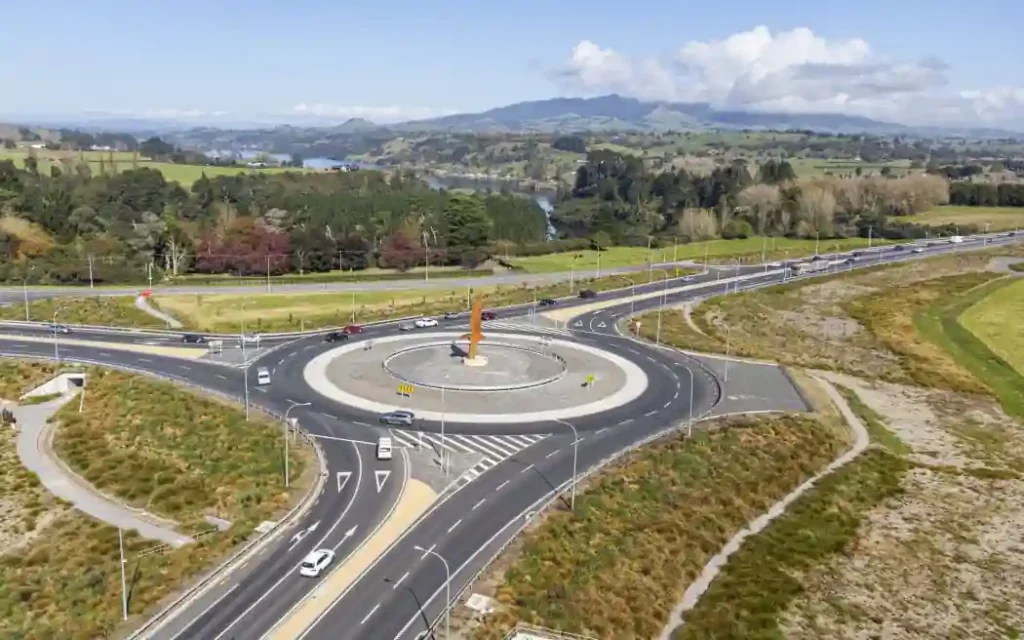

New Zealand’s approval of nearly NZ$1.8 billion for the Waikato Expressway’s Cambridge to Piarere extension gives one of the country’s most important transport corridors a long-awaited funding breakthrough, with the project expected to reshape freight movement, regional investment and road safety across the upper North Island.
The investment will fund a 16-kilometre extension of State Highway 1 from Cambridge to the SH1/SH29 intersection at Piarere, closing a key gap in the wider Waikato Expressway network. The project has been discussed for years and was previously cancelled in 2018, making the new commitment a major turning point for Waikato councils, freight operators and communities that rely on the route.
The New Zealand Government said the extension will improve safety, reduce congestion, increase travel reliability and support economic growth across the upper North Island. Transport Minister Chris Bishop described the corridor as a critical freight and economic link, adding that the upgrade could reduce deaths and serious injuries by up to 70%.
That safety argument is central to the project. The Cambridge to Piarere stretch of SH1 has long been viewed as a high-risk road, used by local traffic, long-distance travellers, tourists and heavy freight. Upgrading it to expressway standard would separate more traffic movements, improve road design and reduce the pressure on a route that has carried growing volumes for years.
The economic case is equally important. Waikato sits inside New Zealand’s “Golden Triangle” alongside Auckland and Tauranga, a region often described as the engine room of the national economy. Around 60% of New Zealand’s GDP is linked to this wider corridor, making reliable road access between inland production areas, ports, industrial estates and major consumer markets a national productivity issue rather than only a local transport matter.
For Waipā and Cambridge, the funding announcement also strengthens confidence in future industrial growth. Hautapu has already become a major example of how improved highway access can attract logistics and distribution investment. Businesses such as Mainfreight have expanded near the expressway because proximity to State Highway 1 gives operators faster connections north to Auckland and east toward Tauranga.
Cambridge MP and Tourism and Hospitality Minister Louise Upston has strongly backed the project, arguing that the region’s growth potential depends on infrastructure that can move people and goods efficiently. She said the pace of development around Hautapu showed how quickly business investment can follow when transport links become more reliable.
Waipā Mayor Mike Pettit also welcomed the decision, calling it a strong signal of confidence in Waikato’s role in New Zealand’s economy. His argument is straightforward: when freight moves more efficiently through Waikato, the benefit is felt by exporters, retailers, manufacturers and consumers well beyond the district boundary.
The Automobile Association has also supported the extension, pointing to safety gains delivered by earlier sections of the Waikato Expressway. AA Waikato District Council chairperson Steve Cantwell said the Cambridge to Piarere corridor is not only important for Waikato but for New Zealand’s wider roading network, because it carries both people and goods through a nationally significant route.
Recent crashes on New Zealand highways have kept road safety in public focus. Swikblog previously reported on a fatal SH1 crash near Waiouru, underlining why safer highway design and more reliable state highway links remain major issues for drivers and policymakers.
Read More
The next phase will be watched closely. Local leaders want contracts signed before the election and construction started before Christmas, reflecting frustration that the project has already been delayed for years. While there are no immediate plans for a continuous four-lane route from Auckland to Tauranga, the Cambridge to Piarere extension moves New Zealand closer to that long-term transport vision.
For the Waikato region, the NZ$1.8 billion commitment is more than a road upgrade. It is a bet that better infrastructure can unlock business growth, reduce crash risk, support freight reliability and give one of New Zealand’s busiest economic corridors the capacity it needs for the years ahead.

Make Swikblog your go-to source on Google for reliable updates, smart insights, and daily trends.