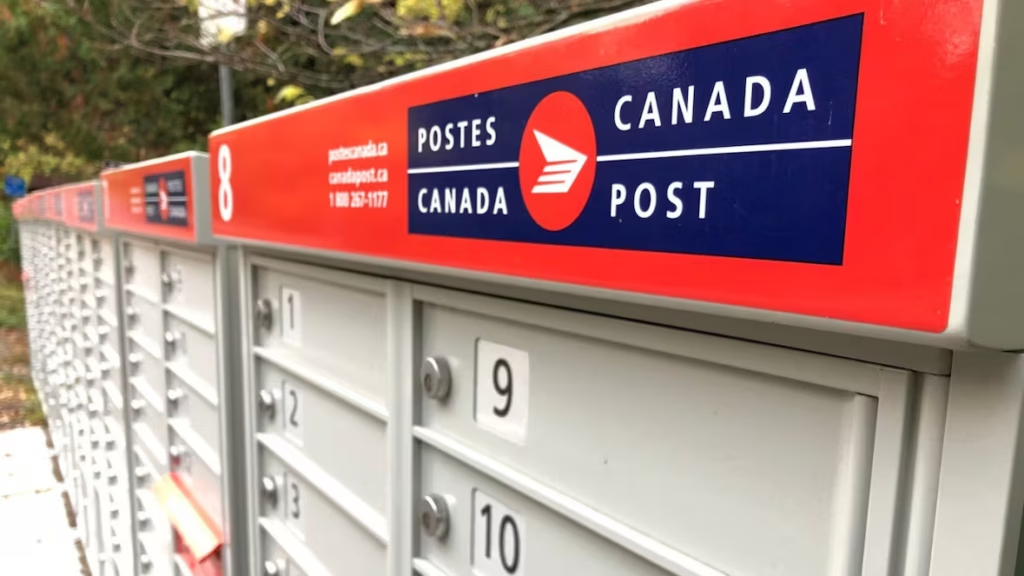

Canada Post is pressing ahead with one of the biggest changes to residential mail service in decades, announcing that another 485,000 addresses will lose door-to-door delivery and move to community mailboxes in 2027.
The latest expansion affects 37 communities across seven provinces and adds to the 136,000 addresses already identified for conversion earlier this year. In total, more than 621,000 households have now been scheduled to transition away from home mail delivery as part of Canada Post’s broader modernization strategy.
While many Canadians already collect mail from centralized locations, the latest announcement highlights the scale of a plan that ultimately targets the roughly four million addresses that still receive mail directly at their front door. Canada Post says the conversions will take place over the next five years as it works to reduce costs and adapt to changing delivery demands.
Hundreds of thousands of households added to conversion plan
Ontario will experience the largest impact in the latest phase, with approximately 158,000 addresses set to move to community mailboxes. The affected communities include Ajax, Brampton, Hawkesbury, Kitchener, London, Mississauga, Ottawa and Pickering.
Quebec follows with around 139,000 addresses scheduled for conversion across Laval, Longueuil, Quebec City, Saint-Hubert, Trois-Rivières and L’Ancienne-Lorette.
British Columbia accounts for approximately 81,000 addresses, including Burnaby, Colwood, Coquitlam, Esquimalt, Kelowna, Langford, New Westminster, Port Coquitlam, Port Moody, Saanich, Songhees Nation, Victoria, View Royal, Westbank First Nation and West Kelowna.
Alberta will see roughly 56,000 addresses converted in Calgary and Edmonton. Manitoba’s affected areas include Winnipeg and Portage la Prairie, while New Brunswick includes Fredericton and Oromocto. Halifax is the affected community in Nova Scotia, with Manitoba, New Brunswick and Nova Scotia each seeing about 17,000 addresses converted.
The newly announced communities will join earlier conversion areas already scheduled for late 2026 and early 2027, significantly expanding the rollout across the country.
Why Canada Post wants more community mailboxes
Canada Post argues that the shift is necessary as the economics of traditional mail delivery continue to change. Letter volumes have declined for years as consumers and businesses increasingly rely on digital communication, while operating costs have continued to rise.
According to the Crown corporation, delivering mail to individual homes costs significantly more than serving multiple households through centralized mailbox locations. Canada Post also says community mailboxes provide greater security because mail and parcels remain locked until collected.
The organization has framed the conversion program as a key part of its effort to modernize operations without becoming a recurring burden on taxpayers.
The announcement comes during a period of broader transformation for the postal service. Earlier this year, Canada Post workers approved a new five-year contract, providing additional operational certainty as the corporation advances major network and delivery changes.
What the changes mean for residents
For affected households, the most visible change will be where mail is collected. Instead of receiving letters directly at the front door, residents will access mail through a designated community mailbox site located within their neighbourhood.
Canada Post says nearly three-quarters of Canadian addresses already receive mail through community mailboxes, apartment lobby boxes or post office boxes. However, millions of households continue to receive traditional home delivery, particularly in established suburban neighbourhoods.
The change may be simple for some households but more challenging for others. Seniors, people with disabilities and residents with mobility concerns may need to pay close attention to where mailbox sites are placed and how accessible they are throughout the year.
Local factors such as sidewalk access, lighting, snow clearing, parking and traffic safety could become important during community discussions. Canada Post says it will work with local governments before finalizing mailbox locations.
What happens before the 2027 switch
The conversion process is expected to unfold gradually. Canada Post says it will begin discussions with municipalities and local governments in the affected communities in the coming weeks and months.
Once suitable locations are identified, community mailbox sites must be reviewed, approved and installed. Canada Post says converting an address from door-to-door delivery to a community mailbox typically takes months, meaning residents should receive advance notice before service changes begin.
Read More
The 2027 rollout is unlikely to be the last major announcement. With four million home-delivery addresses still targeted over five years, more communities could be added as Canada Post continues reshaping how mail is delivered across the country.
Additional information, including postal codes scheduled for future conversion, is available through Canada Post.

Make Swikblog your go-to source on Google for reliable updates, smart insights, and daily trends.