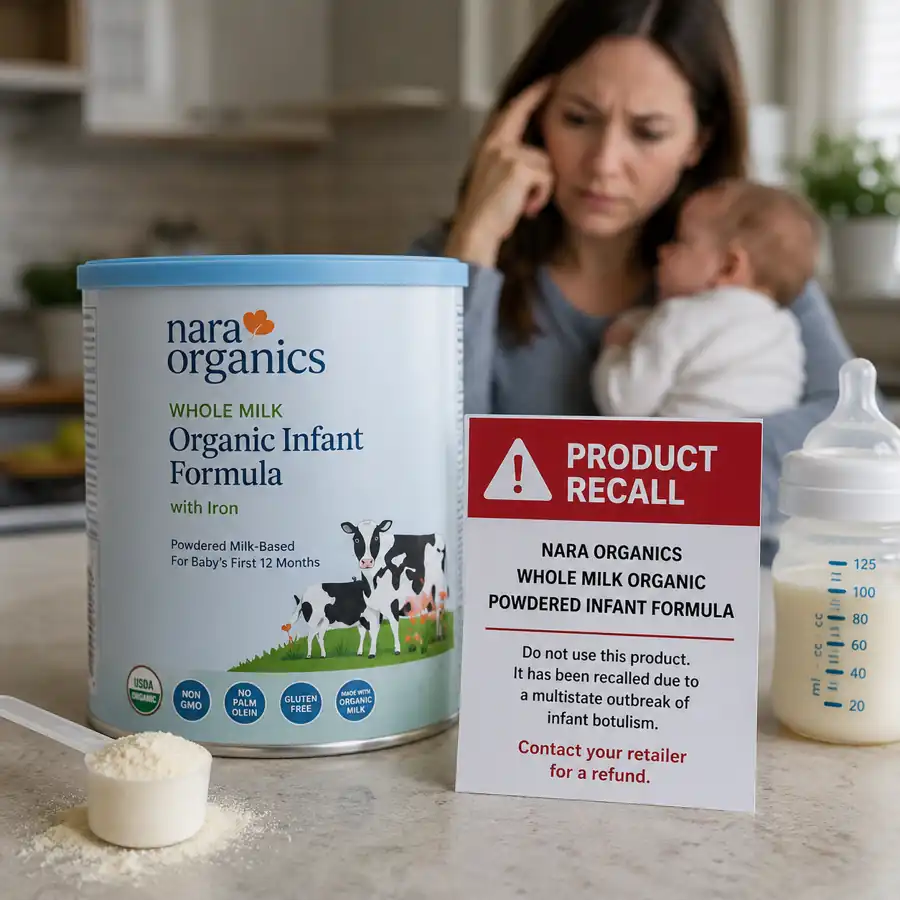

Federal health officials are urging parents and caregivers to stop using Nara Organics Whole Milk Organic Powdered Infant Formula after a multistate outbreak of infant botulism led to the hospitalization of three babies in the United States.
The recall, announced on June 13, affects all lots and all can sizes of the formula sold nationwide through Target stores, Target.com and Nara.com. According to the U.S. Food and Drug Administration, the affected product was distributed between July 2025 and June 2026 and was manufactured in Europe for sale only in the U.S. market.
The FDA and CDC are investigating three confirmed or suspected infant botulism cases reported in California, Pennsylvania and Washington. The infants, who ranged in age from 2 to 5 months, became ill between April and May 2026 after consuming Nara Organics powdered infant formula.
Three Infants Hospitalized as Testing Continues
All three babies required hospitalization and were treated with BabyBIG, the FDA-approved treatment for infant botulism. The illness is rare but serious, especially for babies under 1 year old, whose digestive systems are still developing.
Infant botulism can occur when spores of Clostridium botulinum enter a baby’s gut and produce a dangerous toxin. Early symptoms may include constipation, poor feeding, weak or altered crying, drooping eyelids, decreased facial expression, loss of head control and difficulty swallowing. In severe cases, the illness can progress to breathing problems or respiratory arrest.
Health officials said symptoms can take several weeks to develop after exposure. Parents should seek immediate medical care if a baby who consumed the recalled formula shows any warning signs.
Testing of opened and unopened formula samples is underway, with results expected in the coming weeks. Officials in two states have collected leftover formula for laboratory analysis as the investigation continues.
Read More
What Parents Should Do Now
The CDC says families should stop using Nara Organics Whole Milk Organic Powdered Infant Formula immediately. Unopened cans should be returned or discarded. For opened cans, parents are advised to take a photo of the label, record the lot number and use-by date, and keep the container stored safely away from other baby-feeding items.
Officials recommend labeling any opened container “DO NOT USE” and keeping it for at least one month in case a state health department requests testing. If no symptoms appear after a month, the leftover formula should be thrown away. Any bottles, scoops, surfaces or feeding items that may have touched the formula should be washed with hot soapy water or cleaned in a dishwasher.
The latest recall comes amid heightened scrutiny of infant nutrition products. Earlier concerns around contamination risks also drew attention during the Nestlé baby formula recall, another case that raised questions about product safety and quality controls in the baby food industry.
Nara Organics said it is recalling all of its infant formula products and urged families to stop using them immediately. The company said it was “heartbroken” over the concern and stress the situation may cause families.
The FDA said Nara Organics Whole Milk Organic Infant Formula represents less than 1% of all infant formula sold in the United States, so the recall is not expected to create broader formula shortage concerns.
Parents and caregivers can follow official updates through the FDA outbreak investigation page. Until the investigation is complete, the clearest guidance from health officials is to avoid using the recalled formula and seek urgent medical care if symptoms appear.

Make Swikblog your go-to source on Google for reliable updates, smart insights, and daily trends.