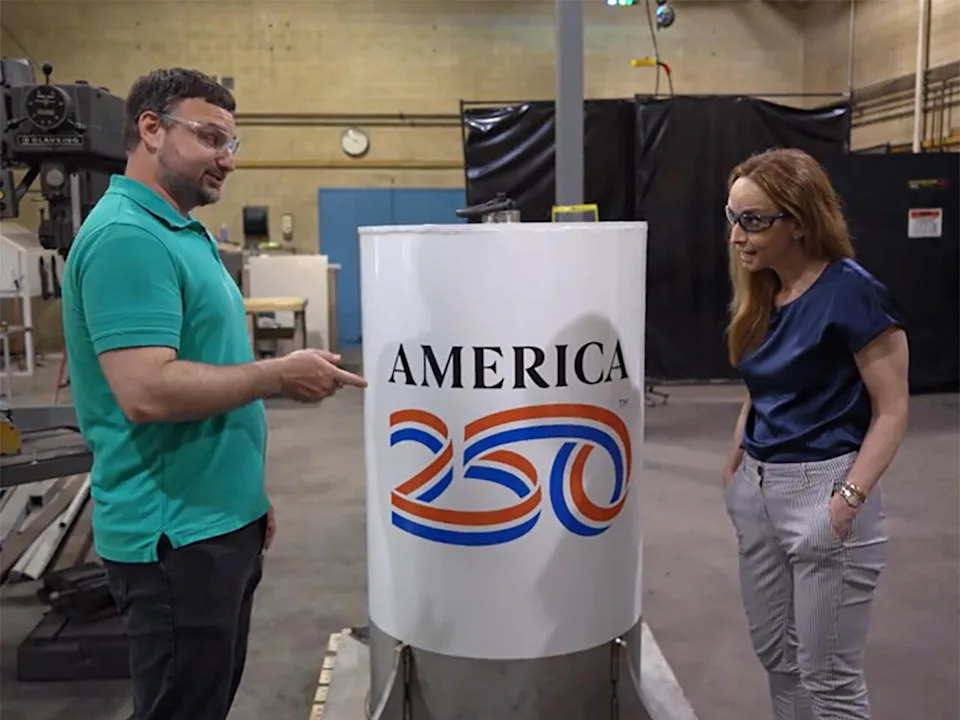

On July 4, 2026, while Americans celebrate the nation’s 250th birthday, a remarkable project will begin a much longer journey. A specially engineered time capsule will be buried in Philadelphia with instructions that it remain sealed until July 4, 2276, when the United States reaches its 500th anniversary.
The initiative, known as America’s Time Capsule, is designed to preserve a physical record of life in 2026. Unlike traditional anniversary projects focused on the present, this one is aimed entirely at people living 250 years in the future. The capsule will be buried at Independence National Historical Park, close to where the Declaration of Independence was adopted, creating a direct link between America’s founding and its future.
A Snapshot of America at 250
The collection was assembled with contributions from all 50 states, Washington, D.C., and five U.S. territories. Organizers wanted the capsule to reflect the country as a whole rather than focusing only on national institutions or famous historical artifacts.
The result is a mix of cultural objects, technology, personal stories and historical memorabilia. Among the items selected are an iPhone 17, Native American artwork, student essays, commemorative coins and pins, a Coca-Cola bottle and a feather from the eagle that accompanied Union soldiers during the Civil War.
Several states chose objects closely connected to their own histories. West Virginia submitted a piece of coal carved into the shape of the state, while Ohio contributed fabric from the Wright Flyer alongside a statement from aviation pioneer Orville Wright.
Together, the collection is intended to show future generations not only what Americans achieved, but also what they valued.
Messages for People Who Haven’t Been Born Yet
One of the most personal aspects of the project comes from ordinary citizens. Visitors to the White House Visitor Center have been invited to write messages addressed to future Americans, with selected submissions expected to become part of the final collection.
Many of the messages focus on optimism, community and hopes for the future. Those handwritten thoughts may eventually provide future historians with a unique look at how people in 2026 viewed their country and the decades ahead.
Unlike official records and government documents, these messages capture individual voices, making the capsule more than a historical archive.
Why an iPhone 17 May Become a Historical Artifact
The inclusion of an iPhone 17 highlights how quickly technology can become history. While smartphones are an everyday part of life today, future generations may view them much the same way modern audiences view telegraphs, typewriters or early radios.
The device represents a period when communication, entertainment, commerce and social interaction increasingly revolved around digital platforms. Even if future technology renders the phone unusable, the object itself could help historians understand the digital culture of the early 21st century.
At the same time, preserving digital information for centuries remains a major challenge. That reality explains why the project includes one of its most advanced technological features.
The Tiny DNA Archive Hidden Inside
Among the capsule’s most innovative components is synthetic DNA storage. Researchers have encoded digital copies of important historical records into DNA, allowing large amounts of information to be preserved in an extremely small space.
The DNA archive includes Thomas Jefferson’s original draft of the Declaration of Independence, a rendering of Abraham Lincoln’s hand and a recording of “The Star-Spangled Banner.” The entire collection can fit inside a vessel roughly the size of a thimble.
The technology demonstrates how preservation methods are evolving beyond paper and hard drives. Similar breakthroughs are being driven by advances in AI-powered computing and next-generation digital infrastructure, which continue to reshape how information is stored, analyzed and protected for future generations.
The Engineering Challenge of Lasting 250 Years
Building a time capsule capable of surviving until 2276 required far more than simply sealing objects inside a container. Engineers at the National Institute of Standards and Technology studied the failures of earlier time capsules and found that water intrusion is one of the most common reasons they deteriorate.
Several designs were considered, including a box, a star and a cylinder. While the star-shaped concept offered a visually striking design, its edges and joints created additional risks. Engineers ultimately selected a stainless-steel cylinder because it offered greater durability and fewer potential entry points for moisture.
The capsule weighs approximately one ton before its contents are loaded. Its design reflects a singular goal: ensuring the collection remains intact despite centuries of environmental exposure.
Not Everything Made the Cut
Selecting objects for the capsule involved more than historical significance. Archivists from the Library of Congress reviewed submissions to determine whether they could survive alongside other materials for 250 years.
Items that could decay, decompose or damage neighboring artifacts were rejected. Materials containing certain adhesives, leather products and food items were excluded because they could deteriorate over time and compromise the rest of the collection.
This careful screening process illustrates the balance between preserving meaningful objects and protecting them for future generations.
Read More
Why the Project Matters Beyond the Anniversary
America’s Time Capsule is ultimately about more than preserving artifacts. It represents a rare attempt to communicate across centuries, offering future Americans a firsthand look at how people in 2026 understood their nation, their technology and their place in history.
When the capsule is finally opened on July 4, 2276, future generations will discover a collection shaped by both ordinary citizens and national institutions. They will see what America chose to remember at age 250 and how it hoped to be remembered at age 500.
Additional information about the national initiative can be found through the official America250 program.
For now, the capsule serves as a reminder that while technology, politics and culture may change dramatically over the next two and a half centuries, the desire to leave a message for the future remains timeless.

Make Swikblog your go-to source on Google for reliable updates, smart insights, and daily trends.