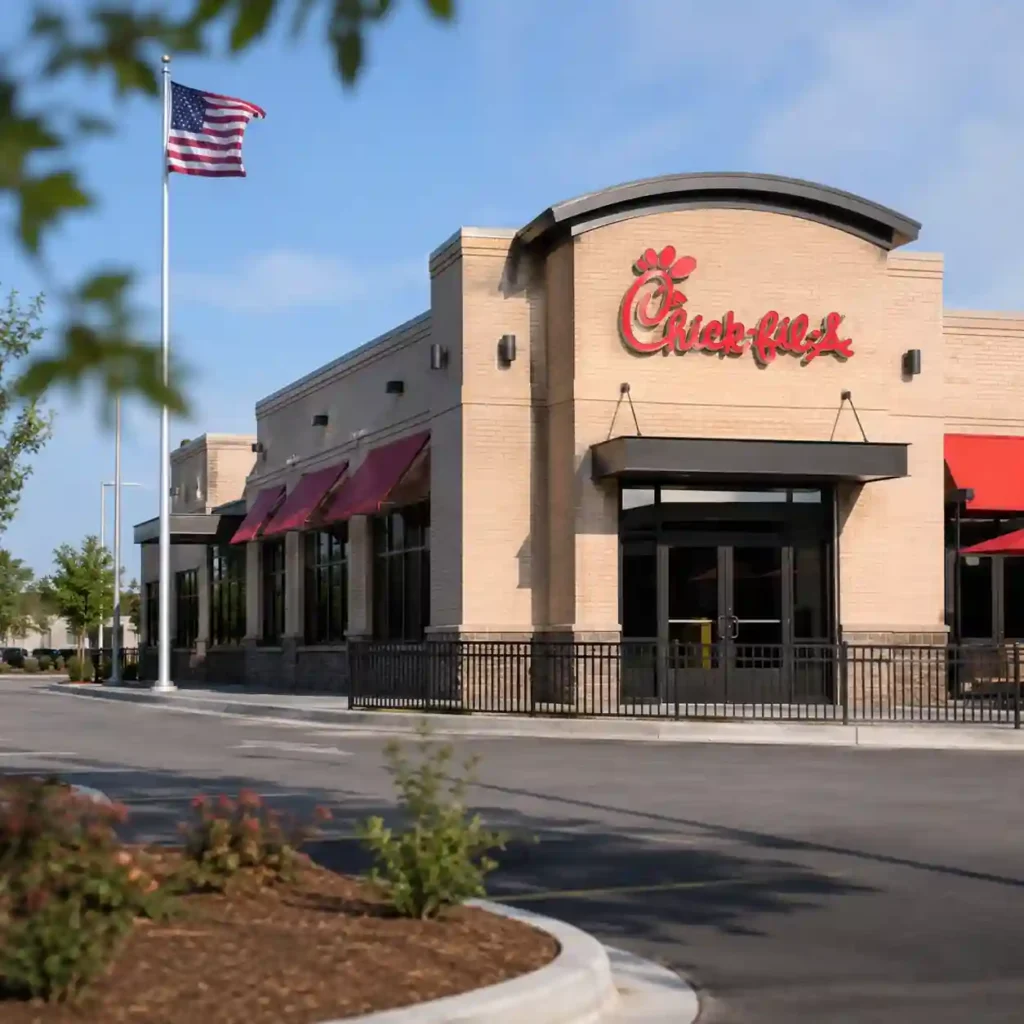

Every Chick-fil-A restaurant will be closed tomorrow, and for millions of customers, the reason is both familiar and unusual in modern fast food. The chain is not shutting its doors because of a recall, labor dispute, holiday schedule or supply problem. It is Sunday, and Chick-fil-A has followed the same rule for nearly 80 years: restaurants close for one full day each week.
The policy dates back to 1946, when founder S. Truett Cathy opened his first restaurant in Hapeville, Georgia. Long before Chick-fil-A became a national chicken chain, Cathy decided that employees should have a guaranteed day to rest, spend time with family and loved ones, or worship if they chose. Chick-fil-A still explains the policy that way on its official Sunday closure page.
Why every Chick-fil-A is closed tomorrow
The simple answer is that Chick-fil-A closes every Sunday. The deeper reason is tied to the founder’s experience in the restaurant business.
Cathy had worked long hours in restaurants that operated seven days a week, including round-the-clock service. After seeing how demanding that schedule could be for workers and operators, he chose to build a different kind of routine into his company from the beginning.
That decision has survived enormous changes in the restaurant industry. Fast-food chains now compete through drive-thrus, mobile apps, delivery platforms, late-night menus and loyalty programs. Yet Chick-fil-A continues to leave Sunday out of its weekly sales calendar.
Why the rule is unusual for fast food
For most restaurant companies, closing one day out of every seven would be a difficult financial choice. Restaurants pay rent, manage equipment, schedule workers and compete for limited customer traffic. Weekend business can be especially valuable, particularly in shopping areas, travel corridors and suburban markets.
That makes Chick-fil-A’s Sunday rule stand out. The company gives up potential sales on a day when many competitors remain open, but the closure has also become part of what makes the brand recognizable.
Customers know the rule before they arrive. Workers know it before they are scheduled. Operators build around it. In an industry where many chains try to stretch hours longer, Chick-fil-A has made a fixed closure part of its operating identity.
Sunday closure works as an employee benefit
One of the clearest effects of the policy is predictability for restaurant employees. Food-service workers often face changing schedules, weekend shifts and limited control over personal time. At Chick-fil-A, Sunday is removed from the regular restaurant workweek.
That does not mean every employee at every level has the same experience, but the restaurant closure gives workers one guaranteed day when they are not expected to serve customers in-store or at the drive-thru.
The policy has also helped some operators experiment with work schedules. A Chick-fil-A restaurant in Miami previously gained attention for offering some employees the option to work three longer shifts of roughly 13 to 14 hours each week instead of five shorter shifts. Because Sunday was already closed, the schedule gave participating workers full-time pay while creating four days away from work.
The original example included workers who used that flexibility in practical ways: one manager finished a degree, while another was able to travel home to Scotland twice in one year. Those examples show how a fixed closed day can become more than a symbolic policy when operators build staffing models around it.
It also creates a Saturday habit
Chick-fil-A does not describe Sunday closure as a marketing tactic, but it can affect customer behavior. Many loyal customers know that if they want Chick-fil-A before the new week begins, Saturday is their last chance.
That creates a kind of weekly scarcity. Unlike a limited-time menu item or a promotional discount, the constraint is permanent. The restaurant is simply unavailable every Sunday.
Over time, that has turned “Closed Sundays” into something close to a brand phrase. Other chains rely on advertising slogans. Chick-fil-A’s weekly absence has become a message of its own.
The values message cuts both ways
For some customers, the Sunday policy is viewed positively because it appears to prioritize rest, family time and employee predictability over an extra day of sales. For others, Chick-fil-A’s values-based identity is more complicated.
The company has faced criticism in the past over charitable donations connected to groups criticized for anti-LGBTQ+ positions. In 2019, Chick-fil-A said it was changing its charitable giving strategy, with future giving focused on areas such as education, homelessness and hunger.
That history matters because the Sunday closure is not viewed in the same way by everyone. For some customers, it strengthens loyalty. For others, past controversies remain part of their decision about whether to support the chain.
Does “closed Sunday” mean no work happens anywhere?
The public-facing rule is clear: traditional Chick-fil-A restaurants do not serve customers on Sundays. Less clear is how much work, if any, happens behind the scenes across corporate offices, franchise operations or planning teams.
Chick-fil-A’s customer service phone support is listed for Monday through Saturday, 9 a.m. to 10 p.m. ET, which fits the broader public rhythm of the Sunday closure. Still, restaurant closure and total companywide work stoppage are not exactly the same thing.
That distinction is important for readers because the rule is often summarized too simply. Customers experience it as a closed restaurant. Employees and operators may experience it differently depending on role, location and responsibilities.
Read More
What customers should know before visiting tomorrow
Anyone planning to visit Chick-fil-A tomorrow should expect regular restaurants to be closed and should plan for Monday instead. That includes drive-thru, dine-in and standard mobile ordering at traditional locations.
Customers traveling through airports, college campuses, stadium areas or special venues should still check the specific location, because licensed and nontraditional food-service sites can have different operating arrangements. Even so, Chick-fil-A’s Sunday closure remains the general rule customers should expect.
Quick reminder: If Chick-fil-A is part of your weekend plans, Saturday is the day to go. Sunday closures are not temporary and are not limited to a specific city or state.
The reason the story continues to attract attention is that Chick-fil-A has turned a limitation into a long-running business signal. In a market built around convenience, the company has chosen consistency over nonstop availability.
For readers following changes across major restaurant chains, Swikblog has also covered how coffee chains are adding fruit-flavored drinks as brands adjust menus to changing customer habits.
Chick-fil-A’s Sunday closure may not be a model every business can copy. But it shows how a company can build an identity around a firm operating choice and keep that choice in place even as the industry around it changes.

Make Swikblog your go-to source on Google for reliable updates, smart insights, and daily trends.