
NYT Connections for June 25, 2026, puzzle #1110, was tougher than it first looked because the board mixed plain everyday words with one deeply hidden sound-based category. The computer and packed-tight groups were easier to build, but the purple group could stall anyone solving only by meaning.
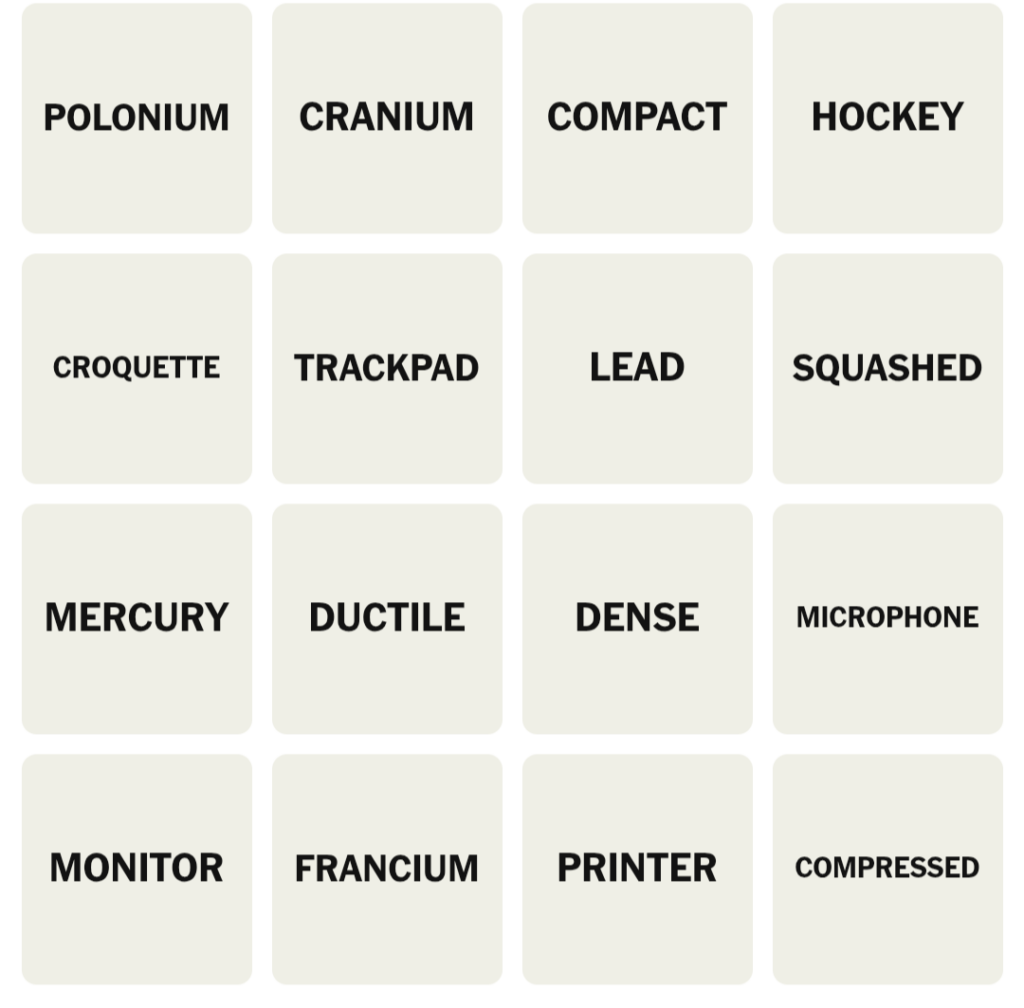
The biggest traps came from words that looked useful for the wrong reason. Compact could pull players toward computer hardware, Lead could be read as a verb instead of an element, and Mercury might suggest planets before hazardous metals.
NYT Connections June 25 Hints
Yellow hint: Think about items used with a computer.
Sharper clue: These are devices or accessories often found around a desk setup.
Trap to avoid: Do not pull in Compact just because it can describe a small device.
Green hint: Think of things pushed close together.
Sharper clue: The shared idea is tightness, pressure or lack of empty space.
Trap to avoid: Compressed may sound technical, but the category is not about files or software.
Blue hint: Think periodic table hazards.
Sharper clue: These are hazardous elemental metals, not just science-related words.
Trap to avoid: Mercury may suggest a planet, and Lead may suggest guiding someone, but both are elements here.
Purple hint: Say the beginning of each word out loud.
Sharper clue: Each answer starts with a sound-alike of a bird name.
Trap to avoid: The words do not share a normal definition-based link. This is a pronunciation trap.
Common wrong paths: A tech grouping can go wrong if Compact or Compressed gets dragged in beside Monitor or Trackpad. A science grouping can also feel too broad if players stop at Mercury and Lead without checking whether all four are elemental metals.
The purple set is the most deceptive because Cranium, Croquette, Ductile and Hockey look unrelated until their opening sounds are heard as crane, crow, duck and hawk.
If the easier yellow and green sets came first, the last eight words likely became a fight between chemistry and wordplay. The key move was not forcing the remaining words into a meaning-based theme. Reading the odd words aloud made the purple pattern much easier to spot.
Today’s NYT Connections Answers
The hints above avoid direct spoilers. The full solution for NYT Connections puzzle #1110 is below, with each group explained so the logic is clear.
Yellow Group
Tap to reveal Yellow answers
Category: Computer peripherals
Answers: Microphone, Monitor, Printer, Trackpad
Explanation: These are all devices or accessories commonly used with a computer. A microphone captures audio, a monitor displays the screen, a printer produces physical copies, and a trackpad controls the cursor.
Main trap: Compact could tempt players into a broader tech-accessory guess. Printer was the best anchor because it clearly pointed to physical computer hardware.
Green Group
Tap to reveal Green answers
Category: Tightly packed
Answers: Compact, Compressed, Dense, Squashed
Explanation: Each word describes something packed closely together or pressed into a smaller space. The words can apply to objects, materials, crowds or space.
Best solving anchor: Squashed was the clearest anchor because it strongly suggests physical pressure. Once paired with Compressed, Compact and Dense fit naturally.
Blue Group
Tap to reveal Blue answers
Category: Hazardous elemental metals
Answers: Francium, Lead, Mercury, Polonium
Explanation: These are chemical elements known for serious hazards, toxicity, radioactivity or instability. The connection becomes clear only when the words are treated as elements rather than everyday terms.
Main trap: Lead has a common verb meaning, and Mercury can point to the planet or the Roman god. The category works because all four are hazardous elemental metals.
Purple Group
Tap to reveal Purple answers
Category: Starting with bird homophones
Answers: Cranium, Croquette, Ductile, Hockey
Explanation: Each word begins with a sound-alike of a bird name: Cranium starts like crane, Croquette starts like crow, Ductile starts like duck, and Hockey starts like hawk.
Main trap: Nothing about the meanings of these four words naturally connects. The solve depends on sound, not spelling or definition, which made this the puzzle’s hardest group.
Today’s solving lesson is to change methods when the remaining words refuse to connect by meaning. Connections often hides its hardest group in pronunciation, prefixes or word fragments, and puzzle #1110 was a clear example of that.
For official gameplay, players can visit the New York Times Connections page.

Make Swikblog your go-to source on Google for reliable updates, smart insights, and daily trends.