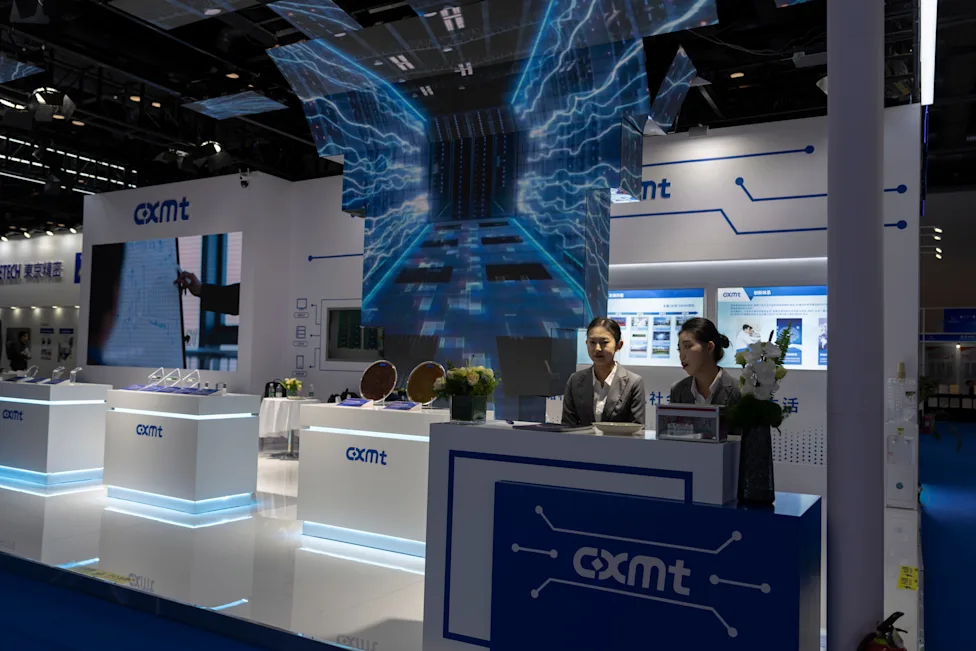

Shares of ChangXin Memory Technologies, better known as CXMT, surged about 470% during their Shanghai debut on Monday, July 27, after the Chinese memory-chip manufacturer completed mainland China’s largest initial public offering in years.
The listing matters beyond its first-day gain. CXMT is China’s largest DRAM producer and an important part of Beijing’s effort to build a domestic semiconductor supply chain as artificial-intelligence demand grows and US-led restrictions limit access to advanced foreign technology.
What happened in the CXMT IPO?
CXMT listed on the Shanghai Stock Exchange’s technology-focused STAR Market. It priced its shares at 8.66 yuan, approximately $1.30, and raised about 57.9 billion yuan, or $8.5 billion to $8.6 billion.
Total proceeds could approach 66.6 billion yuan if underwriters fully exercise the overallotment option. That would bring the fundraising amount close to $10 billion.
The shares opened at about 49.50 yuan and remained roughly 470% above the issue price by midday. The surge briefly lifted CXMT’s market value above 3 trillion yuan, or more than $440 billion, although valuations created during volatile debut trading can change quickly.
Why did CXMT shares surge?
Investors are treating CXMT as both a fast-growing manufacturer and a strategically important Chinese technology company.
AI data centres require large amounts of memory to deliver information quickly to processors. Samsung Electronics, SK Hynix and Micron have consequently directed more capacity toward high-bandwidth memory and premium server products.
That shift has tightened supplies of conventional DRAM used in computers, smartphones and other electronics. Higher memory prices and strong Chinese demand have helped CXMT increase sales after years of spending heavily on research and factories.
CXMT reported first-quarter 2026 revenue of 50.8 billion yuan, about $7.5 billion, representing growth of more than 700% from a year earlier. Total net profit reached approximately 33 billion yuan, while profit attributable to shareholders was about 24.76 billion yuan.
The company expects first-half revenue of 110 billion to 120 billion yuan and attributable profit of 50 billion to 57 billion yuan. Those figures help explain investor enthusiasm, but they also reflect unusually strong memory prices that may not continue indefinitely.
What does CXMT manufacture?
Founded in Hefei in 2016, CXMT produces dynamic random-access memory, or DRAM. These chips temporarily hold information that processors need to retrieve quickly and are used in AI servers, computers, smartphones, vehicles and other electronics.
The Associated Press report on CXMT’s Shanghai debut described the company as China’s largest memory-chip manufacturer.
Increasingly data-heavy services are also supporting demand for computing infrastructure. Developments such as Facebook’s immersive video-feed test illustrate how digital platforms continue introducing products that require more processing, storage and supporting memory.
How does CXMT compare with its competitors?
Counterpoint Research ranked CXMT as the world’s fourth-largest DRAM producer by shipments in 2025, when it held approximately 6% of the market.
Samsung accounted for about 36%, SK Hynix held 29%, and Micron controlled approximately 24%. CXMT’s share increased to around 9% in early 2026 and is forecast to reach about 11% by 2028. Counterpoint estimates that it may need at least 15% to remain competitive over the long term.
Why does HBM matter?
High-bandwidth memory, or HBM, stacks memory components to move data much faster than conventional DRAM. It is essential for advanced AI processors and servers.
US restrictions limit China’s access to leading foreign HBM products, making CXMT a potential domestic supplier. However, it has not yet matched Samsung, SK Hynix or Micron in commercial HBM production.
Competitive HBM requires advanced manufacturing, specialised packaging and consistently high production yields. Restrictions on advanced chipmaking tools make that development more difficult and force CXMT to depend increasingly on Chinese equipment suppliers.
How will CXMT use the IPO proceeds?
Listing information indicates that 7.5 billion yuan will upgrade memory-wafer production lines, while 13 billion yuan will support a DRAM technology project. Another 9 billion yuan is allocated to future-focused research and development.
The investment could expand output, improve manufacturing processes and reduce reliance on overseas technology. It comes amid broader investor attention on major Chinese companies and the regulatory environment highlighted by China’s record enforcement action against Trip.com.
Read More:
Could CXMT ease the memory shortage?
Additional CXMT production could eventually improve conventional DRAM availability and reduce pressure on computer and smartphone manufacturers. The outcome will depend on how quickly it expands factories, improves yields and secures equipment.
Supply will also be influenced by whether Samsung, SK Hynix and Micron continue shifting production from conventional memory toward higher-margin HBM.
What are the risks?
Memory is a cyclical industry in which prices and profits can fall sharply when supply exceeds demand. CXMT also faces export controls, manufacturing bottlenecks, a technology gap in HBM and a demanding valuation following its 470% debut gain.
The Pentagon has designated CXMT as a company it says has links to China’s military, a characterisation Beijing generally rejects. Some US lawmakers have also sought restrictions on American companies purchasing its products.
CXMT’s next test is whether it can convert its IPO funding into greater capacity, stronger technology and competitive AI memory after the excitement surrounding its first trading day fades.

Make Swikblog your go-to source on Google for reliable updates, smart insights, and daily trends.