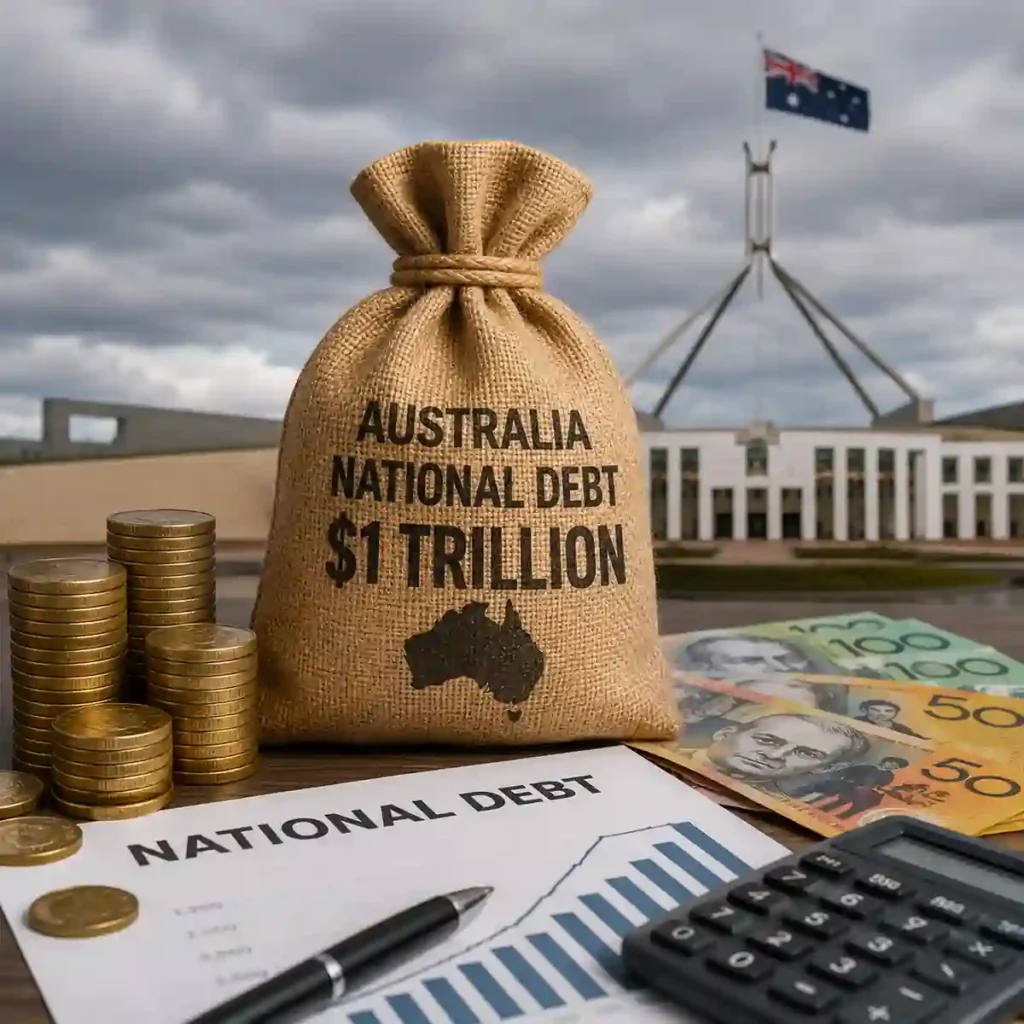

Australia’s federal gross debt has crossed the $1 trillion mark for the first time, putting a striking new number on the Commonwealth’s finances and intensifying debate over government spending, deficits and the growing cost of servicing debt.
The milestone was reached as the Australian Office of Financial Management (AOFM), which manages Commonwealth borrowing, issued new government securities. But the headline needs context: Australia did not suddenly borrow $1 trillion, and crossing the threshold does not mean taxpayers have been handed an immediate $1 trillion bill.
How Australia crossed $1 trillion
The AOFM reported $983.7 billion of Australian Government Securities on issue as of August 14, 2026. Further issuance during the following days, including around $4 billion in additional borrowing on August 20, was enough to take the total briefly beyond the trillion-dollar threshold.
The first crossing may be short-lived because around $6 billion of Treasury Notes mature on August 21. However, the broader borrowing requirement remains. Australia’s 2026–27 financing program anticipates around $125 billion of Treasury Bond issuance as the government refinances maturing securities and meets funding requirements.
Gross debt and net debt tell different stories
The $1 trillion figure refers to gross Commonwealth debt, broadly represented by Australian Government Securities outstanding. Net debt is considerably lower because it accounts for relevant financial assets.
According to Australian Office of Financial Management budget data, Commonwealth net debt was estimated at $556 billion, or 18.8% of GDP, at June 30, 2026. It is forecast to reach 21.9% of GDP by 2029–30.
That distinction matters because a $1 trillion headline viewed without the size of Australia’s economy or government assets can give an incomplete picture of the country’s fiscal position.
Why Australia is still borrowing
The Albanese government recorded two consecutive federal budget surpluses before returning to deficit. The underlying cash deficit is forecast at $28.3 billion for 2025–26 and $31.5 billion for 2026–27, with further deficits expected.
Governments borrow to finance deficits, refinance securities reaching maturity and manage cash requirements. Australia also accumulated substantial additional debt during the pandemic as emergency economic support dramatically increased government spending.
The government says it has identified more than $100 billion in savings and reprioritisations while continuing to fund areas including health, defence, housing and cost-of-living measures.
The debt milestone also arrives shortly after a federal budget focused heavily on household finances. A closer look at the Australia Budget 2026 winners and losers shows how tax relief, government spending and cost-of-living measures are competing with pressure to keep the nation’s finances sustainable.
What $1 trillion means for taxpayers
The most important issue for taxpayers is not the psychological trillion-dollar threshold but the cost of servicing government borrowing.
Interest expenses can reduce the amount of revenue available for hospitals, infrastructure, defence, welfare or tax relief. Higher borrowing costs can also make refinancing existing debt more expensive over time.
Crossing $1 trillion does not automatically trigger higher taxes. Tax rates remain policy decisions. Persistent deficits and increasing interest expenses can, however, put pressure on future governments to raise revenue, restrain spending or change priorities.
That comes as households are already adjusting to the July 1 tax, Centrelink, superannuation and minimum wage changes, including measures affecting workers, families and retirees in the 2026–27 financial year.
Who does Australia owe the money to?
Australia does not owe the entire $1 trillion to one country, bank or organisation. The Commonwealth raises money by selling government securities to investors.
Those investors can include banks, superannuation and investment funds, overseas institutions and other large investors. They receive interest and are repaid according to the terms of the securities they hold.
This is why investor confidence matters. Australia needs to remain capable of issuing and refinancing debt at sustainable borrowing costs.
Polymarket and Kalshi Face Australia ASIC Warning: What Users Need to Know
Medicare $272 Million Unclaimed Money: Australians Could Be Owed a $280 Rebate
Labor and Coalition clash over the milestone
Opposition economy spokesman Tim Wilson described the crossing as a “sad day” and argued that continued government spending and borrowing would leave future generations carrying the cost. His argument centres on the idea that today’s debt ultimately becomes a future budget obligation through interest and repayments.
The Albanese government rejects that interpretation. Treasurer Jim Chalmers’ office argues gross debt would have crossed $1 trillion about three years earlier under the trajectory Labor inherited and says debt could have been approaching $1.2 trillion this year under previous projections.
The government also says its fiscal management has avoided more than $70 billion in interest costs.
Why two budget surpluses did not erase the debt
A budget surplus does not wipe out decades of accumulated government borrowing. It means government receipts exceeded relevant payments under that budget measure during a particular financial year.
Existing bonds also mature at different times. Debt management therefore involves issuing securities, refinancing existing obligations and repaying securities as they mature. With the budget now back in deficit, the Commonwealth continues to have substantial financing requirements.
Is Australia facing a debt crisis?
The $1 trillion milestone by itself does not indicate an immediate sovereign debt crisis. Australia retains top-tier sovereign credit ratings and has a lower government debt burden than many other advanced economies.
That does not make the trajectory irrelevant. Persistent deficits, slower economic growth or rising borrowing costs could reduce the government’s room to respond to future recessions, emergencies or major spending demands.
For taxpayers, the figures worth watching after the $1 trillion headline are annual budget deficits, gross and net debt relative to GDP, government borrowing costs and interest payments. Those measures provide a much clearer picture of Australia’s fiscal health than whether gross debt happens to sit just above or below $1 trillion on a particular day.

Make Swikblog your go-to source on Google for reliable updates, smart insights, and daily trends.