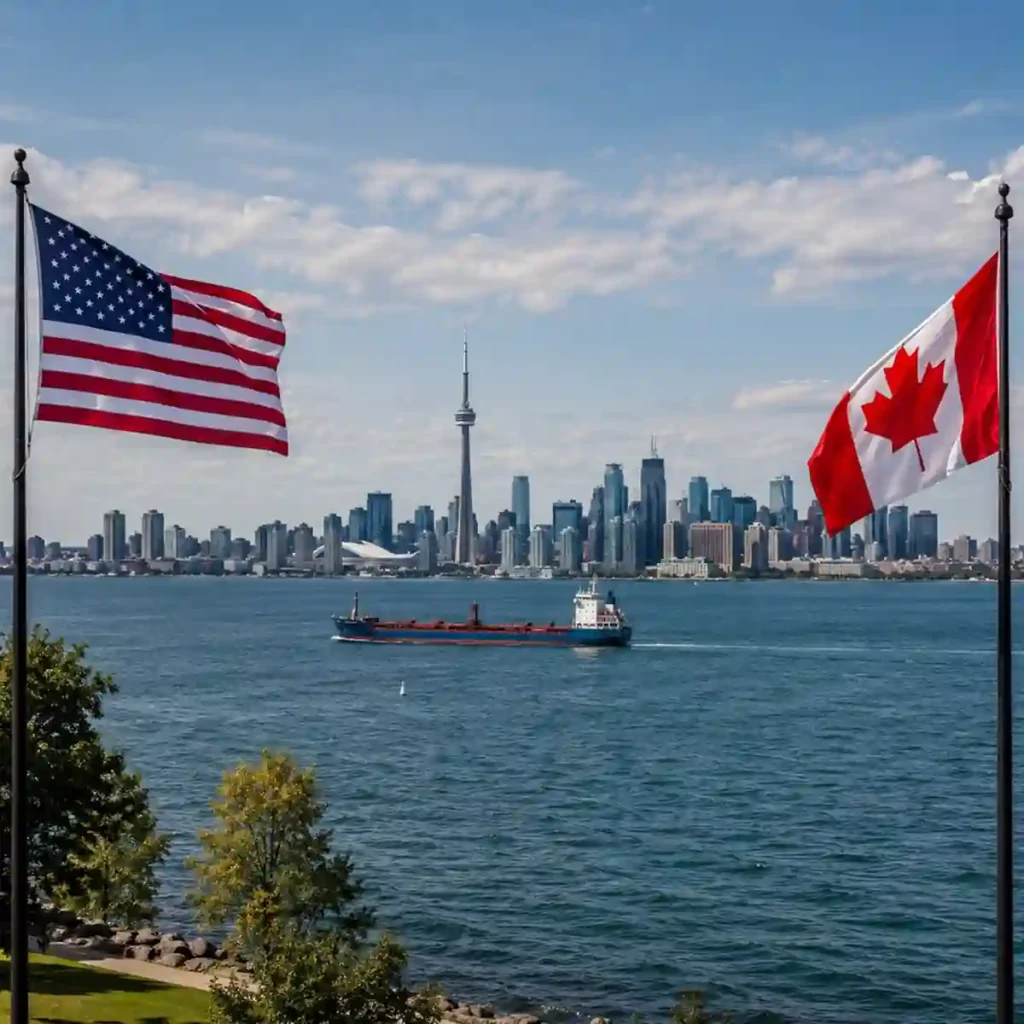

President Donald Trump has doubled down on his proposal to rename Lake Ontario “Lake America,” posting a video on August 27 showing him crossing out “Lake Ontario” on a map and writing “Lake America” in its place. The latest move comes as the U.S.-Canada trade dispute deepens, but Lake Ontario has not been formally renamed and Canada would not be required to adopt any new U.S. designation.
Trump has taken his “Lake America” proposal a step further. In a newly posted video, the president holds up a map of the Great Lakes, crosses out “Lake Ontario” with a marker and writes “Lake America” over it.
The video follows Trump’s August 25 statement that the United States was giving “serious consideration” to changing the lake’s name as relations with Canada deteriorate over trade.
The video does not, by itself, constitute a formal federal geographic-name change. Lake Ontario remains the established name, and Canada cannot be compelled to adopt a different U.S. designation for the shared lake.
Trump crosses out ‘Lake Ontario’ and writes ‘Lake America’
The controversy escalated on August 27 when Trump posted a video showing himself manually changing the lake’s name on a map.
The demonstration reinforces Trump’s support for “Lake America,” but there has been no confirmed announcement showing that the U.S. government has completed a formal federal renaming process.
Trump first raised the proposal on August 25, saying the United States was giving “serious consideration” to changing the name because he did not expect the country to be doing much business with Ontario.
Is Lake Ontario officially Lake America now?
No. Lake Ontario has not been officially renamed “Lake America.” Trump’s statements, social-media posts and map video are different from a completed federal geographic-name decision.
The U.S. Board on Geographic Names standardizes geographic names used by federal agencies.
Lake Ontario is more complicated than a geographic feature located entirely inside the United States because the international boundary between the U.S. and Canada passes through the lake.
Washington could determine terminology used by U.S. federal agencies, but it could not force Ottawa or the government of Ontario to adopt the same name.
Why is Trump targeting Lake Ontario?
The naming dispute has emerged during one of the sharpest recent deteriorations in U.S.-Canada trade relations.
The United States began imposing 50% tariffs on hundreds of Canadian goods on August 22 after negotiations between Washington and Ottawa failed to produce an agreement.
The measures affect roughly $20 billion worth of Canadian imports and cover only part of the enormous trading relationship between the neighboring countries.
Readers can see a broader breakdown of Canadian products affected by Trump’s 50% tariffs.
Canada’s retaliatory tariffs start September 8
Canada has responded by announcing retaliatory tariffs on hundreds of U.S.-made products.
The countermeasures are scheduled to take effect on September 8, 2026, escalating the dispute beyond Trump’s comments about Lake Ontario.
The targeted American products span multiple sectors, including food, consumer goods, clothing and other manufactured products.
Ottawa has also announced billions of dollars in support for Canadian businesses and workers that could be affected by the trade confrontation.
Canada prepares for a prolonged trade fight
Prime Minister Mark Carney’s government has signaled that Canada is preparing for the possibility that the dispute could continue rather than being resolved quickly through negotiations.
Both governments have nevertheless left open the possibility of eventually returning to talks.
Ontario Premier Doug Ford has pushed for a strong Canadian response, while other provincial leaders are debating how far Canada should go in using exports such as energy, potash and other resources as leverage.
Why the auto industry is the bigger economic risk
The Lake Ontario name dispute has attracted attention, but potential tariffs on automobiles and vehicle parts could have much larger economic consequences.
The United States and Canada operate deeply integrated automotive supply chains. Vehicle components can move across the border multiple times before a finished automobile reaches a dealership.
Higher tariffs can therefore create additional costs for manufacturers, suppliers and potentially consumers on both sides of the border.
The broader implications are covered in our guide to the U.S.-Canada tariff dispute and its impact on cross-border trade.
Who controls Lake Ontario?
Neither Canada nor the United States controls the entire lake. Lake Ontario forms part of the international boundary, with New York along the American shore and the province of Ontario along the Canadian side.
It is the smallest of the five Great Lakes by surface area and drains eastward through the St. Lawrence River toward the Atlantic Ocean.
The lake has long been managed through U.S.-Canada cooperation involving navigation, water levels, environmental protection and other shared-water issues.
Could Google Maps call it Lake America?
A formal U.S. naming decision would not automatically require Google Maps or other mapping companies to replace “Lake Ontario” worldwide.
Digital mapping services can display different geographic names depending on official government terminology, local rules and the country from which a user is viewing the map.
That means a future U.S. designation could potentially appear differently for American and Canadian users.
How is this different from the Gulf of America?
Trump has compared the idea with his administration’s earlier move to use “Gulf of America” for U.S. federal purposes instead of Gulf of Mexico.
Lake Ontario presents an even clearer international naming problem because the U.S.-Canada border passes directly through the body of water.
Even if Washington adopts “Lake America” for federal use, Canada’s government could continue using Lake Ontario.
Trump Plans to Revoke Up to 200,000 B1/B2 Visas: Who Is Affected?
Trump 50% Canada Tariffs: What Changes and Which Products Are Affected
What to watch next
The next major development would be a formal White House or federal government action directing U.S. agencies to adopt “Lake America” as the official American name.
On trade, attention now turns to September 8, when Canada’s retaliatory tariffs are scheduled to begin. Businesses are also watching for additional measures involving automobiles, parts, steel or other closely integrated industries.
As of August 27, Lake Ontario remains Lake Ontario. Trump’s map video represents his strongest public push yet for “Lake America,” but it has not established a completed official rename.

Make Swikblog your go-to source on Google for reliable updates, smart insights, and daily trends.