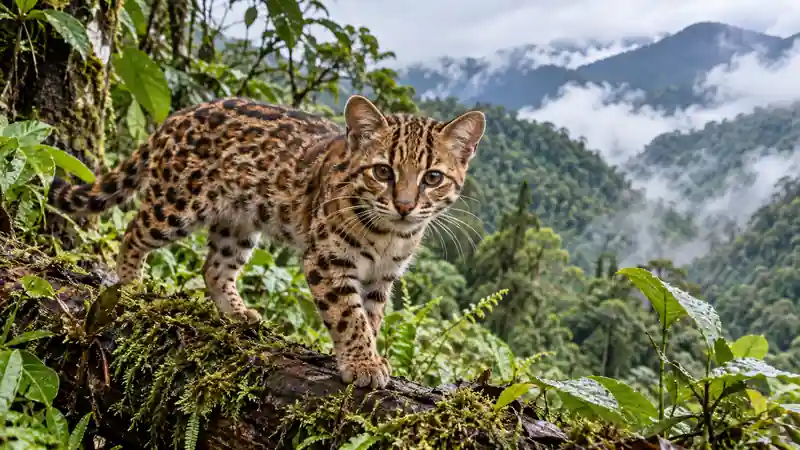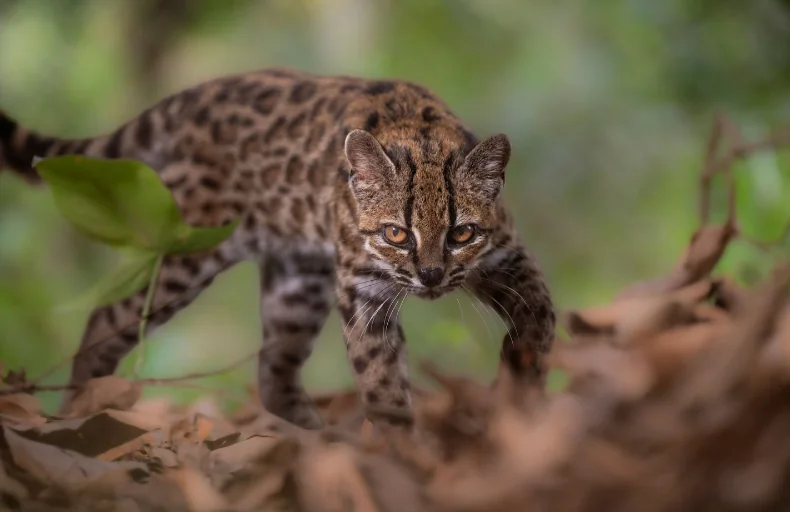

Scientists have identified a tiny spotted wild cat from Bolivia as a new species, marking the first time in more than a century that researchers have formally described a previously unrecognized living feline species.
Named Leopardus tilcayo, the cat is associated with Bolivia’s Yungas cloud forests and is smaller than the average domestic cat. Local communities already knew the animal as the tilcayo, but genetic research has now established that it represents a distinct evolutionary lineage rather than another population of a known South American tiger cat.
The finding carries an immediate conservation significance. Researchers are still working to establish the cat’s population, geographic range and exposure to habitat loss in a mountain-forest ecosystem already facing environmental pressure.
New cat species discovered in over 100 years
— Nature is Amazing ☘️ (@AMAZlNGNATURE) September 17, 2026
Scientists have identified Leopardus tilcayo, a tiny wild cat found in Bolivia’s Yungas forests. The discovery began with a wildlife sanctuary reporting a “weird cat” and was later confirmed through genetic research pic.twitter.com/9VVJgdYTIH
A tiny spotted cat from Bolivia’s cloud forest
Leopardus tilcayo belongs to the group of small spotted felines commonly known as tiger cats, which occur across parts of Central and South America.
The Bolivian cat measures about 46 centimetres, or 18 inches, in body length and weighs roughly 1.4 kilograms, or about 3 pounds. Its light-brown coat is patterned with irregular dark rosettes, giving it a miniature leopard-like appearance.
Those markings also contributed to the scientific puzzle. Several tiger cats look remarkably similar, making it difficult to determine their relationships from appearance alone.
The scientific name retains “tilcayo,” the name used by local communities. The animal was therefore not unknown to people in the region; the breakthrough was establishing its separate biological identity.
A sanctuary cat helped start the investigation
The investigation began after a spotted kitten was found near forest habitat and initially mistaken for an unusual domestic cat. As it grew, its behaviour showed that it was a wild animal, and it was eventually transferred to the Senda Verde Animal Refuge in Bolivia.
Bolivian biologist Paola Nogales-Ascarrunz later examined the cat and noticed features that did not fully match descriptions of known tiger cats. Differences in its rosette pattern were among the details that encouraged researchers to investigate further.
One of the animals examined is a male, now about 10 years old, living at Senda Verde. Researchers have said their information remains limited to two live individuals they examined and a small number of camera-trap records.
Genetic evidence confirmed a distinct lineage
Researchers turned to genomic analysis because visual differences alone could not reliably establish the cat’s identity.
The international team analysed DNA from 38 cats sampled across several South American countries, including eight museum specimens. The results placed the Bolivian tilcayo in a genetically distinct lineage.
The findings were published in the scientific journal Current Biology, providing the scientific basis for recognising Leopardus tilcayo as a separate species.
Genetic analysis indicates that its lineage separated from related tiger cats about 1.4 million years ago, pointing to a much deeper evolutionary divide than a simple regional variation.
Genetics reshaped the tiger-cat family tree
The study went beyond the Bolivian discovery. Researchers concluded that tiger cats previously classified more broadly represent five genetically distinct species.
They also described a new subspecies from Peru’s Yungas region, Leopardus tigrinus antisuyo. Its name refers to Antisuyu, the region of the former Inca Empire that included the area where the animal occurs.
The findings demonstrate the growing importance of genetic evidence in wildlife research. Animals can appear almost identical while belonging to evolutionary lineages that may have different ranges and conservation needs.
Accurate population monitoring is equally important in other wild-cat conservation programmes, including efforts involving India-born cheetah cubs living in the wild at Kuno National Park.
Scientists are still learning about the tilcayo
Major gaps remain in scientists’ understanding of the new species. There is no reliable estimate for its total population, complete geographic range, breeding behaviour or lifespan in the wild.
Camera-trap evidence suggests the cat may be more active at night. Researchers have also identified remains of small rodents in scat samples, indicating that rodents may form part of its diet.
Its environment makes field research difficult. The Yungas contain steep terrain, dense vegetation, high humidity and cloud-covered forests where small, elusive mammals can be difficult to detect.
Habitat monitoring can become particularly important when wildlife populations are poorly understood. In Australia, the discovery of more than 500 turtles after an outback lake nearly dried up similarly highlighted the close relationship between wildlife survival and changing habitat conditions.
Yungas habitat adds urgency to the discovery
Bolivia’s Yungas forests face pressure from deforestation, agricultural expansion, human-caused fires and mining. Those threats are particularly relevant when scientists do not yet know whether the tilcayo occupies a broad area or survives within a much narrower range.
A restricted distribution could make habitat loss more consequential than earlier assessments suggested when different tiger-cat populations were grouped under broader classifications.
The new research therefore gives conservation scientists a more precise framework for future surveys, including where to place camera traps, collect genetic samples and investigate possible populations.
Conservation status remains under review
Leopardus tilcayo does not yet have a definitive species-specific conservation assessment. Scientists currently lack enough population and distribution data to determine its level of risk with confidence.
Tiger cats have previously been assessed under an older classification that recognised fewer separate lineages. Researchers have shared the new findings with the International Union for Conservation of Nature so future reviews can consider the newly identified groups individually.
Separating these populations could produce a clearer picture of conservation risk. A lineage may appear relatively secure when included within a widespread group but prove considerably more restricted when assessed independently.
A species that was hiding in plain sight
The tilcayo was not uncovered on an unexplored island or in an inaccessible cave. Local communities already knew the animal, camera traps had recorded similar cats and an individual had spent years at a wildlife sanctuary.
The decisive development was genomic evidence showing that this familiar-looking animal represented its own evolutionary branch. That distinction changes the way researchers can map its distribution and evaluate potential threats.
Formal recognition now gives scientists a clearer starting point for field surveys across the Yungas. Additional genetic samples and camera-trap records will be crucial for establishing the tilcayo’s range, population and long-term conservation needs.

Make Swikblog your go-to source on Google for reliable updates, smart insights, and daily trends.