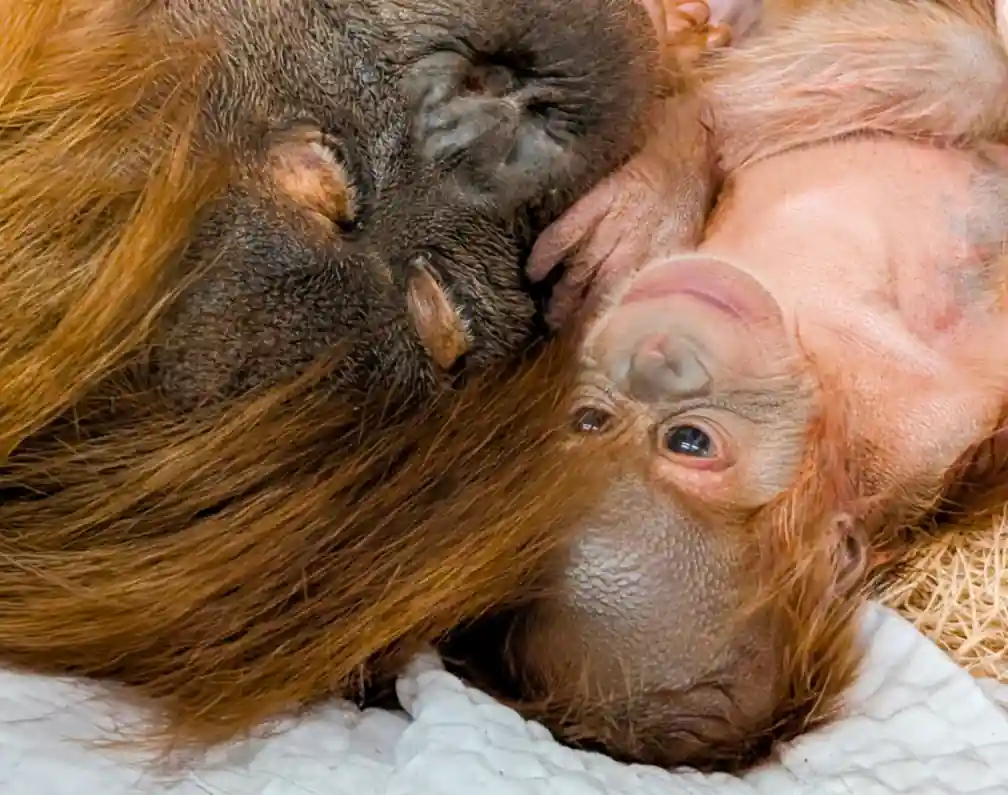

Denver Zoo Conservation Alliance has welcomed a male Sumatran orangutan born to 15-year-old Hesty, marking an important addition to the managed population of one of the world’s most endangered great apes.
Hesty gave birth on May 24, 2026, after about seven hours of labor. The Denver, Colorado, zoo announced the arrival on May 29 and said the first-time mother began caring for her infant immediately.
Animal care specialists reported that the pair were bonding and that nursing was progressing successfully. Staff remained nearby during the delivery but did not need to intervene.
Hesty’s journey from assisted care to motherhood
The birth carries added meaning for the zoo because Hesty was born there in 2010 to Nias and Mias. She needed several weeks of assisted care as an infant before being reunited with her mother.
Zoo specialists spent years preparing Hesty for the possibility of becoming a mother. Positive-reinforcement training taught her to participate voluntarily in health checks, pregnancy monitoring and other procedures that could help staff protect her and a future infant.
The preparation included exercises for situations in which a newborn might need veterinary attention. Hesty learned to move a stuffed toy through a specially designed transfer area, allowing staff to practise receiving an infant without forcing a separation.
Those contingency measures were not required after the delivery. According to the zoo, Hesty showed strong maternal behaviour and kept the newborn close while he began nursing.
The infant’s father is Jaya, an 18-year-old Sumatran orangutan who arrived in Denver from Como Park Zoo and Conservatory in 2019. The pairing followed a breeding recommendation from the Association of Zoos and Aquariums’ Species Survival Plan.
The program coordinates animals among accredited institutions to maintain a healthy and genetically diverse population. Jaya and Hesty are both first-time parents.
Why this orangutan birth matters
Sumatran orangutans are native to northern Sumatra in Indonesia and are listed as critically endangered. Their remaining forest habitat is under pressure from land conversion, infrastructure development, fires and fragmentation.
A population survey presented by Indonesia’s Ministry of Forestry in July 2026 estimated that about 11,694 Sumatran orangutans remain in the wild. The updated figure was based on surveys conducted between 2021 and 2023.
Orangutans reproduce slowly. Mothers invest several years in raising one offspring, limiting how quickly a population can recover after animals or habitat are lost.
Births in accredited zoos do not replace conservation work in Indonesia. However, coordinated breeding can preserve genetic diversity within the managed population, support scientific research and help explain why connected forest habitat is essential to the species’ survival.
Conservation decisions frequently involve balancing human activity with the protection of vulnerable species. A similar approach can be seen in Western Australia’s 2026 pink snapper fishing ban and rebate program, which is intended to reduce fishing pressure during an important breeding period.
When visitors may see the baby
Hesty and her son initially remained behind the scenes to rest and bond. The zoo said access to its Great Apes area could be limited during the adjustment period and that introductions to other orangutans would happen gradually.
There is no guarantee that the infant will be visible during every visit. Young orangutans remain in close physical contact with their mothers, while Hesty’s comfort and the baby’s development will determine how much time they spend in public areas.
The zoo opened a public naming vote with three choices: Rambutan, a red Southeast Asian fruit eaten by orangutans; Oka, a Balinese name associated with a child or heir; and Jamartin, honoring Indonesian orangutan conservationist Dr. Jamartin Sihite.
Voting has now closed. As of the zoo’s latest published update, the winning name had not yet been announced.
Read More:
A full-circle moment for Denver Zoo
For the specialists who supported Hesty after her own difficult start, watching her independently care for an infant completes a story that began nearly 16 years ago.
The birth is an encouraging outcome for the zoo’s breeding program, but it also points to the larger challenge beyond Denver. The long-term future of Sumatran orangutans depends on protecting forests, keeping habitats connected and reducing preventable deaths in the wild.
The arrival joins other recent stories encouraging closer attention to the natural world, including the rare Blue Moon and micromoon expected in 2026.

Make Swikblog your go-to source on Google for reliable updates, smart insights, and daily trends.