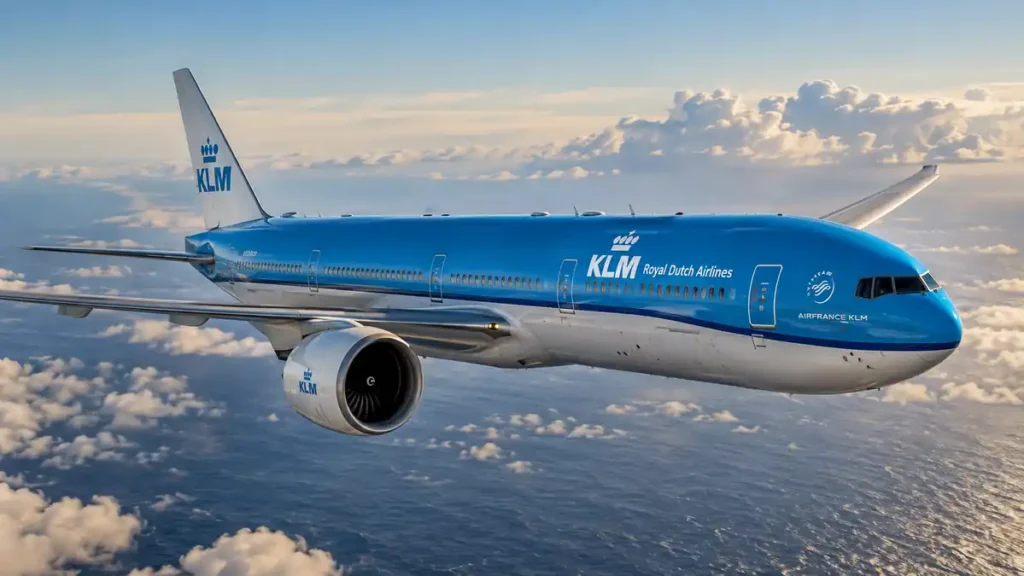

A KLM flight from Amsterdam to Curaçao was forced to turn back over the Atlantic after a passenger’s power bank caught fire, sending the aircraft back to Schiphol after an unusually long journey that ended at its departure airport.
Flight KL735 was about five and a half hours into the trip on Thursday, September 17, when the battery incident occurred. Cabin crew extinguished the fire, but the captain decided to return to Amsterdam rather than continue towards Curaçao.
The aircraft landed safely at Schiphol at around 8:40 p.m. local time after spending roughly 11 hours in the air. Later reports added another significant detail: multiple Dutch media sources linked the power bank to former KLM chief executive Camiel Eurlings, although KLM has not publicly confirmed the passenger’s identity.
Power bank fire prompted KL735 to turn back
A passenger seated near the incident told Dutch broadcaster RTL that a sudden bang was followed by flames near a seat. The crew responded quickly and brought the fire under control before the aircraft changed course.
The decision to return highlights how an onboard emergency can disrupt a flight even after the immediate danger appears contained. A similar precautionary return occurred when an American Airlines Boeing 737 returned after a bird strike and visible engine flames.
Another recent case involved a Jet2 Boeing 737 that diverted after an emergency alert shortly after departure, demonstrating how crews may change course when safety concerns develop during flight.
Former KLM CEO reportedly linked to the device
Multiple sources cited by Dutch media reportedly identified the owner of the power bank as Camiel Eurlings, who previously served as KLM’s president and chief executive.
KLM has declined to identify the passenger, citing privacy, and has not confirmed the reported link to Eurlings. The airline is also examining whether the device was being charged when it caught fire.
A witness told RTL that the power bank was connected to a charger at the time. That detail has not been independently confirmed by KLM.
Later reporting said one person suffered a minor injury, while an earlier account from KLM said nobody was hurt. Because the information differs, the exact injury circumstances remain unclear.
Passengers returned to Amsterdam instead of Curaçao
The turnaround meant travellers who had already spent more than five hours flying towards the Caribbean ultimately returned to the Netherlands.
KLM said affected passengers would be rebooked. The airline also noted that Curaçao is a popular destination, meaning it was not immediately certain that every traveller could be placed on the next available flight.
KLM rules prohibit charging power banks onboard
Power banks are treated as spare lithium batteries under KLM’s official hand-baggage rules.
Passengers may carry up to two power banks, generally with a capacity of 100 Wh or less. Devices between 100 Wh and 160 Wh require airline approval, while batteries above 160 Wh are not permitted.
KLM also says power banks must remain with the passenger, cannot be stored in overhead bins and must not be used or charged during the flight. Damaged, defective or recalled batteries should not be brought onboard.
Why lithium battery incidents are taken seriously
Lithium-ion batteries can produce intense heat, smoke or flames if a cell becomes damaged or develops an internal fault. In rare cases, overheating can trigger thermal runaway, which is why airlines require spare batteries to remain accessible in the cabin rather than inside checked baggage.
Cabin storage also allows crew members to detect heat or smoke quickly and respond before a battery problem becomes more difficult to control.
KLM is investigating the KL735 incident
The airline is reviewing the circumstances surrounding the power bank fire, including the reported claim that the device was being charged onboard.
This was also not KLM’s first recent disruption involving a power bank. In August 2025, another KLM flight reportedly returned to Amsterdam after a battery device in an overhead storage area caught fire and smoke entered the cabin.
For passengers, the latest incident reinforces the importance of checking airline battery restrictions before travelling, keeping power banks accessible and avoiding onboard charging where the carrier specifically prohibits it.

Make Swikblog your go-to source on Google for reliable updates, smart insights, and daily trends.