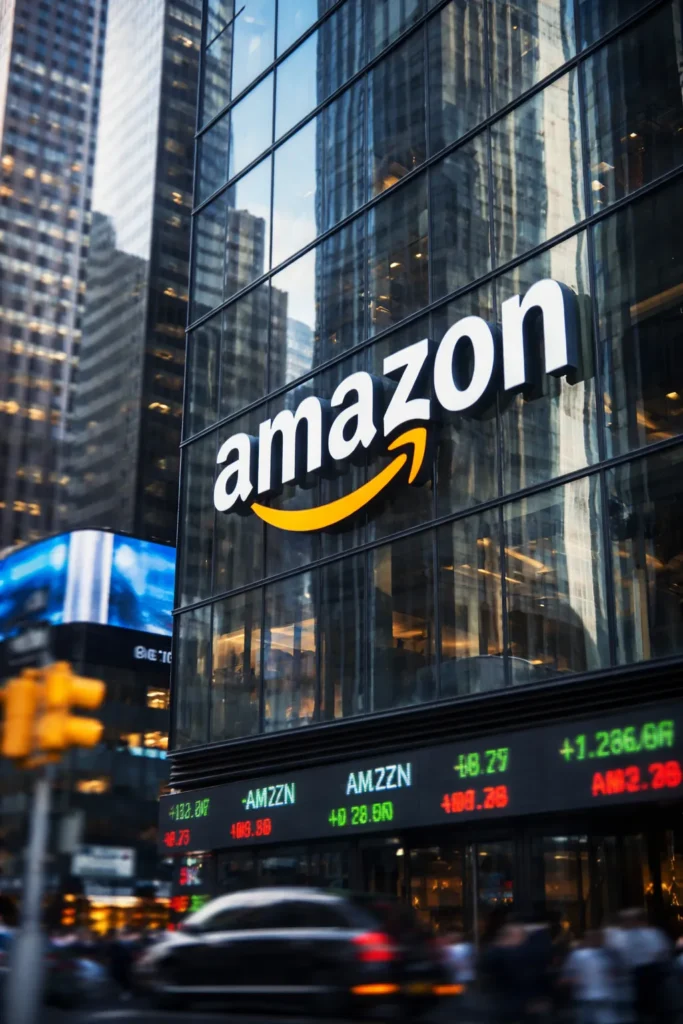

Amazon stock (NASDAQ: AMZN) slipped 1.37% to $210 in Monday trading as investors digested new developments from the company’s autonomous vehicle unit, Zoox. The Amazon-owned startup announced it will expand its robotaxi testing program into Dallas and Phoenix, marking one of its most ambitious geographic expansions since Amazon acquired the company for approximately $1.3 billion in 2020.
With the new launch, Zoox now operates testing programs across 10 U.S. markets, reinforcing Amazon’s long-term ambitions in autonomous mobility and transportation technology. The expansion arrives at a time when the global robotaxi industry is intensifying, with companies such as Waymo, Tesla, and several Chinese mobility firms racing to dominate the emerging market.
For investors tracking Amazon’s broader innovation strategy, Zoox represents a relatively small but increasingly strategic part of the company’s technology portfolio alongside artificial intelligence, cloud computing, and logistics automation.
Zoox Adds Two New Cities to Autonomous Testing Network
Zoox said it will initially deploy a limited fleet of retrofitted Toyota Highlander SUVs equipped with its full sensor stack. Each vehicle will operate with a human safety driver while mapping road conditions, traffic patterns, and environmental variables before fully autonomous operations begin.
Dallas and Phoenix were selected due to their complex road networks, wide suburban layouts, and variable weather conditions, which allow the company to test its software in diverse driving scenarios.
The company has already logged more than 1 million autonomous miles across its testing programs and has provided rides to more than 300,000 passengers in San Francisco and Las Vegas. In both cities, Zoox currently offers limited free public rides as it gathers operational data ahead of commercial service expected to begin in 2026.
You may also like:
Purpose-Built Robotaxi Design
Unlike many competitors that retrofit existing vehicles, Zoox has developed a fully autonomous vehicle designed specifically for ride-hailing services. The vehicle features no steering wheel, no pedals, and no driver seat, with passengers seated face-to-face inside a bidirectional cabin layout.
In 2025, the U.S. National Highway Traffic Safety Administration granted Zoox a regulatory exemption allowing the vehicle to operate on public roads despite lacking traditional driving controls. Details about federal autonomous vehicle regulations are available through the National Highway Traffic Safety Administration.
The company is also scaling its production capabilities. Zoox operates a 220,000-square-foot manufacturing facility in the San Francisco Bay Area and aims to eventually produce up to 10,000 robotaxis annually once full commercial deployment begins.
Robotaxi Market Expected to Exceed $1 Trillion
Autonomous ride-hailing could become one of the most disruptive transportation technologies of the next decade. Industry analysts estimate the robotaxi market could grow into a $1 trillion opportunity globally as driverless fleets replace traditional ride-sharing services.
Alphabet’s Waymo currently leads the U.S. market. The company is completing roughly 450,000 paid rides per week across several cities and continues to expand into additional metropolitan areas including Miami, Austin, and Los Angeles.
Tesla has also entered the race with its robotaxi program launched in Austin and the San Francisco Bay Area in 2025. Tesla’s system relies primarily on cameras rather than the lidar-heavy sensor stacks used by Waymo and Zoox. While the approach may reduce hardware costs, regulators continue to review safety data before wider commercial approval.
Zoox’s strategy appears more methodical, focusing on purpose-built vehicles and controlled city-by-city expansion rather than rapid nationwide deployment.
Amazon’s Strategic Advantage
Although Zoox currently represents a small portion of Amazon’s business, the project fits into a broader ecosystem that includes logistics, delivery automation, and cloud computing.
Amazon generated more than $575 billion in revenue in 2024, with major contributions from e-commerce, digital advertising, subscriptions, and Amazon Web Services (AWS). AWS alone produced approximately $90 billion in annual revenue, making it the largest cloud infrastructure provider globally.
The autonomous vehicle initiative could eventually integrate with Amazon’s delivery network, creating new possibilities for automated transportation, urban mobility systems, and last-mile logistics.
Readers interested in related industry developments can explore our AI and transportation coverage and Tesla vs Waymo vs Zoox comparison.
Market Reaction
Despite the Zoox expansion news, Amazon shares moved modestly lower during Monday’s trading session. The 1.37% decline to $210 reflects broader market sentiment rather than a direct reaction to Zoox developments, as the autonomous vehicle program remains years away from contributing meaningful revenue.
Still, long-term investors continue to watch Amazon’s experimental projects closely. Alongside artificial intelligence investments, robotics, and cloud computing, Zoox represents another potential growth avenue for the company as technology reshapes global transportation systems.

Make Swikblog your go-to source on Google for reliable updates, smart insights, and daily trends.