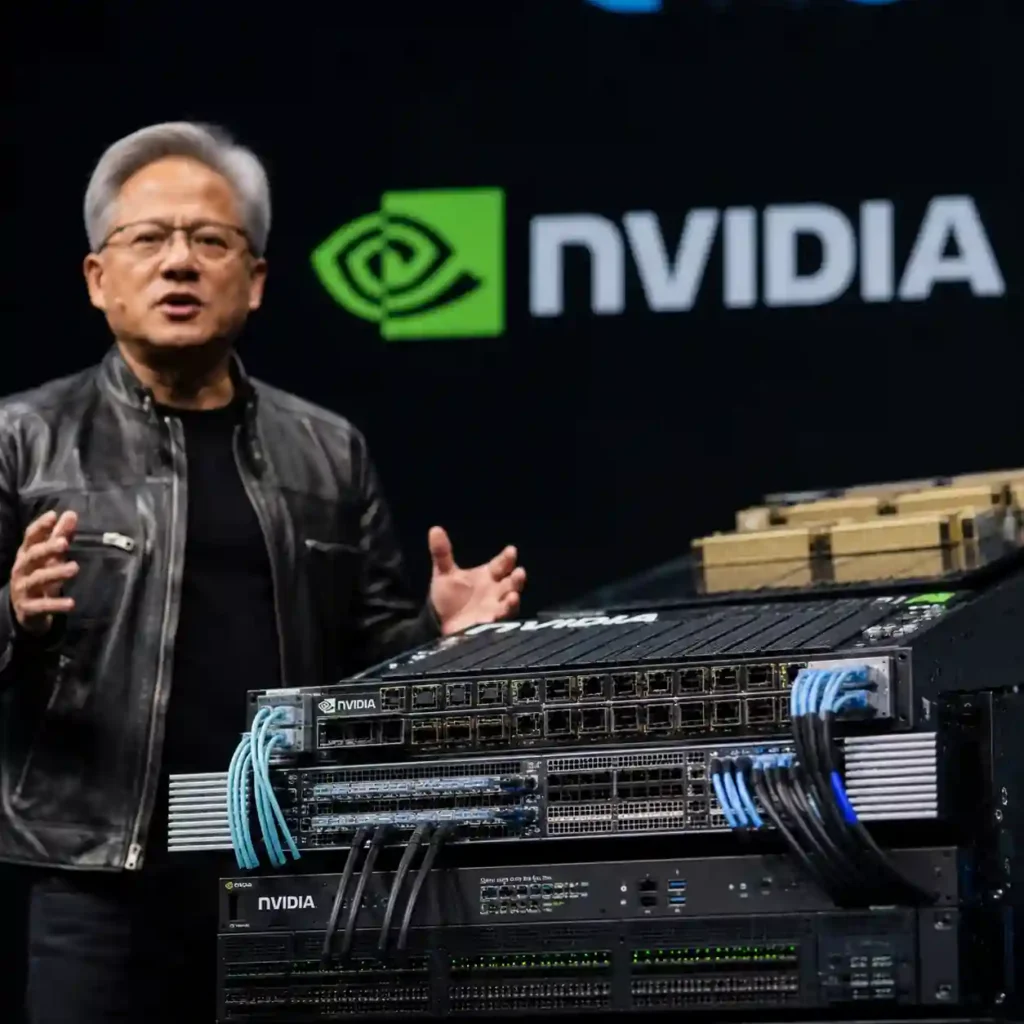

Nvidia’s biggest AI story may no longer be limited to the graphics processors that made it a market giant. A less flashy part of the company is now growing fast enough to challenge some of the biggest names in networking, including Cisco, Broadcom and Arista Networks.
The shift is coming from Nvidia’s data center networking business, which has become central to how modern AI systems are built. In fiscal first-quarter results, Nvidia reported record revenue of $81.6 billion, up 85% from a year earlier, while data center revenue climbed to $75.2 billion, up 92% year over year, according to Nvidia’s official earnings release.
Inside that data center boom, networking has turned into a much larger business than many investors expected. Nvidia’s quarterly networking revenue reached about $15 billion, roughly triple the level from a year ago. On an annualized basis, that puts the business near a $60 billion run rate.
That figure matters because it puts Nvidia’s networking operation close to the size of Cisco’s entire annual revenue base. It also shows why the company should not be viewed only as a GPU supplier. Nvidia is increasingly becoming a complete AI infrastructure company.
Why AI Networking Has Become So Important
Large AI models are not trained on one chip working alone. They require thousands of GPUs operating together across huge data center clusters. Those chips must constantly exchange information, and every delay can reduce performance or waste expensive computing capacity.
This is why networking has become one of the most valuable parts of the AI buildout. Faster switches, low-latency connections and tightly integrated systems help cloud companies train and run AI models more efficiently. As AI workloads grow, the network connecting the chips becomes almost as important as the chips themselves.
That is where Nvidia has gained an advantage. Its 2020 acquisition of Mellanox gave the company control of InfiniBand technology, a high-performance networking system widely used in advanced AI and supercomputing environments. At the time, the deal looked like an infrastructure bet. Today, it looks like a key reason Nvidia can sell more than GPUs.
Nvidia’s Spectrum-X Ethernet platform adds another layer to that strategy. It gives the company a stronger position in Ethernet-based AI networking, where Broadcom, Cisco and Arista already have deep relationships with hyperscale and enterprise customers.
The difference is that Nvidia can package networking with its GPUs, CUDA software, systems and AI platforms. That gives customers a more integrated option at a time when companies are trying to build AI data centers quickly and avoid performance bottlenecks.
Read More
- Visit Swikblog Homepage
- Hawaii Earthquake Today: 6.0 Big Island, No Tsunami
- Meta Forum: Facebook Groups App Takes Aim at Reddit and Discord
- Everest Crowding Fears Rise After Record 274 Climbers Summit in One Day
- Auckland FC Historic A-League Grand Final Win Over Sydney FC
- 40,000 Californians Evacuated After Orange County Chemical Tank Explosion Risk
Broadcom remains a major force in custom AI silicon, interconnect chips and switches. Cisco still has huge influence across enterprise networking. Arista is deeply tied to cloud data center expansion. But Nvidia’s rapid networking growth shows that it is now competing across several of their strongest markets at once.
This also changes the investment case. Nvidia’s valuation has often been judged against other semiconductor companies, but the business now reaches into networking, AI software, cloud infrastructure and full data center systems. That wider footprint helps explain why investors continue to assign the stock a premium multiple despite concerns about competition and AI spending cycles.
There are still real risks. Nvidia’s growth depends heavily on continued AI infrastructure spending by hyperscalers, governments and large enterprises. Any slowdown in capital expenditure could pressure expectations. Rivals are also moving quickly, and large cloud companies continue to invest in their own custom chips and networking designs.
Still, Nvidia’s networking surge gives the company a powerful second engine inside the AI boom. The market once treated Nvidia as the main winner in AI chips. Now, the company is trying to control the entire system around those chips.
If that strategy keeps working, Nvidia may not just overtake individual rivals in selected AI networking markets. It could become the default infrastructure supplier for the next generation of AI data centers.
For more coverage on how AI infrastructure spending is reshaping big tech competition, read Swikblog’s report on the Google and Blackstone AI cloud venture.

Make Swikblog your go-to source on Google for reliable updates, smart insights, and daily trends.