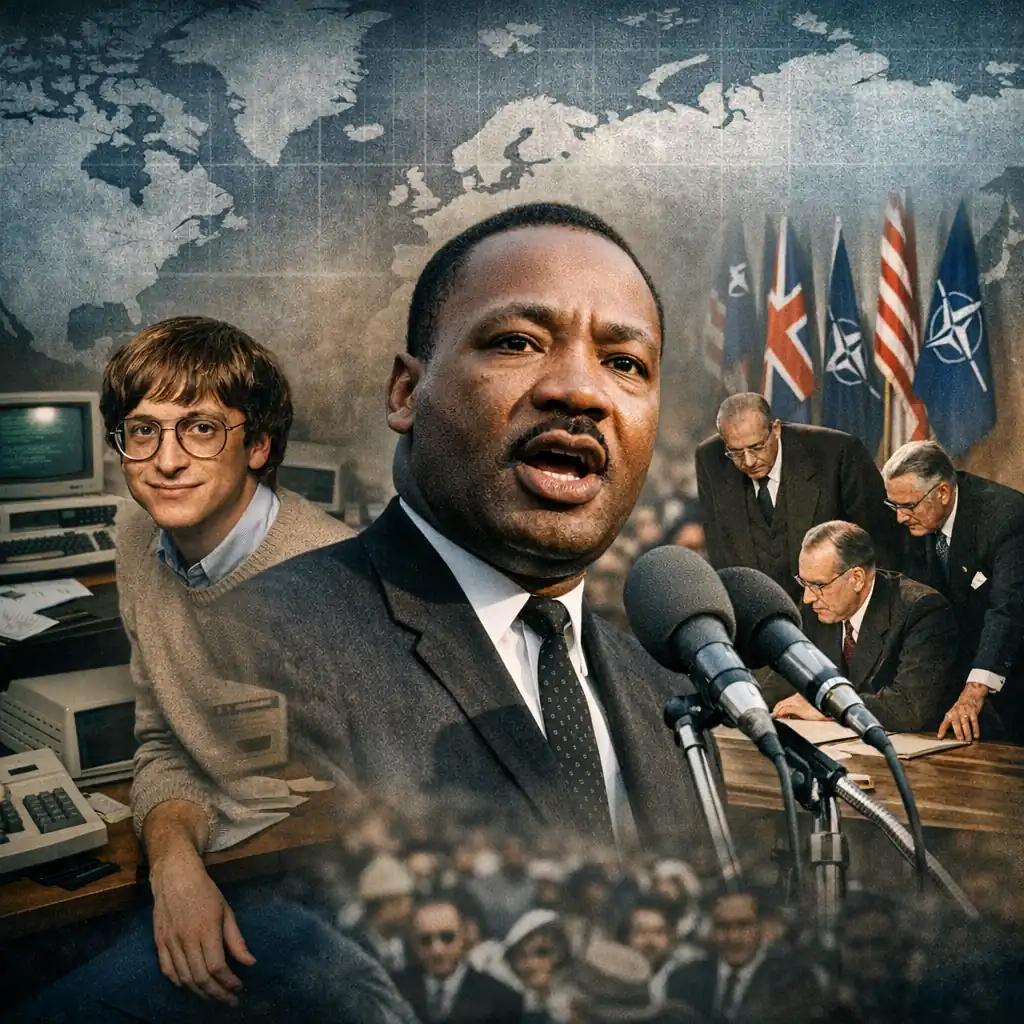

Some dates carry more weight than others. April 4 is one of them — a day where history didn’t just move forward, it shifted direction.
From the birth of Microsoft to the assassination of Martin Luther King Jr., from the creation of NATO to global tragedies and milestones, April 4 stands out as a date packed with moments that continue to shape the modern world. It’s a rare intersection of innovation, loss, politics, and culture — all unfolding across decades on the same calendar day.
The day Microsoft was founded — and the digital era began
On April 4, 1975, Bill Gates and Paul Allen founded Microsoft, a decision that would go on to transform how the world works, communicates, and does business.
At the time, computers were far from mainstream. But Gates and Allen saw what others didn’t — a future where software would power everyday life. That vision turned into one of the most influential companies in history.
Today, Microsoft is deeply embedded in global infrastructure — from office productivity tools to cloud computing and artificial intelligence. Whether it’s a student writing assignments, a business managing operations, or developers building software, Microsoft’s impact is everywhere.
April 4, 1975, didn’t just mark the start of a company — it marked the beginning of the modern digital age.
A day marked by tragedy: Martin Luther King Jr.
But April 4 also carries one of the darkest moments in modern history. In 1968, civil rights leader Dr. Martin Luther King Jr. was assassinated in Memphis at just 39 years old.
His death sent shockwaves across the United States and the world. Cities erupted in grief and protest, but his message of equality and nonviolent resistance only grew stronger.
Even decades later, King’s influence remains global. His speeches, ideas, and leadership continue to inspire movements fighting inequality, injustice, and discrimination across continents.
NATO’s creation reshaped global power
Nearly two decades before King’s assassination, April 4 witnessed another major turning point. In 1949, 12 nations came together in Washington to sign the North Atlantic Treaty, officially creating NATO.
The alliance was formed in the shadow of World War II, designed to ensure collective defense against future threats. Over time, NATO became one of the most powerful military alliances in the world.
Even today, it plays a critical role in global security and geopolitical strategy. For deeper insight into its ongoing role, you can explore NATO’s official platform.
Historic milestones that shaped society
April 4 is not defined by just a few events — it is layered with milestones across centuries.
In 1887, Susanna Madora Salter made history by becoming the first female mayor in the United States, marking a significant moment in women’s political representation.
Earlier still, in 1850, Los Angeles was officially incorporated — a step that would eventually lead to the rise of one of the world’s most influential cities in entertainment, business, and culture.
And in 1841, U.S. President William Henry Harrison died just one month after taking office, becoming the first American president to die in office — a moment that tested the country’s constitutional stability.
Innovation, exploration, and unexpected tragedy
The spirit of innovation also runs through April 4.
In 1983, the space shuttle Challenger launched on its first mission, symbolizing a new era in space exploration and human ambition.
But alongside progress, the date has also seen devastating events. In 1933, the USS Akron — a U.S. Navy airship — was destroyed in a storm, killing 73 people in one of the deadliest airship disasters in history.
In 1991, a tragic midair collision near Philadelphia killed U.S. Senator John Heinz and six others, shocking the nation.
More recently, in 2017, a chemical attack in Syria killed dozens of civilians, drawing global condemnation and highlighting the ongoing human cost of modern conflict.
Global shifts and cultural moments
April 4 has also marked significant political and cultural changes.
In 2005, Kyrgyzstan’s president Askar Akayev resigned after being forced out by a coup, reflecting the volatility of political power in the region.
In 2014, the United Nations announced that the number of Syrian refugees entering Lebanon had crossed one million, underlining the scale of the humanitarian crisis.
In 2019, the Church of Jesus Christ of Latter-day Saints reversed a controversial policy affecting children of LGBTQ+ parents, signaling a shift in religious and social discourse.
And in 2024, a copy of Action Comics No. 1 — the comic that introduced Superman — sold for $6 million, becoming the most expensive comic ever, proving the growing value of pop culture history.
Even the world of arts and media is tied to this date. In 2013, renowned film critic Roger Ebert passed away after battling cancer, leaving behind a legacy that shaped film criticism globally.
Why April 4 still matters today
What makes April 4 extraordinary is not just the number of events, but their impact.
It is a day that reflects the full spectrum of human experience — innovation, leadership, tragedy, resilience, and transformation. It shows how a single date can hold stories that define industries, movements, and nations.
From Microsoft’s rise shaping the global economy, to NATO influencing geopolitical balance, to Martin Luther King Jr.’s legacy continuing to guide social justice movements — the effects of April 4 are still unfolding.
History is often seen as something distant. But days like this remind us that the past is deeply connected to the present. And sometimes, everything changes on a single date.

Make Swikblog your go-to source on Google for reliable updates, smart insights, and daily trends.